Two words, often swapped
Rainforest and jungle are often used as if they meant the same thing, conjuring images of steamy heat, vines and parrots. In fact they describe different things. Rainforest is an ecological term for a type of forest defined by very high rainfall and a tall, closed canopy of trees. Jungle is an everyday word, not a scientific category, for vegetation so dense that it is hard to walk through. The two are connected, because jungle usually forms within or around rainforest, but they are not the same. Walking through an old, undisturbed rainforest is often easier than people expect. Walking through jungle generally requires a machete and a great deal of patience.
What makes a rainforest
Tropical rainforests grow near the equator, in the Amazon and Congo basins, South-East Asia and parts of Australia and Central America. They receive heavy rain throughout the year, usually more than 1,750 to 2,000 millimetres annually, and stay warm in every season. That is about twenty times Dubai's typical yearly rainfall of roughly 100 millimetres. The trees form layers: tall emergents that can exceed 50 metres, a dense canopy below them, an understorey of young trees and shrubs, and the forest floor. Temperate rainforests exist too, along cool, wet coasts such as the Pacific Northwest of North America, but the image most people hold is tropical.
Why the floor is open
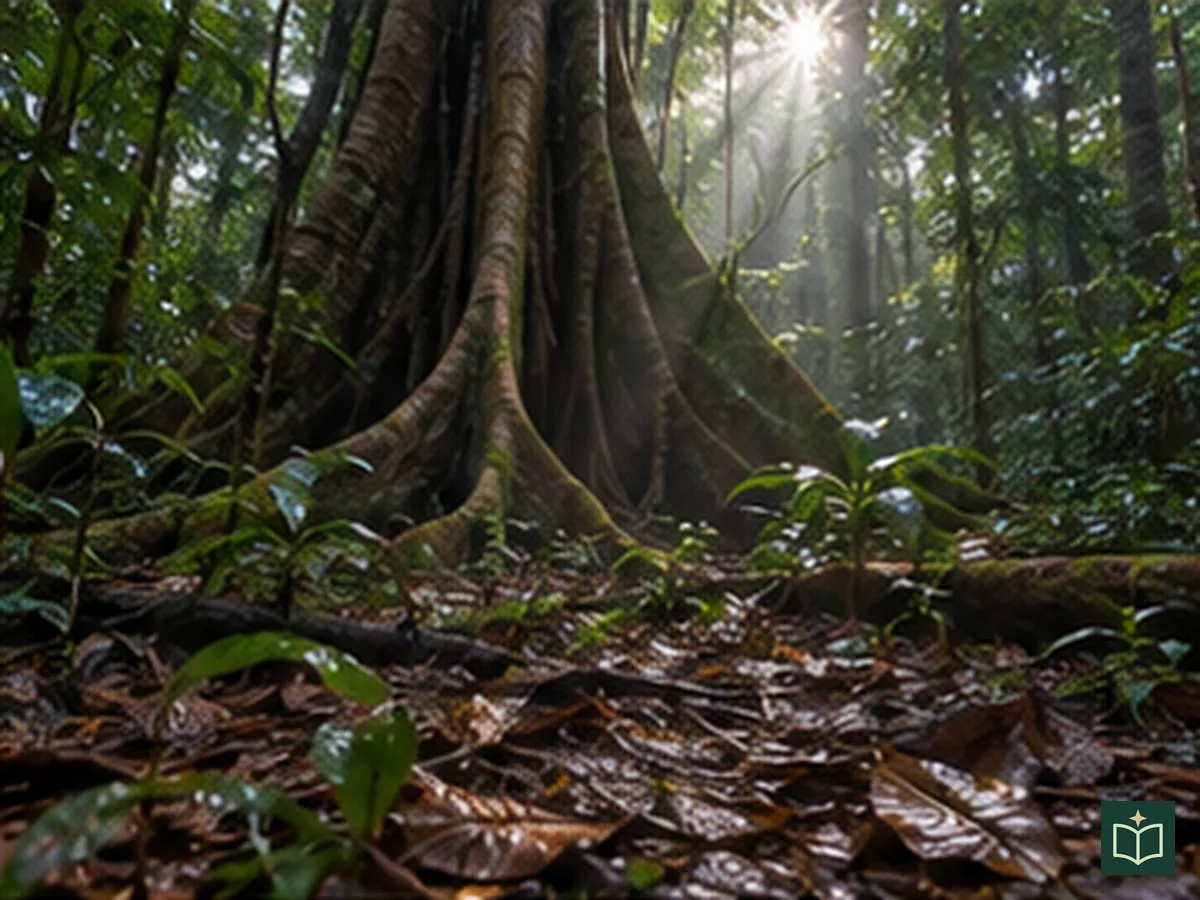
The canopy is the key to understanding the difference. Its overlapping crowns intercept almost all the sunlight; commonly cited figures suggest only around 1 to 2% reaches the floor of a mature tropical rainforest. Few plants can grow in such deep shade, so the ground is often surprisingly clear, covered in leaf litter, fungi, seedlings waiting for a chance and the buttress roots of large trees. It is dim, humid and still. Most of the life is overhead, where the leaves, flowers and fruit are. Many rainforest animals, from monkeys and sloths to frogs and insects, spend their entire lives in the canopy and never touch the ground.
Where jungle grows
Jungle appears where that light barrier breaks. Along riverbanks, the gap over the water lets sunlight pour in from the side, so vegetation crowds the edges, which is why explorers travelling by boat described rainforests as impenetrable. When a giant tree falls, it opens a gap in the canopy, and seedlings, vines and shrubs race for the light, forming a temporary thicket. Forest edges beside roads or fields behave the same way. Land that has been logged or cleared and then left to regrow becomes secondary forest, often a dense tangle for decades. In this sense jungle is less a type of forest than a stage of growth or recovery.
Where the word came from
The word jungle reached English from Hindi and Urdu, which took it from the Sanskrit jangala. Strikingly, the original meaning was dry, uncultivated or wild land, not lush forest. British writers in colonial India applied it to tangled wild vegetation, and the meaning drifted towards dense tropical growth. Rudyard Kipling's The Jungle Book, published in 1894, helped fix the romantic image of the jungle in the popular imagination. Since then the word has spread into metaphor, as in the 'urban jungle' or 'law of the jungle', describing any confusing or ruthless environment. Rainforest is far younger as a common term, coined in German in the late nineteenth century.
Why the distinction matters
Tropical rainforests are thought to hold more than half of the world's land plant and animal species, and they store vast amounts of carbon, which is why their loss matters for climate and biodiversity. When an area is cleared and regrows as jungle-like secondary forest, it may look green and thriving, but it usually holds fewer species and less carbon than the original forest for a long time. So a dense tangle is not necessarily a sign of a healthy rainforest; often it is a sign of disturbance. Visitors to indoor rainforest attractions, including one in Dubai, see a carefully managed version of the layered system rather than wild jungle.
Sources & further reading
- Britannica · Tropical rainforest ↗
- NASA Earth Observatory · Tropical deforestation ↗
- National Geographic Education · Rain forest ↗
Figures are rounded and widely published; check the linked organisations for the latest editions. These organisations do not endorse this website.