One material, two names
Magma and lava are the same substance at different stages of its journey. Magma is molten or partly molten rock beneath Earth's surface. Lava is what geologists call it once it erupts from a volcano or fissure onto the surface. The material is a mixture of liquid rock, solid crystals and dissolved gases, mainly water vapour and carbon dioxide, with some sulphur gases. While it is buried, high pressure keeps those gases dissolved, much as pressure keeps the fizz in a sealed bottle of soda. Leaving the ground is like opening the bottle. That simple change, a sudden drop in pressure, transforms how the molten rock behaves.
Where magma comes from
Most of Earth's interior is solid, even where it is extremely hot, because pressure keeps rock from melting. Magma forms in a few special settings. At mid-ocean ridges and hotspots such as Hawaii and Iceland, hot mantle rock rises and the pressure falls, so part of it melts. At subduction zones, where one tectonic plate sinks beneath another, water released from the sinking plate lowers the melting point of the mantle above, as around the Pacific's Ring of Fire. Rising magma can also melt surrounding crust. Being lighter than the rock around it, magma rises and collects in chambers a few kilometres down, where it may sit for years or millennia before erupting.
What changes at the surface
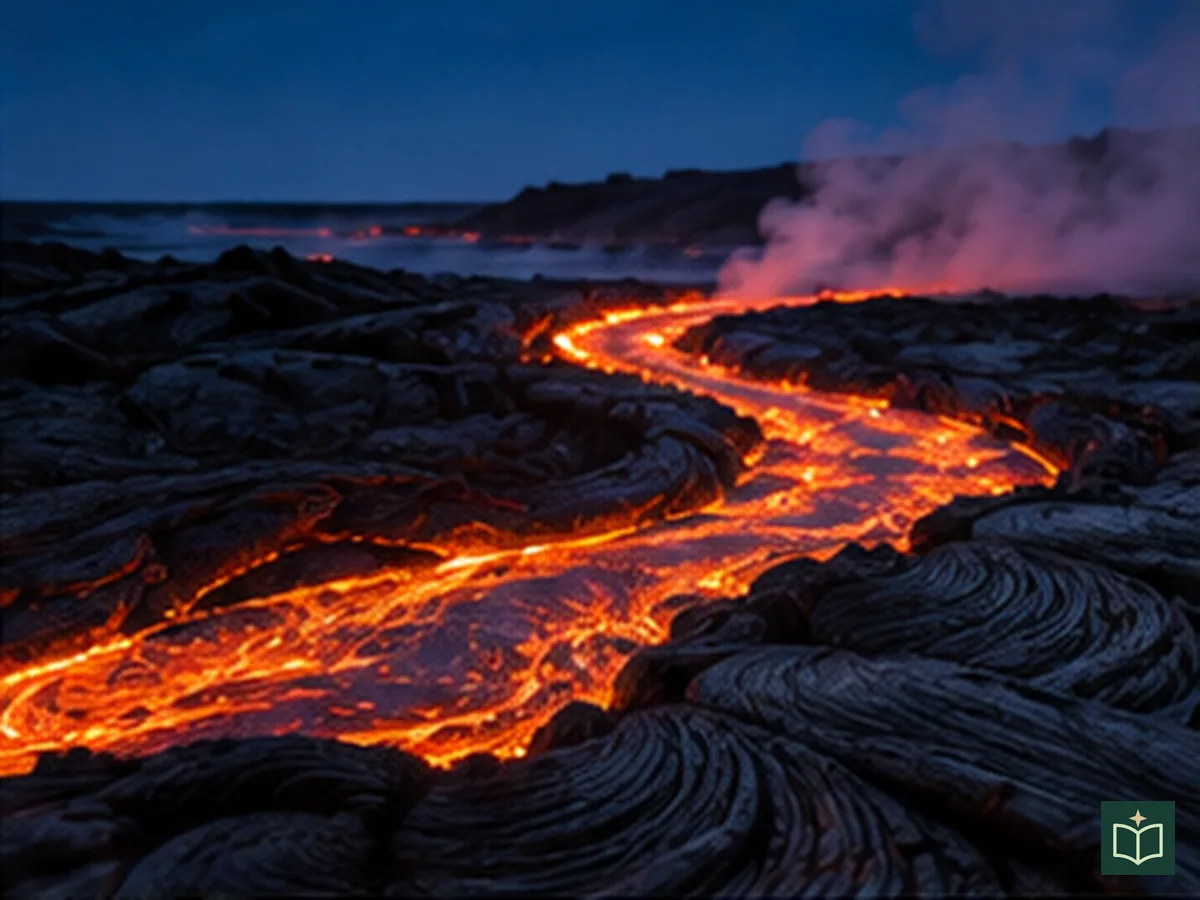
As magma rises towards the surface, falling pressure lets its dissolved gases form bubbles. What happens next depends on how sticky the melt is, which is set mainly by its silica content. Basaltic magma, low in silica, is runny, so gas escapes easily and the eruption is usually effusive, producing flowing rivers of lava, as in Hawaii and Iceland. Silica-rich magma, such as rhyolite, is extremely viscous and traps its gas until the pressure is released violently, shattering the melt into ash and pumice. Mount St Helens in 1980 and Pinatubo in 1991 were explosive eruptions of this kind. Lava also cools quickly at the surface, forming a crust as it flows.
Temperature and flow
Basaltic lava erupts at roughly 1,100 to 1,250°C and glows bright orange. Silica-rich lavas are cooler, around 650 to 800°C for rhyolite, but far stiffer, so they ooze and pile up into domes rather than flowing. Basaltic flows come in two textures, named with Hawaiian words: pāhoehoe, with a smooth, ropey skin, and ʻaʻā, a rough jumble of sharp blocks. Most lava flows advance slowly, often at walking pace or less, so people can usually move out of the way, though they destroy buildings and roads in their path. Much more dangerous are pyroclastic flows, avalanches of hot gas and ash that can travel at hundreds of kilometres an hour.
Rocks from both
Magma and lava produce different rocks, depending on where they cool. Magma that solidifies slowly underground has time to grow large crystals, forming coarse-grained intrusive rocks such as granite and gabbro, which are exposed only after overlying rock erodes. Lava cools quickly at the surface, forming fine-grained rocks such as basalt, or natural glass called obsidian if it cools almost instantly. The UAE's Hajar Mountains offer a rare window into both. They contain part of the Semail ophiolite, a slab of ancient ocean floor formed from magma at a spreading ridge some 95 million years ago and pushed onto Arabia, including gabbros and, in places, pillow lavas that erupted underwater.
Volcanoes near the Gulf
The UAE has no active volcanoes, but the Arabian Peninsula is not volcanically quiet. Western Saudi Arabia contains large fields of young basaltic lava called harrats, formed as the Red Sea has slowly opened. In 1256 an eruption in Harrat Rahat sent lava flows to within about eight kilometres of Medina. Scientists monitor these areas because some remain capable of erupting. Worldwide, around 1,350 volcanoes are considered potentially active by the US Geological Survey. Understanding the journey from magma to lava, and especially the role of gas, helps volcanologists judge whether a restless volcano is more likely to send out slow lava flows or produce a dangerous explosive eruption.
Sources & further reading
Figures are rounded and widely published; check the linked organisations for the latest editions. These organisations do not endorse this website.