A plate on the move
The Arabian Peninsula sits on its own tectonic plate. For roughly the past 30 million years, it has been pulling away from Africa, opening the Red Sea and the Gulf of Aden, and pushing north-east into Eurasia. The convergence rate is roughly two to three centimetres a year. Most of that collision is absorbed in Iran, where the crust is crumpled, thickened and broken by faults. The UAE lies on the interior of the Arabian Plate, far from its active edges. That is why large earthquakes beneath the country itself are rare, while tremors from across the Gulf are felt from time to time.
The Zagros: crumpled crust
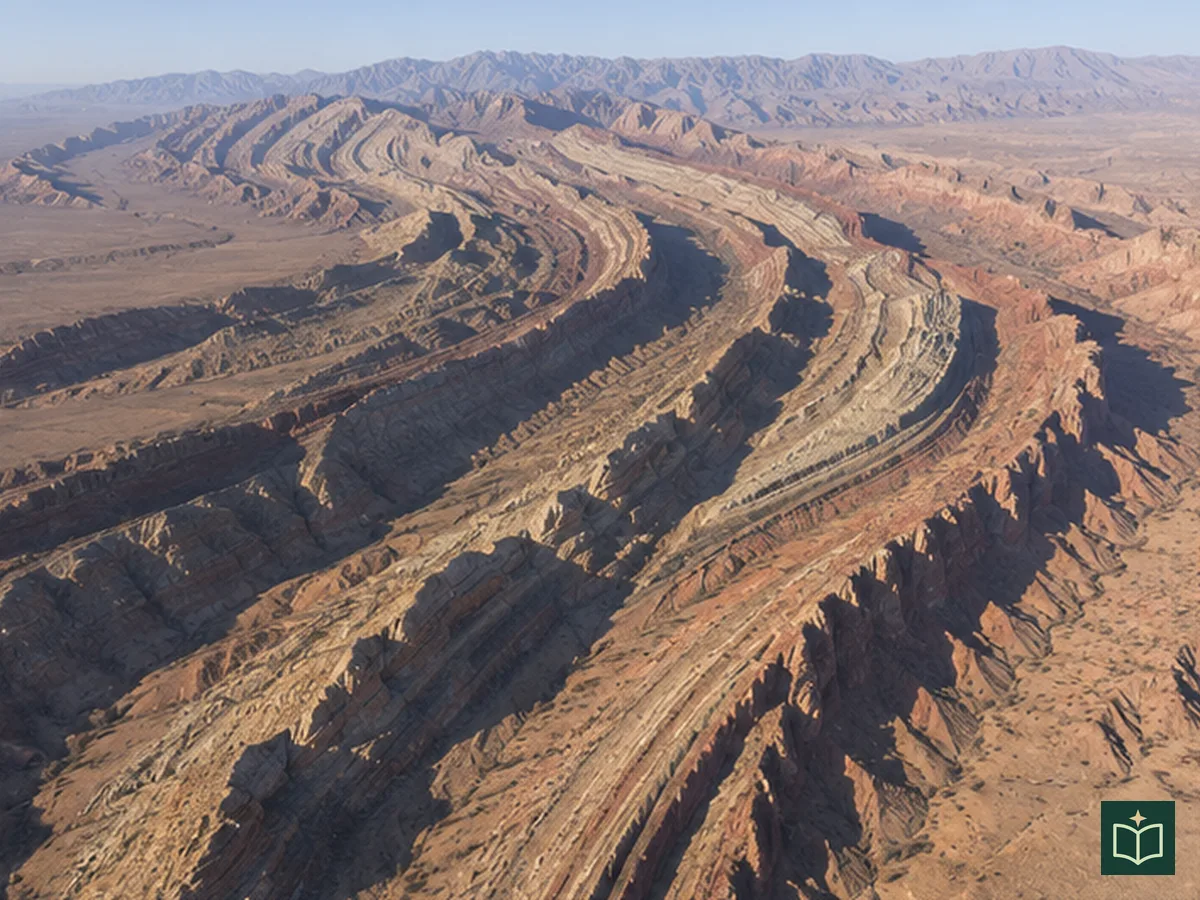
Across the Gulf, the Zagros mountains run for more than 1,500 kilometres through western and southern Iran. They are a fold-and-thrust belt: layers of rock squeezed into long ridges by Arabia’s push. The Gulf itself is partly a basin formed in front of this rising mountain belt. Earthquakes in the Zagros are frequent, mostly of moderate size, around magnitude 5 to 6, and usually relatively shallow. Some strike towns near the Iranian coast, such as Bushehr and Bandar Abbas, only a couple of hundred kilometres from UAE cities. Larger events in southern Iran are often felt as gentle swaying in high-rise buildings in Dubai, Abu Dhabi and Doha.
The Makran: a hidden subduction zone
Further east, the boundary changes character. Along the Makran coast of southern Iran and Pakistan, the oceanic floor of the Gulf of Oman is sliding beneath Eurasia in a subduction zone. Such zones can produce the largest earthquakes on Earth. In 1945, a magnitude 8.1 earthquake struck off the Makran coast and generated a tsunami that killed thousands of people and reached the shores of Oman and India. In 2013, a magnitude 7.7 earthquake near Saravan, in south-eastern Iran, was felt widely across the Gulf, and office towers in Dubai were evacuated as a precaution. The Makran is one reason the region’s tsunami risk is studied closely.
Why towers feel it most
People on the upper floors of skyscrapers often notice tremors that those at ground level miss. The reason lies in wave frequency. Distant earthquakes deliver mainly long-period seismic waves, slow rolling motions that lose energy less quickly than short, sharp vibrations. Tall buildings have long natural periods of sway too. A common rule of thumb puts a building’s period at about one-tenth of a second per storey, so an 80-storey tower might sway back and forth roughly once every eight seconds. When incoming waves match that rhythm, the building responds more strongly. Engineers design Gulf towers to withstand such motion, so swaying usually indicates a flexible structure doing its job.
The UAE’s own ground
The UAE is not entirely quiet. Small earthquakes are recorded occasionally, especially in the north-east near the Hajar mountains and around Masafi and Dibba, where old faults remain. A moderate earthquake struck near Masafi in 2002, causing minor damage. Most local events are too small to be felt. The National Center of Meteorology operates a seismic network that monitors activity across the country and the wider region. Building codes in the UAE include seismic provisions, with stricter requirements in the north and east. Overall, though, the country’s hazard level is low compared with Iran, Turkey or Pakistan, because it sits away from the plate’s active boundaries.
What to keep in mind
Feeling a building sway does not mean an earthquake struck nearby; it usually reflects a distant event and a tall structure responding to long waves. Equally, low local hazard does not mean zero risk. Reclaimed land and soft coastal sediments can amplify shaking, and long-distance waves can still disturb sensitive equipment or cause alarm. Authorities advise residents to follow official guidance, stay away from windows during shaking and use stairs rather than lifts afterwards. Understanding the geography helps keep perspective: the UAE is a spectator to one of the world’s major continental collisions, close enough to feel it but far enough to be largely spared.
Sources & further reading
- USGS · Earthquake Hazards Program ↗
- National Center of Meteorology (UAE) ↗
- Britannica · Zagros Mountains ↗
Figures are rounded and widely published; check the linked organisations for the latest editions. These organisations do not endorse this website.