Two ways to heat a pan
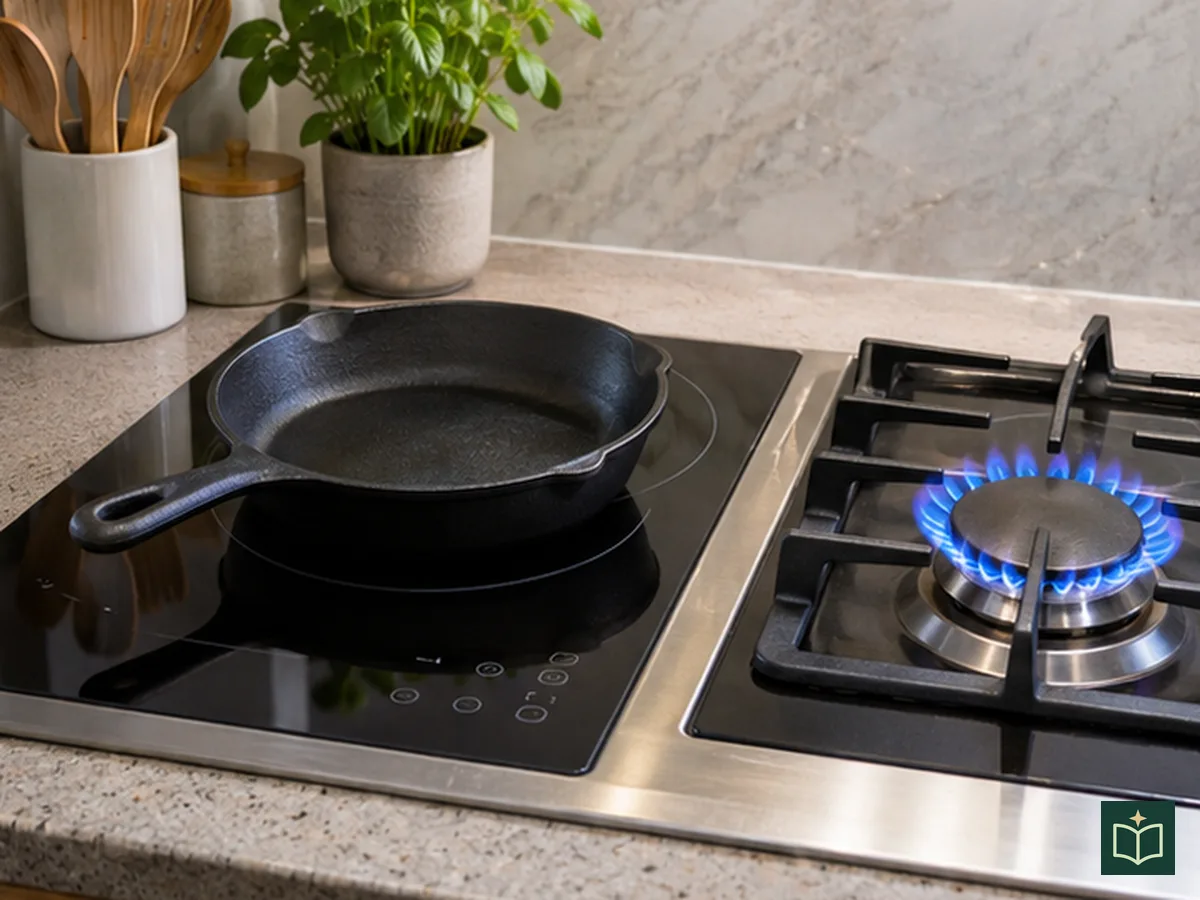
Gas and induction hobs both cook food, but they deliver heat in opposite ways. A gas hob burns natural gas or liquefied petroleum gas, and the hot flame and combustion gases warm the bottom and sides of the pan. Much of that heat escapes around the pan into the kitchen. An induction hob has no flame and no glowing element. Beneath its smooth glass top sits a copper coil carrying alternating current. This creates a rapidly changing magnetic field that passes through the glass and induces electric currents inside a suitable pan. The pan's own resistance turns those currents into heat, so the pan becomes the heater.
Speed and efficiency
Because induction puts energy straight into the pan, far less is wasted. The US Department of Energy estimates induction at about 85% efficient, meaning roughly 85% of the energy used ends up in the food, compared with around 32 to 40% for gas. Consider heating 2 litres of water from 25°C to boiling. The water needs about 0.17 kilowatt-hours of heat. At 85% efficiency, an induction hob uses about 0.21 kWh; at 40%, a gas burner burns fuel worth about 0.44 kWh. Induction also brings water to the boil quickly, often faster than gas. Running costs still depend on local electricity and gas prices.
Control and cooking style
Many cooks love gas for its visible, instant response: turn the knob and the flame grows or shrinks immediately, and it is easy to judge by eye. Gas also suits techniques such as charring peppers or flatbreads over an open flame, and tossing food in a round-bottomed wok, which keeps heating even when lifted. Induction responds just as quickly, because the pan stops heating almost the moment power is cut, and it allows very precise low settings for melting chocolate or simmering sauces. But it works only while the pan sits flat on the surface, and the lack of a visible flame takes some getting used to.
The cookware question
Induction needs pans with a magnetic base, usually cast iron, enamelled cast iron or magnetic stainless steel. Plain aluminium, copper, glass and ceramic pans do not work unless they have a magnetic layer bonded to the base, and many modern pans are now made induction-ready with such layers. A simple test is to hold a fridge magnet to the bottom of the pan: if it sticks firmly, the pan will work. Gas, by contrast, heats almost any pan. Flat-bottomed pans work best on induction, since good contact with the glass matters, so some traditional round-bottomed pans and clay pots may need a flat-bottomed alternative.
Heat, air and safety
In a hot climate such as the Gulf's, the heat a hob releases into the kitchen matters. A gas flame warms the surrounding air, adding to the load on air conditioning, while induction heats mainly the pan, leaving the kitchen noticeably cooler. Burning gas indoors also produces nitrogen dioxide and other pollutants, so good ventilation and a working extractor hood are important. Induction produces no combustion gases, though cooking itself still releases fumes and smoke. For safety, induction's glass stays cooler than a radiant electric hob, warmed only by the hot pan, and most models switch off automatically when a pan is removed, reducing the risk of burns and fires.
Choosing between them
The right choice depends on cooking habits, costs and the kitchen's infrastructure. Gas hobs are generally cheaper to buy, work with any pan and keep working during power cuts, which matters in some places. Induction hobs cost more upfront, may require new pans and a suitable electrical supply, but are efficient, easy to clean and keep kitchens cooler. Many professional kitchens now use induction for these reasons. Climate policy plays a part too: as electricity grids add more solar and other low-carbon power, induction cooking produces fewer emissions, while gas always burns a fossil fuel. Portable single induction plates offer an inexpensive way to try it first.
Sources & further reading
- US Department of Energy · Energy Saver ↗
- ENERGY STAR ↗
- World Health Organization · Household air pollution ↗
Figures are rounded and widely published; check the linked organisations for the latest editions. These organisations do not endorse this website.