Two words, one process
Biodegradation is the breakdown of a material by living organisms, mainly bacteria and fungi, which digest it into water, carbon dioxide or methane, and new biomass. In principle almost every natural material does this, from a banana peel to a wooden chair, and so do some plastics. The catch is time. A peel can vanish in weeks, a tree trunk in decades, and conventional plastics so slowly that the process is effectively irrelevant. 'Biodegradable' therefore describes what may happen eventually, somewhere, under some conditions. 'Compostable' is narrower. It means a material breaks down within a defined period, in a defined composting environment, without leaving harmful residues behind. The second word is a subset of the first.
What the standards demand
Compostable claims are backed by test methods. In Europe, the EN 13432 standard for packaging requires that at least 90% of the material converts to carbon dioxide within six months under industrial composting, that it disintegrates so that no more than 10% remains as fragments larger than two millimetres after twelve weeks, and that the finished compost is not toxic to plants. The American standard ASTM D6400 sets similar tests. Separate certifications exist for home composting, which runs cooler and slower. 'Biodegradable' has no single equivalent global test or timescale, which is why some regulators restrict its use on packaging unless the conditions and duration are spelled out.
Why heat matters so much
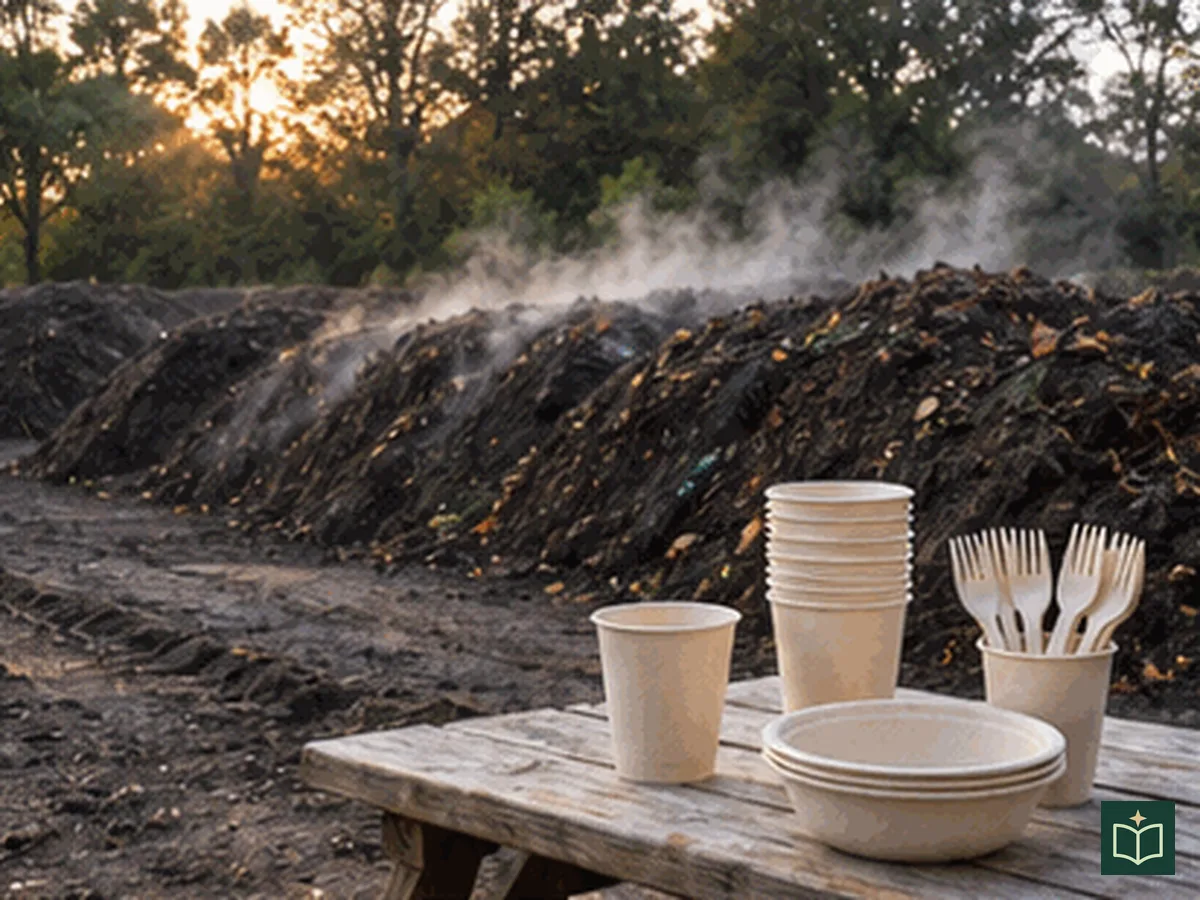
An industrial composting site keeps large piles at roughly 55 to 70°C for weeks, turning them for oxygen and controlling moisture. Many compostable plastics need exactly that. Polylactic acid, or PLA, a common plant-based plastic used for clear cups and cutlery, softens and breaks down readily in those hot piles but very slowly in a cool garden heap, and slower still in the sea. A compostable cup sent to landfill does little better than an ordinary one, because buried waste lacks oxygen and steady microbial activity. So 'compostable' is a promise about a particular destination. If the local waste system does not collect compostables separately, the benefit largely disappears.
The problem with vague claims
Labels such as 'biodegradable' or 'eco-friendly' on plastic bags have drawn criticism because they imply the item will harmlessly disappear. Some so-called oxo-degradable plastics contain additives that make them crumble into small fragments in sunlight and air, but the fragments can persist as microplastics. The European Union banned oxo-degradable plastics under its 2019 single-use plastics rules. Consumer authorities in several countries have also challenged unqualified green claims as misleading. A further risk is behaviour: people told an item is biodegradable may be more willing to drop it as litter, assuming it will vanish, when outdoors it may survive for years and harm wildlife long before it breaks down.
What it means for the Gulf
For most households in the UAE and wider Gulf, separate collection of food and compostable waste is still limited, though composting projects run in some communities, farms and municipal programmes. The UAE has moved to restrict single-use plastic bags and other disposable items, encouraging reusable options rather than relying on materials that need special handling. In hot, dry desert conditions, materials exposed outdoors tend to dry out rather than rot, because microbes need moisture as well as warmth. A compostable fork dropped in the sand is not composting. The practical lesson is that the end-of-life route matters as much as the material, and labels should be read with the local system in mind.
Reading the label wisely
Three questions help. Is there a certification mark naming a recognised standard, and does it say industrial or home composting? Does the local council or waste operator actually accept compostable packaging? And would a reusable item avoid the question entirely? Food waste itself is often the best candidate for composting, since it breaks down quickly and returns nutrients to soil. Compostable packaging is most useful where it travels with that food waste, such as caddy liners or tea bags. Where no composting route exists, a recyclable item placed in the right bin, or simply buying less disposable packaging, usually does more good than a reassuring word printed on a wrapper.
Sources & further reading
- European Commission · Biobased, biodegradable and compostable plastics ↗
- US EPA · Composting at home ↗
- UNEP · Beat plastic pollution ↗
Figures are rounded and widely published; check the linked organisations for the latest editions. These organisations do not endorse this website.