Three ways the view goes grey
Fog, mist and haze all reduce how far we can see, and in everyday speech the words blur together. Meteorologists use them precisely, because each points to a different cause and different risks. Fog and mist are made of tiny water droplets suspended in the air, essentially a cloud touching the ground. Haze is made of dry particles: dust, sand, sea salt, smoke and pollution. Weather observers at airports record them with separate codes in their reports: FG for fog, BR for mist, from the French brume, and HZ for haze. The distinction tells pilots and drivers what they are facing and how quickly it may clear.
Fog and mist: a matter of distance
Fog and mist form the same way. When air cools to its dew point, or gains enough moisture, water vapour condenses onto microscopic particles to form droplets, often just a few thousandths of a millimetre across. The difference is density, measured by visibility. Under the international definition used by the World Meteorological Organization, it is fog when visibility drops below 1,000 metres and mist when it stays at 1,000 metres or more. Forecasters often describe fog as dense when visibility falls below about 200 metres. Mist feels damp and often lifts quickly as the sun warms the air; thick fog can linger for hours.
Haze: dry particles
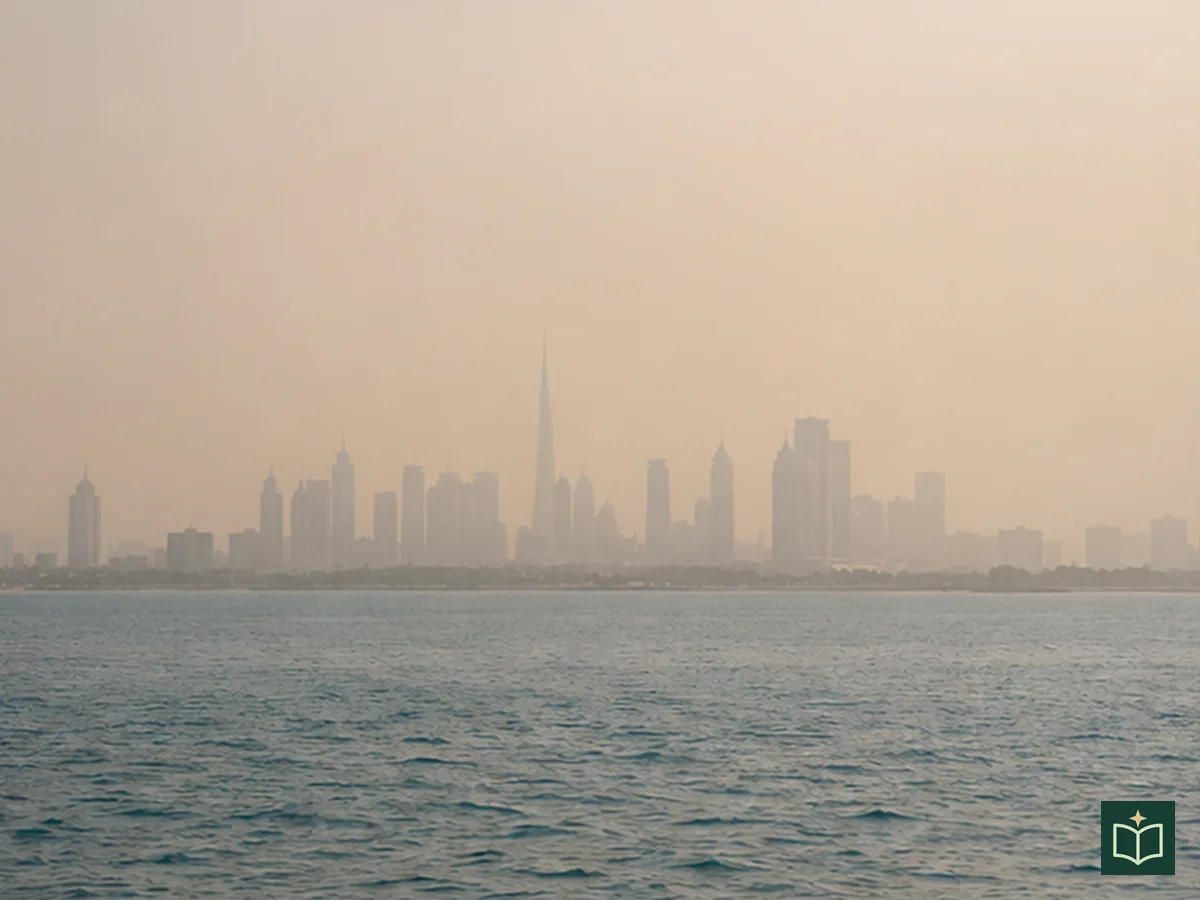
Haze forms when countless tiny solid or liquid particles scatter sunlight, giving the sky a milky, washed-out look and softening distant buildings and hills. Unlike fog, it does not need saturated air, and observers usually report haze when humidity is noticeably lower than in fog. The particles may come from wind-blown desert dust, sea spray, wildfire smoke, vehicle exhaust or industry. Haze often looks brownish or grey-yellow against the light, while fog looks white. Visibility in haze can still drop sharply, especially during dust events, but because the particles are dry, it does not leave the cold dampness of fog on skin and windscreens.
Gulf summers and winter fogs
The Gulf sees all three, at different times of year. In summer, hazy skies are common. Strong northwesterly winds lift dust from deserts and dry riverbeds across the region, and high temperatures and humidity near the coast add sea salt and moisture to the mix, so the horizon over cities can vanish into a pale glare for days. In the cooler months, from roughly October to March, the pattern shifts. Clear, calm nights let the ground cool rapidly, and moist air from the sea condenses into dense fog by dawn, especially along the coast and inland plains of the UAE, often clearing by mid-morning.
Driving and flying through them
The safety advice differs with each. In fog, visibility can collapse within metres, and drivers often misjudge speed and distance. Authorities, including the UAE's National Center of Meteorology and police, issue fog warnings and advise reducing speed, keeping well back and using low-beam headlights or fog lights rather than full beams, which reflect off the droplets. Hazard lights are best kept for when a vehicle is stopped. Airports may slow arrivals and use low-visibility procedures. Haze is usually less dramatic but can still hide distant vehicles, and when it comes from dust or pollution it can irritate eyes and lungs, so people with asthma may need to take precautions.
Why the labels matter
Knowing which is which helps interpret forecasts and air quality. A morning fog warning signals a short-lived but serious driving hazard. A haze report, especially alongside a dust or air quality alert, signals that the air itself may be unhealthy to breathe for hours or days, and that sensitive groups should limit time outdoors. The words also help explain the scenery: a white, damp, chilly veil at dawn is fog; a soft, sunlit, brownish blur on a hot afternoon is haze. Satellites and visibility sensors now track both continuously, but for anyone on the ground the simplest test is to ask whether the air feels wet or dry.
Sources & further reading
- World Meteorological Organization · International Cloud Atlas ↗
- UK Met Office · Fog ↗
- UAE National Center of Meteorology ↗
Figures are rounded and widely published; check the linked organisations for the latest editions. These organisations do not endorse this website.