A wartime problem
During the Second World War, armies needed firing tables that told gunners how to aim artillery for different ranges, winds and shells. Each table required thousands of trajectory calculations. At the US Army’s Ballistic Research Laboratory, teams of human ‘computers’, many of them women with mathematics degrees, worked them out with desk calculators, and a single trajectory could take a skilled person about 20 hours. The backlog was enormous. In 1943 the army funded a proposal from John Mauchly and J. Presper Eckert at the University of Pennsylvania’s Moore School of Electrical Engineering to build an electronic machine to do the work. They called it the Electronic Numerical Integrator and Computer, ENIAC.
Valves, not gears
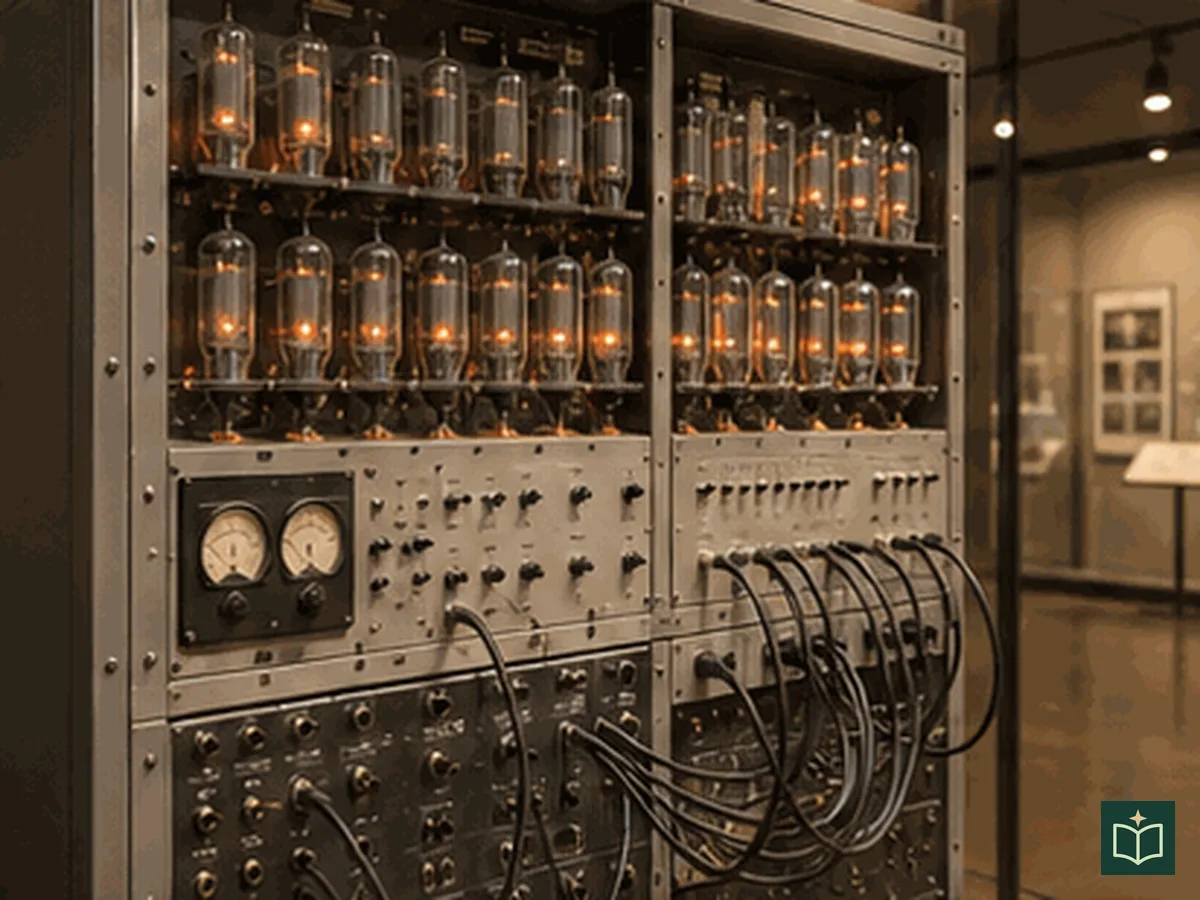
ENIAC’s speed came from the vacuum tube, or valve, a glass bulb that controls a flow of electrons and can switch on and off in microseconds. Mechanical and electromechanical calculators relied on gears or relays that physically moved, which limited them to a few operations a second. ENIAC contained about 17,500 tubes arranged into accumulators that stored and added ten-digit decimal numbers. It could perform about 5,000 additions a second. The machine weighed around 30 tonnes, lined a room with panels stretching about 24 metres in a U shape and drew about 150 kilowatts of power. Tubes failed regularly, so engineers ran them gently to make them last longer.
Programming by hand
ENIAC had no keyboard, screen or stored program. To set up a calculation, operators turned thousands of switches and plugged cables between its units, physically routing numbers and control pulses through the machine. Configuring a new problem could take days. The first programmers were six women recruited from the human computing teams: Kathleen McNulty, Jean Jennings, Frances Elizabeth Snyder, Marlyn Wescoff, Frances Bilas and Ruth Lichterman. With few manuals, they learned the machine from its wiring diagrams and invented techniques such as breaking problems into steps and tracing faults to individual tubes. For decades their role was largely overlooked, but historians now recognise them as founders of software.
The speed that stunned
When ENIAC was unveiled to the public in February 1946, the war was over, but the machine’s performance astonished observers. A trajectory that took a human computer about 20 hours could be calculated in roughly 30 seconds, some 2,400 times faster. It went on to work on weather prediction, cosmic-ray studies and calculations for the hydrogen bomb, running at the Aberdeen Proving Ground until 1955. Newspapers called it an electronic brain. Its real legacy was proof: a large machine built from fragile valves could run reliably for long enough to do useful work, and governments and companies began investing heavily in electronic computing.
Was it the first?
The title of ‘first computer’ depends on the definition. In Germany, Konrad Zuse’s Z3 of 1941 was programmable but used relays, not electronics. In the United States, the Atanasoff–Berry Computer, completed around 1942, was electronic but built for one type of problem. In Britain, the Colossus machines at Bletchley Park used valves from 1944 to help break German teleprinter codes, but they were kept secret for decades. ENIAC is usually described as the first general-purpose, programmable electronic digital computer. A common misconception is that it stored its programs in memory as modern machines do. It did not; that crucial idea came next.
Toward the stored program
While ENIAC was being built, its designers and the mathematician John von Neumann worked on a successor, EDVAC. Von Neumann’s 1945 report described a machine that would hold both data and instructions in the same memory, so a new program could be loaded rather than wired. The first machine to run a stored program was the Manchester ‘Baby’ in England, in June 1948, followed by EDSAC at Cambridge in 1949. Eckert and Mauchly went on to build UNIVAC, one of the first commercial computers. Valves gave way to transistors in the late 1950s, but the stored-program design sketched in those years still describes almost every computer today.
Sources & further reading
Figures are rounded and widely published; check the linked organisations for the latest editions. These organisations do not endorse this website.