Answers have to come from somewhere
Many machine-learning systems learn by example. To recognise pedestrians, a model is shown millions of images in which people have marked where the pedestrians are. To transcribe speech, it trains on recordings matched with accurate transcripts. To judge whether a review is positive, it needs reviews already tagged. This approach, called supervised learning, depends on labels: the correct answers attached to raw data. Large language models first learn from huge amounts of unlabelled text, but turning them into useful assistants again relies on people, who write example answers and rank responses. Behind every headline about artificial intelligence sits a large, mostly invisible workforce producing those labels.
What annotation involves
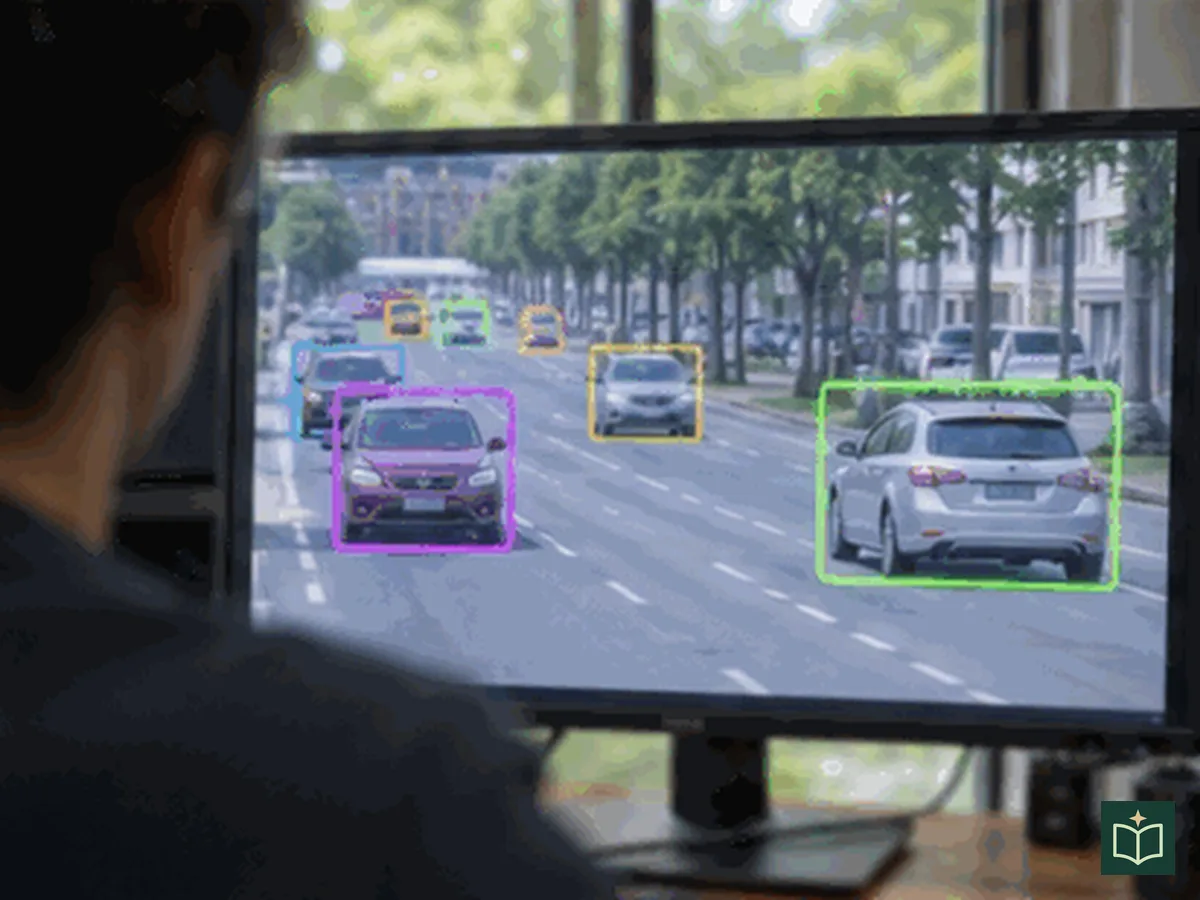
Annotation covers a wide range of tasks. Some are quick, such as choosing which of several categories fits a photo. Others are painstaking: drawing precise outlines around every car, cyclist and kerb in a street scene for self-driving systems, transcribing noisy phone calls, or marking which pixels in a medical scan show a tumour. Language tasks include tagging names and places in text, translating sentences and rating chatbot replies for accuracy, helpfulness and safety. Some workers review violent or abusive material so models learn to recognise it, a task that carries real psychological strain. Each project comes with guidelines, often dozens of pages long, defining exactly what counts as each label.
Who does the work
Labelling is done by a mix of people. Crowd-work platforms split tasks into small pieces paid individually. Specialist companies employ full-time annotators, many in Kenya, India, the Philippines and Latin America, alongside workers in Europe and North America. Highly skilled tasks increasingly go to experts: doctors label scans, lawyers judge legal answers and programmers grade code. Language coverage depends on finding native speakers. Building good Arabic systems needs annotators fluent in Gulf, Egyptian, Levantine and Maghrebi dialects, not only Modern Standard Arabic. Pay and conditions vary widely, and researchers and journalists have raised concerns about low wages, insecure work and exposure to disturbing content in parts of the industry.
The ImageNet moment
One labelling project changed the field. In 2007, the computer scientist Fei-Fei Li and colleagues began ImageNet, an effort to label millions of images with the categories of a large English vocabulary database. Using online crowd workers from many countries, the project eventually organised about 14 million images into more than 20,000 categories. From 2010, an annual competition based on a subset of the data followed. In 2012, a deep neural network called AlexNet beat its rivals by a wide margin, a result widely seen as the start of the deep-learning boom. The lesson was that large, carefully labelled datasets mattered as much as clever algorithms and faster chips.
Why label quality matters
People disagree, tire and make mistakes, and models absorb those errors. A 2021 study led by researchers at MIT found that several widely used test datasets contained a few per cent of wrong labels, enough to change which models appeared best. Projects counter this by having several people label each item. If three annotators are each right 90 per cent of the time and err independently, a majority vote is right about 97 per cent of the time. Hidden test questions with known answers check attention, and experts settle disagreements. Clear guidelines matter most: if instructions are ambiguous, consistent labelling becomes impossible, and the model learns the confusion.
What labels can and cannot do
Labels encode human judgements, including their blind spots. If annotators share a cultural background, their idea of ‘offensive’, ‘professional’ or ‘polite’ may not match other communities, and a model will inherit that view. If certain accents, skin tones or dialects are rare in the data, performance suffers for those groups. Companies now use AI to pre-label data, with people correcting it, and to generate synthetic examples, which reduces cost but risks repeating a model’s own errors. Human annotation is not disappearing; it is shifting towards harder, more expert judgements. Knowing who labelled the data, and how, is increasingly seen as essential to understanding any AI system.
Sources & further reading
- ImageNet · About ↗
- Stanford Institute for Human-Centered AI · AI Index Report ↗
- Britannica · Machine learning ↗
Figures are rounded and widely published; check the linked organisations for the latest editions. These organisations do not endorse this website.