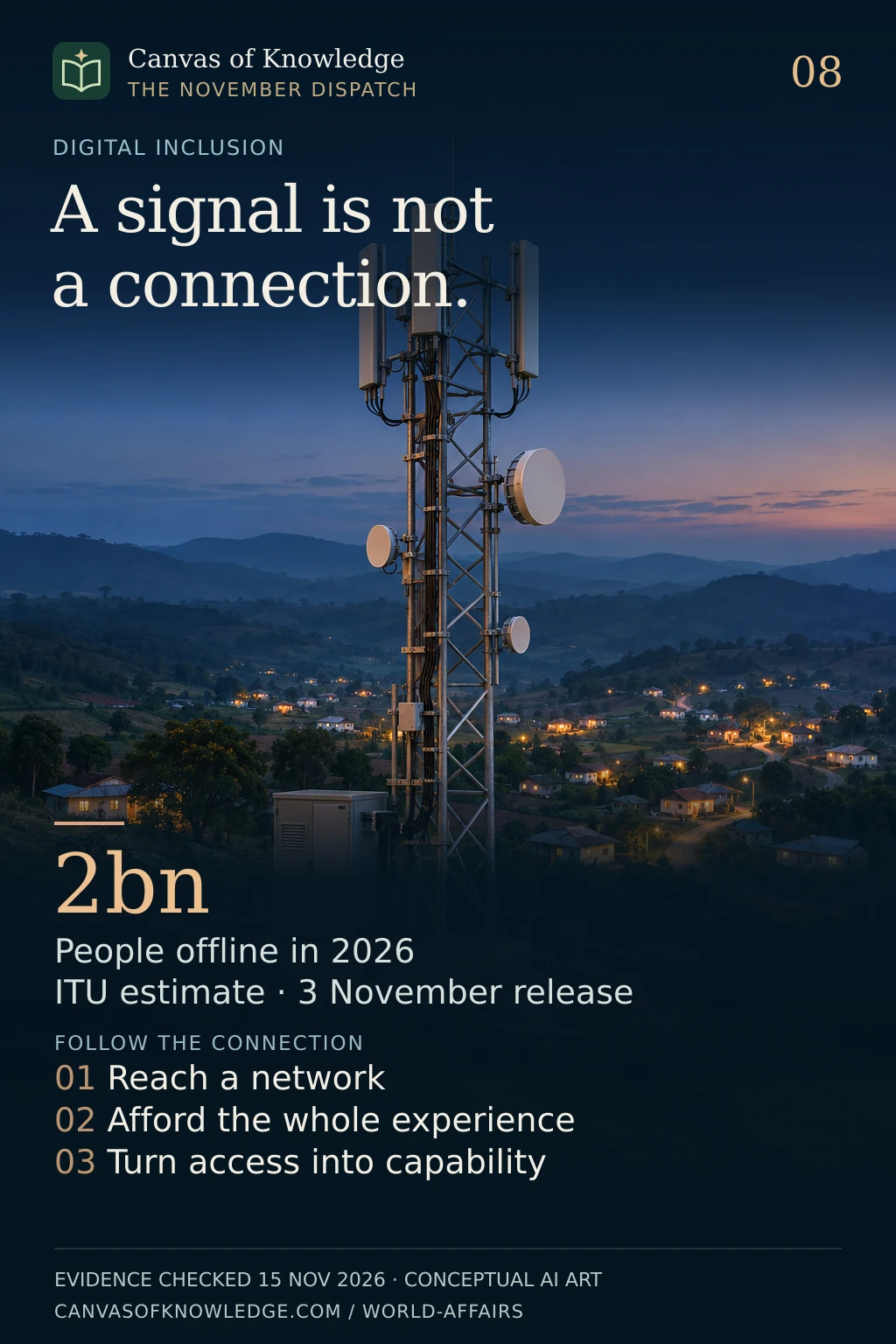
A signal is not a connection.
Billions are online, yet a coverage map cannot show who can afford a useful connection, operate a suitable device or participate safely.
 View full-size infographic
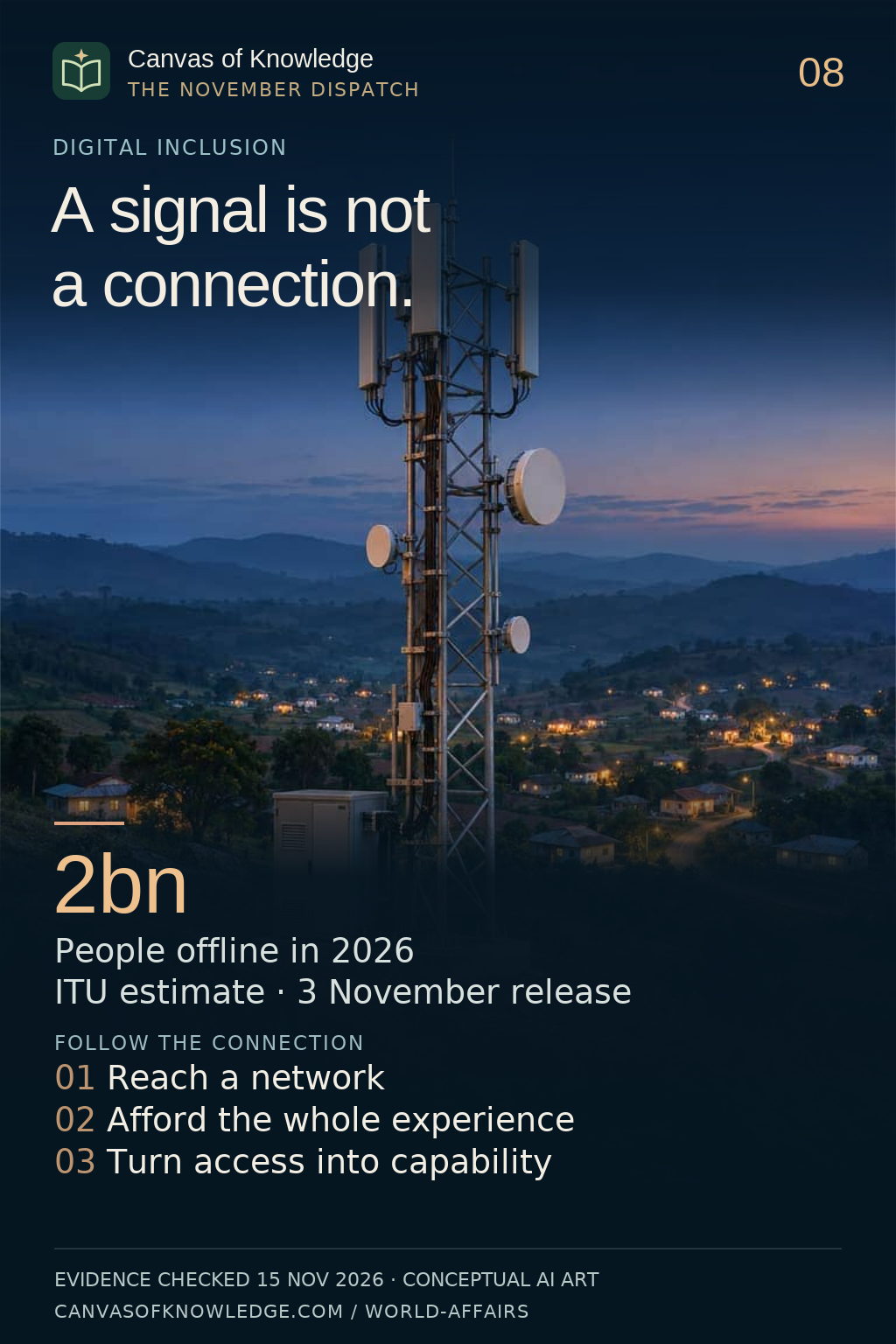
A signal is not
a connection.
People estimated to remain offline in 2026 · ITU, 3 November release
Digital inclusion is a chain of conditions. Network reach matters, but access becomes meaningful only when people can use it reliably, affordably and safely.
ITU Facts and Figures released 3 November 2026; 2026 estimates. Older World Bank evidence is explicitly identified as 2025-report context.
ITU's new annual assessment estimates 6.3 billion people use the internet in 2026, or 76 per cent of the world. Two billion remain offline. The advance is substantial, but an online headcount cannot tell us whether the connection is useful enough to study, run a business or complete an essential service.
- 01
Reach a network
A signal must be available where someone needs it. Coverage describes a technical possibility, not proof that a person subscribes or uses the internet. A map coloured as covered can therefore conceal households that are still unable to participate.
- 02
Afford the whole experience
A connection needs an appropriate device as well as data. Price must be considered against the resources of the user, not only compared with prices elsewhere. A cheap-looking monthly tariff can still compete with essential household spending.
- 03
Turn access into capability
Skills, security and connection quality affect what a person can actually do. Being able to receive a message does not guarantee being able to verify information, complete a complex form or manage an online business. The useful outcome is greater choice and capability.
The same internet. Unequal participation.
- High-income countries93People using the internet, 2026 (%)
- Low-income countries32People using the internet, 2026 (%)
ITU Facts and Figures 2026 estimates. Income-group aggregates conceal differences within countries; these are use rates, not network coverage.
Evidence period: ITU Facts and Figures released 3 November 2026; 2026 estimates. Older World Bank evidence is explicitly identified as 2025-report context. · Source details below
Averages flatten different worlds
ITU estimates internet use at 93 per cent in high-income countries and 32 per cent in low-income countries in 2026. These are population-use rates, not network-coverage rates or numbers of subscriptions. They reveal a major difference between groups while still hiding variation within each. The global total should therefore be read alongside who is connected and under which conditions, rather than treated as a single measure of equal opportunity.
There is more than one missing link
ITU's separate universal and meaningful connectivity framework identifies six interdependent dimensions: quality, availability, affordability, devices, skills and security. This helps explain why one impressive infrastructure announcement cannot settle the inclusion question. A capable device cannot compensate for an unaffordable service; a strong signal cannot supply missing skills. Our illustration is a person submitting a job application: the relevant test includes opening the page, understanding it, attaching documents and completing the process securely, not merely seeing a network icon.
Progress in reach can coexist with a quality gap
The World Bank's Digital Progress and Trends Report 2025, drawing on earlier data, found that wider access could coexist with widening affordability and quality gaps between richer and poorer economies. That is historical context, not a fresh 2026 measurement. Its lesson for interpreting the new ITU release is to keep several questions open at once. Is access spreading? Is performance improving? Are people gaining the means to use it? Our reading is that the next frontier is dependable participation: reducing the friction between a nominal connection and a task completed. More users is real progress; more usable access is a distinct achievement worth measuring.
Better questions.
A clearer picture.
- Are people newly online gaining reliable service, suitable devices and practical skills?
- Do affordability measures reveal pressures on lower-income households within each country?
- Do services remain usable and safe for people with limited connectivity or experience?
Sources & dates.
- ITU · Facts and Figures 2026 release
Published: 3 November 2026
Evidence period: 2026 global and income-group estimates; revised historical series - ITU · Universal and meaningful connectivity framework
Published: Undated framework page; checked 15 November 2026
Evidence period: Conceptual framework, not a 2026 statistical series - World Bank · Digital Progress and Trends Report 2025, connectivity chapter
Published: 2025
Evidence period: Earlier observations, principally 2022–2024; used as context, not current estimates
Checked 15 November 2026. Conditions can change after publication. These organisations do not endorse Canvas of Knowledge.