One element, many forms
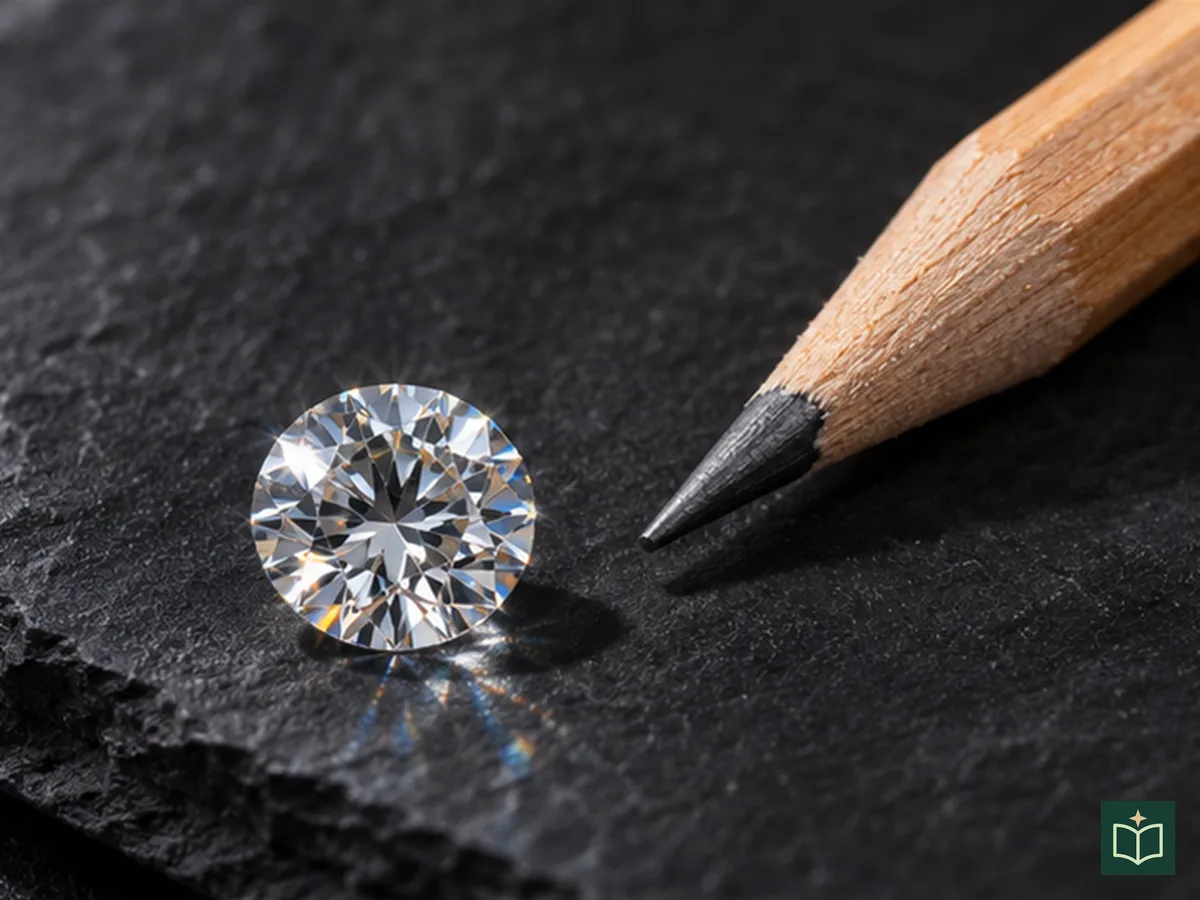
Some elements can exist in several different structural forms, called allotropes. Carbon is the most striking example. Diamond and graphite are both made entirely of carbon atoms, yet one is a transparent gem that cuts glass and the other is the soft, grey material in pencils that leaves marks on paper. Chemically, they are identical: burn either in pure oxygen and both produce only carbon dioxide. The difference lies entirely in how the atoms are connected. Since the 1980s, scientists have found more forms, including football-shaped molecules called fullerenes, rolled-up carbon nanotubes and single-atom sheets known as graphene, each with its own properties.
Inside a diamond
In diamond, every carbon atom forms strong covalent bonds with four neighbours, arranged at equal angles in a pyramid-like shape called a tetrahedron. Each neighbour bonds to four more, and the pattern repeats in all three dimensions, producing a single interlocking framework through the whole crystal. Breaking or scratching a diamond means breaking many of these strong bonds at once, which is why diamond tops the Mohs hardness scale at 10. All four outer electrons of each carbon atom are locked into bonds, leaving none free to move, so diamond does not conduct electricity. Its rigid lattice does carry heat superbly, better than copper.
Inside graphite
In graphite, each carbon atom bonds strongly to only three neighbours, forming flat sheets of interlocking hexagons, like chicken wire. Within a sheet the bonds are very strong. Between sheets, however, the attraction is weak, so layers can slide past one another easily. That makes graphite soft and slippery, useful as a dry lubricant and as pencil 'lead', which leaves a trail of flaked-off layers on paper. Each carbon atom's fourth outer electron is not fixed in a bond but spread across the sheet, free to move. That is why graphite conducts electricity, and why it is used in battery electrodes, including the anodes of most lithium-ion batteries.
Made under pressure
Under everyday conditions at Earth's surface, graphite is the more stable form of carbon. Diamond becomes stable only at enormous pressures, found more than about 150 kilometres below the surface, where temperatures exceed 1,000°C. Natural diamonds grew there, often billions of years ago, and were carried up rapidly by rare volcanic eruptions. Strictly speaking, a diamond on a ring is slowly turning into graphite, but the process is so slow at room temperature that it would take far longer than the age of the universe to notice. Since the 1950s, factories have recreated deep-Earth conditions to make synthetic diamonds, and newer methods grow them from carbon-rich gas.
Numbers that show the difference
The contrasting structures show up in measurable ways. Diamond has a density of about 3.5 grams per cubic centimetre, while graphite's is about 2.2, so diamond is roughly 60% denser because its atoms are packed more tightly. Diamond is transparent and bends light strongly, giving the sparkle that cutters exploit; graphite is opaque and absorbs light. Diamond is an electrical insulator; graphite conducts. Diamond is the hardest natural material known; graphite can be scratched with a fingernail. Yet if both were heated strongly in air, each would eventually burn away. Diamond is not indestructible: it can chip along certain planes, and a jeweller can cleave a crystal with a well-placed blow.
Why it matters
The diamond and graphite story is one of chemistry's clearest lessons: structure determines properties. The same principle explains why some plastics are rigid and others flexible, and why steel's properties change with heat treatment. Both forms of carbon are economically important. Industrial diamonds, most of them synthetic, coat drill bits and saw blades used to cut stone, concrete and metal. Graphite is a key material for steelmaking electrodes and for the batteries in phones and electric cars, which is why it now appears on many countries' lists of critical minerals. Graphene, isolated in 2004 and recognised with a Nobel Prize in 2010, extends the family further.
Sources & further reading
Figures are rounded and widely published; check the linked organisations for the latest editions. These organisations do not endorse this website.