An unbalanced pull
Inside a glass of water, each water molecule is surrounded on all sides by others, and the attractions between them balance out. At the surface, though, a molecule has neighbours beside and below it but almost none above, only air. It is therefore pulled sideways and inwards. The result is that the liquid behaves as though it is covered by a thin, stretched film that resists being broken or stretched further. This property is called surface tension. Every liquid has some, but water's is unusually strong because its molecules attract one another through hydrogen bonds, relatively powerful links between the hydrogen of one molecule and the oxygen of another.
Walking on water
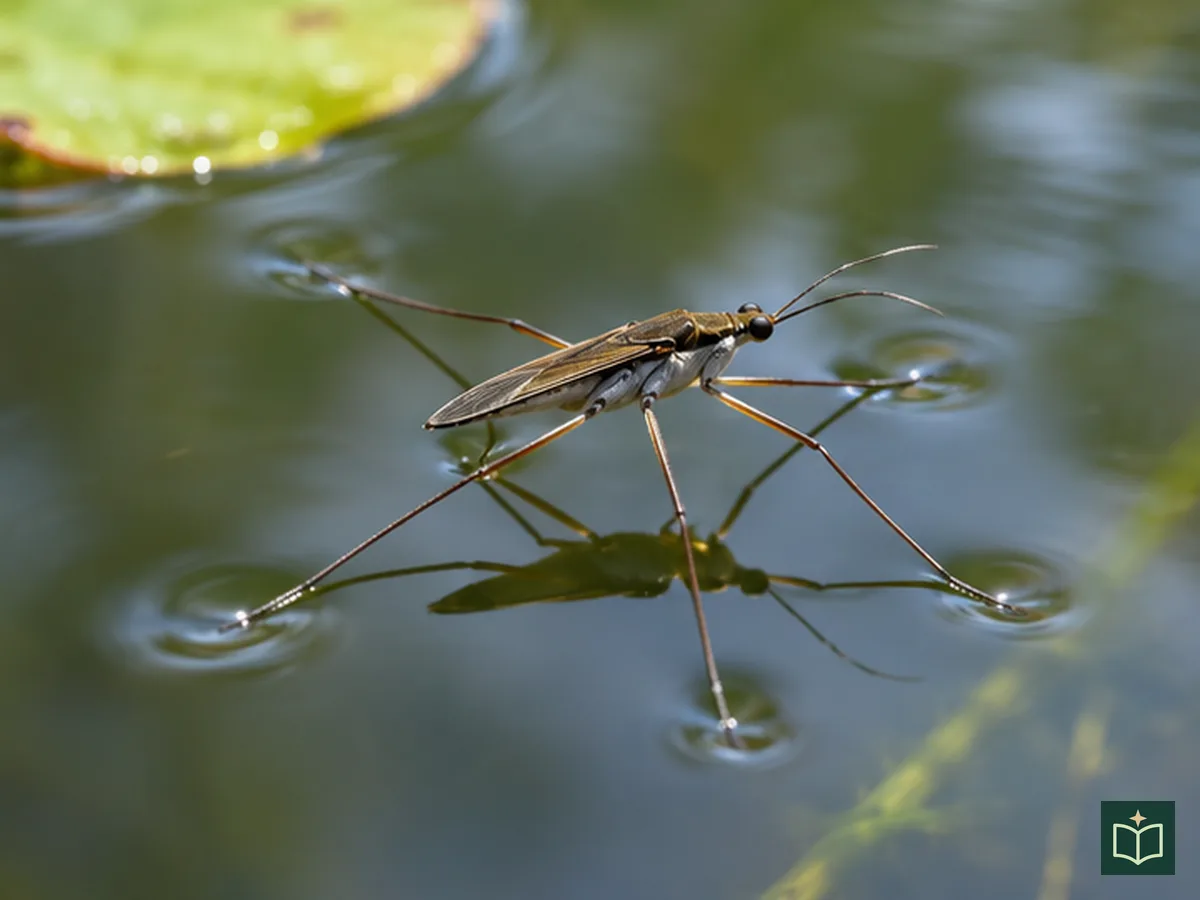
Surface tension is strong enough to support small creatures. Water striders, or pond skaters, spread their weight across long, thin legs covered in tiny water-repelling hairs. Each leg presses a dimple into the surface without breaking it, and the stretched surface pushes back. A steel paperclip or sewing needle, laid gently flat on still water, will float the same way, even though steel is about eight times denser than water. Push one end under, and it sinks immediately. Some lizards and spiders can briefly run across water too, though larger animals rely on speed and splashing rather than surface tension alone. For anything human-sized, the film is far too weak.
Why drops are round
Because surface tension pulls the surface as small as possible, a free drop of liquid takes the shape with the least surface area for its volume: a sphere. Raindrops are nearly spherical when small; larger ones are flattened by air resistance into shapes more like burger buns, not the teardrops of cartoons. On a waxy leaf or a freshly polished car, water beads up into rounded droplets because it is more attracted to itself than to the surface. On clean glass, which water clings to, it spreads into a thin sheet. The balance between a liquid's attraction to itself and to a surface also explains how water climbs narrow tubes and soaks into paper.
Numbers behind the skin
Surface tension is measured as force per unit length, in millinewtons per metre. Pure water at 25°C has a value of about 72, among the highest of common liquids; ethanol is about 22, and most oils are around 30. Liquid mercury, at roughly 480, is far higher, which is why spilled mercury forms shiny beads. Temperature matters: as water warms, its molecules move faster and pull on each other less, so surface tension falls. Hot water therefore wets fabrics and dishes more readily than cold, one reason hot water helps with washing. Dissolved salts raise surface tension slightly, so seawater's skin is a little stronger than fresh water's.
How soap breaks it
Soaps and detergents are surfactants, short for surface-active agents. Their molecules have one end attracted to water and the other repelled by it, so they crowd at the surface with their water-avoiding tails pointing outward. That disrupts the network of hydrogen bonds and can cut surface tension by more than half. A classic demonstration shows this vividly: sprinkle pepper on water, touch the centre with a soapy finger, and the pepper races to the edges as the surface skin is pulled away from the soap. Lower surface tension lets water spread into fibres and crevices, which is one reason soapy water cleans better than plain water.
Bubbles and beyond
Bubbles depend on a balance of forces. Pure water bubbles burst almost instantly, because its strong surface tension pulls the thin film apart. Adding soap lowers the tension and stabilises the film, letting it stretch into a large sphere, the shape with the smallest surface for the air inside. Surface tension matters well beyond the kitchen sink. It shapes the droplets from inkjet printers and fuel injectors, controls how pesticides and paints spread, and is a challenge in space, where without gravity, water forms floating spheres that cling to surfaces. In the body, a natural surfactant keeps the tiny air sacs of the lungs from collapsing with each breath.
Sources & further reading
Figures are rounded and widely published; check the linked organisations for the latest editions. These organisations do not endorse this website.