Why the Gulf desalinates
The Arabian Peninsula has almost no permanent rivers or lakes, low rainfall and fast-depleting groundwater. Rapid population and economic growth since the mid-twentieth century has therefore depended on desalination. Gulf states account for a large share of global desalination capacity, and in several of them most municipal drinking water comes from the sea. Kuwait, Qatar, Bahrain and the UAE are among the most reliant. Plants line the coasts of the Arabian Gulf and the Gulf of Oman. Because they need large amounts of energy, desalination is closely tied to the power sector, and many plants were built alongside power stations from the start.
Thermal desalination
The earliest large Gulf plants used thermal methods, especially multi-stage flash distillation. Seawater is heated and passed through a series of chambers at progressively lower pressure, where part of it ‘flashes’ into vapour that condenses as fresh water. Multi-effect distillation works on a similar principle. These plants were often paired with gas-fired power stations, using steam left over from electricity generation. That cogeneration made sense when fuel was cheap, but thermal desalination uses a lot of energy, much of it as heat, typically equivalent to several times the electricity needed by modern membrane plants. Thermal plants also tie water output to power output, which limits flexibility.
Reverse osmosis
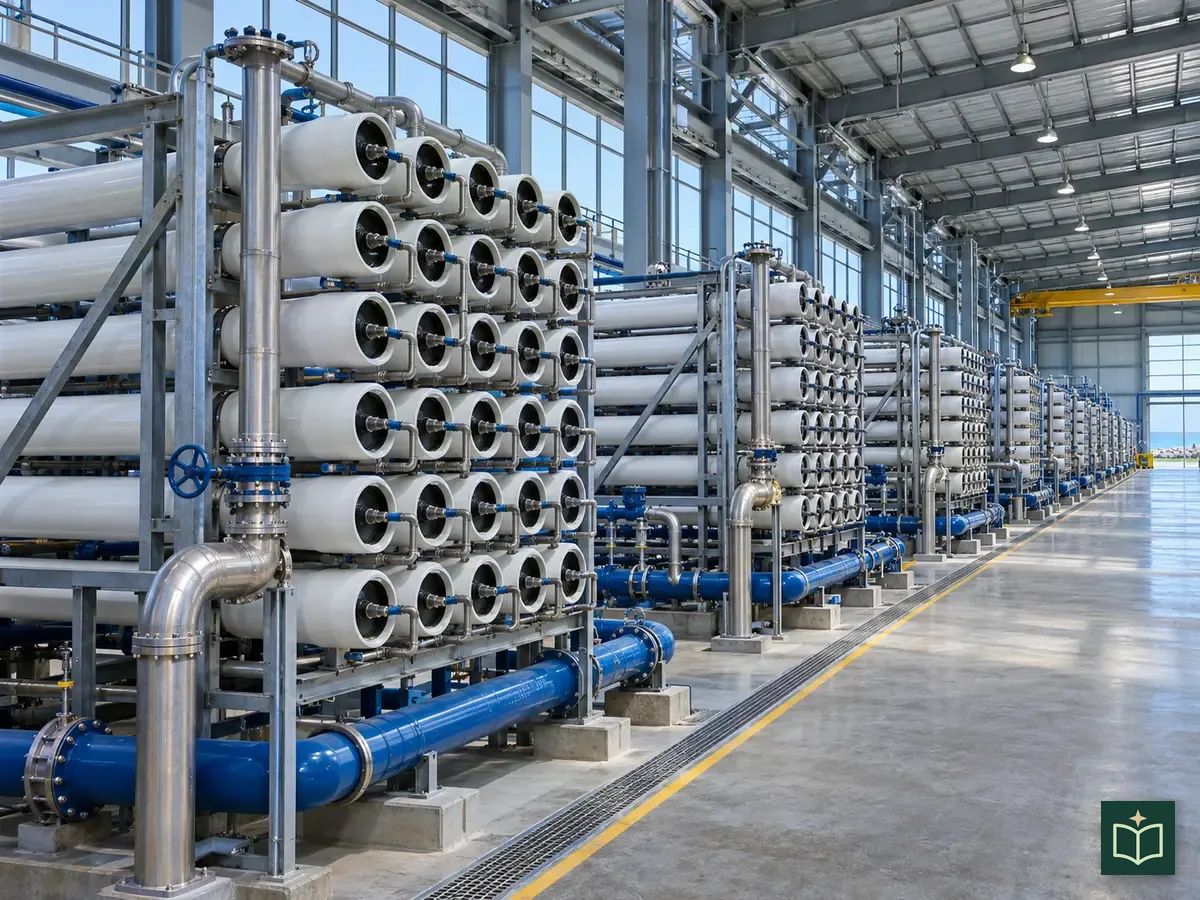
Reverse osmosis uses high-pressure pumps to push seawater through semi-permeable membranes that let water molecules pass but block most salt. Modern seawater plants use energy recovery devices that capture pressure from the outgoing brine, bringing electricity use down to roughly 3 to 4 kilowatt-hours per cubic metre. The Taweelah plant in Abu Dhabi, completed in the early 2020s, is among the largest reverse osmosis plants in the world, with capacity of around 900,000 cubic metres a day. The Gulf’s warm, salty and sometimes algae-rich water makes pre-treatment more demanding, but the region is steadily shifting from thermal to membrane technology.
What it means at home
A cubic metre is 1,000 litres. At about 3.5 kilowatt-hours per cubic metre, producing 200 litres of fresh water for one person’s daily use takes roughly 0.7 kilowatt-hours, before pumping it through the city and treating the wastewater afterwards. That is similar to running a small air conditioner for a short time. Across a country, the totals become large: desalination is one of the biggest electricity users in many Gulf states. This is why water tariffs, leak reduction and reusing treated wastewater for irrigation and cooling are part of energy policy, not only water policy. Saving water saves electricity, and the reverse is also true.
Brine and the sea
For every litre of fresh water produced, seawater plants typically discharge one to two litres of concentrated brine, which is saltier and sometimes warmer than the surrounding sea. It may also contain traces of chemicals used in treatment. The Arabian Gulf is shallow and semi-enclosed, with high natural evaporation, so scientists monitor how brine discharges affect local salinity and marine life. Diffusers that spread brine quickly, careful siting and stricter standards can reduce impacts. Researchers are also studying ways to extract useful minerals from brine. Physics sets a floor: separating salt from seawater has a theoretical minimum energy of roughly 1 kilowatt-hour per cubic metre.
Pairing with solar
Because reverse osmosis runs on electricity, it can be powered by solar and other low-carbon sources rather than fuel burned on site. Several Gulf projects link new desalination plants with solar power, and decoupling water from gas-fired cogeneration gives grid operators more flexibility. Storage helps too: drinking water can be stored in reservoirs more cheaply than electricity in batteries, so plants can produce more when solar power is plentiful. The long-term trend is toward lower energy per cubic metre, cleaner power and more water reuse. Even so, desalinated water will remain one of the region’s essential and energy-intensive public services.
Sources & further reading
Figures are rounded and widely published; check the linked organisations for the latest editions. These organisations do not endorse this website.