The budget squeeze travels.
Bond markets have reopened for many developing economies. The harder question is what the money costs, and what the repayments leave behind.
 View full-size infographic
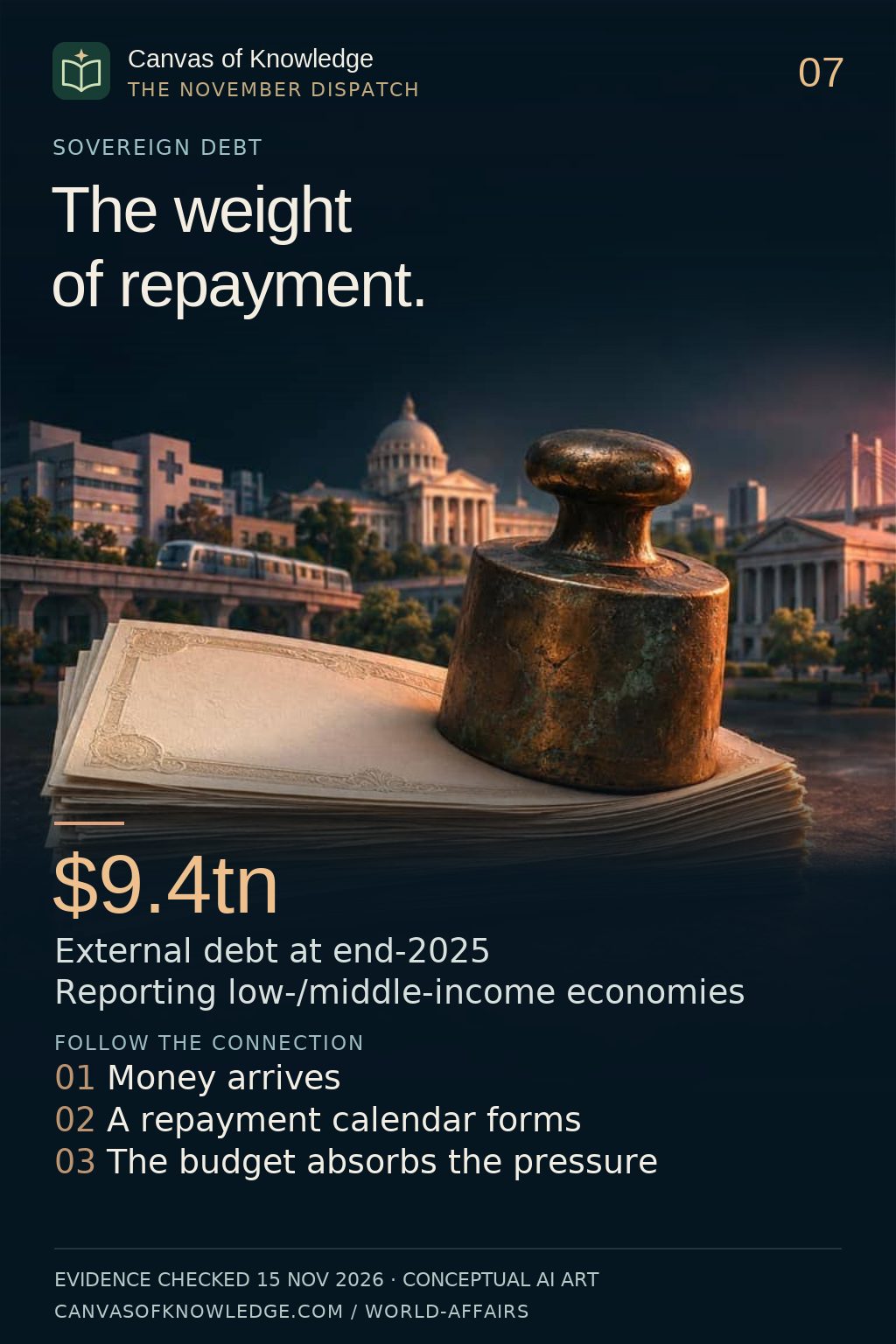
The weight
of repayment.
External debt of reporting low- and middle-income countries at end-2025 · World Bank
Borrowing can build a country's future. Its usefulness depends on the terms, the investment it finances and the resources left after servicing it.
World Bank release: 5 November 2026; debt data: end-2025. IMF and UNCTAD context: October 2026.
The World Bank's 5 November International Debt Report release describes a return of private lending alongside expensive borrowing. That combination challenges an easy headline: access to a bond market does not automatically mean affordable development finance. A successful sale raises cash today; its repayment terms shape choices for years afterwards.
- 01
Money arrives
A government can borrow to build infrastructure, sustain services or refinance earlier obligations. These uses have different consequences. A new loan that replaces an old one may ease an immediate deadline without providing much additional money for public investment.
- 02
A repayment calendar forms
Interest and principal fall due on particular dates. Currency, maturity and whether rates are fixed or variable matter alongside the headline amount. A large stock of long-term affordable debt can pose a different challenge from a smaller bill concentrated into one difficult year.
- 03
The budget absorbs the pressure
When debt payments grow faster than available revenue, the space for other priorities narrows. The choices may involve taxation, spending, refinancing or negotiation. Each has consequences, and none can be assessed properly from the debt total alone.
Market access has different price tags.
- IDA-eligible borrowers9.4Average interest rate on new bonds, 2025 (%)
- IBRD-only borrowers5.5Average interest rate on new bonds, 2025 (%)
World Bank IDR 2026. New bond borrowing, not interest rates on the entire debt stock. Borrower groups differ in income, risk and financing terms.
Evidence period: World Bank release: 5 November 2026; debt data: end-2025. IMF and UNCTAD context: October 2026. · Source details below
An open market can still be expensive
The World Bank reports that countries eligible for its concessional IDA financing paid an average 9.4 per cent on new bonds in 2025, compared with 5.5 per cent for IBRD-only borrowers. Those are rates on new borrowing, not the cost of every outstanding loan. Replacing a maturing bond can spread payments over time while locking in a more demanding future interest bill.
Interest has a public-service counterpart
UNCTAD's October assessment estimates developing countries' net interest payments on public debt at $995 billion in 2025. This is a different measure from external debt stocks: it concerns government interest, including domestic borrowing. The important connection is the budget constraint. Money committed to servicing debt cannot simultaneously fund another programme unless revenue, financing or spending elsewhere changes. That does not establish that every loan was wasteful; productive borrowing can leave valuable public assets.
Look beyond the national border
The IMF's October Fiscal Monitor briefing warns that high debt, higher interest rates and persistent spending pressures can transmit fiscal risks internationally. Our reading is to examine the chain rather than announce a universal tipping point: who needs to refinance, on what terms, and with which revenue base? A country ratio is a starting question, not a diagnosis. The quality of tax collection, institutions and the spending being financed belongs in the same picture as the bonds. Two governments with similar debt ratios can have very different room to manoeuvre.
Better questions.
A clearer picture.
- Are new loans adding productive capacity or mainly replacing earlier obligations?
- How much debt matures soon, and in which currencies?
- Do future budgets preserve essential services while making repayment plans credible?
Sources & dates.
- World Bank · International Debt Report 2026 release
Published: 5 November 2026
Evidence period: 2025 external debt stocks, flows and new borrowing rates - UNCTAD · A World of Debt 2026
Published: October 2026; launch coverage dated 7 October
Evidence period: 2025 public debt and net interest payments; other indicators have separate reference years - IMF · Fiscal Monitor briefing, Annual Meetings 2026
Published: 14 October 2026
Evidence period: October 2026 fiscal-risk assessment
Checked 15 November 2026. Conditions can change after publication. These organisations do not endorse Canvas of Knowledge.