Two moments, not one
In casual speech dawn and sunrise are used interchangeably, but they are separate events. Sunrise is the moment the upper edge of the Sun's disc appears above a flat horizon. Dawn is the beginning of morning twilight, when the sky first starts to lighten, which can be well over an hour earlier. The interval between them exists because Earth has an atmosphere. Sunlight striking air high above us is scattered downwards and sideways, so the sky glows even though the Sun itself is hidden. On an airless world such as the Moon there is no twilight at all: the sky stays black until the Sun's disc appears, and day arrives in an instant.
Three stages of twilight
Astronomers divide twilight by how far the centre of the Sun lies below the horizon. Astronomical twilight runs from 18 to 12 degrees below. At its start the sky is effectively dark, and the faint glow is noticeable only away from city lights, though it is enough to wash out the dimmest stars and galaxies. Nautical twilight runs from 12 to 6 degrees below. The horizon becomes visible against the sky, which historically allowed sailors to measure star positions against it for navigation. Civil twilight runs from 6 degrees below until sunrise. During this stage there is usually enough light for outdoor activities without lamps, and the brightest planets and stars remain visible.
What counts as sunrise
Sunrise has a precise definition too. It is the moment the Sun's upper edge touches the horizon, not its centre. The atmosphere bends light around the curve of the Earth, an effect called refraction, so the Sun appears above the horizon when it is geometrically still slightly below it. Official sunrise times allow for this, placing the Sun's centre a little under one degree below the horizon at the moment it seems to appear. The same effects work in reverse at sunset, and evening twilight follows the same three stages towards night. Because of refraction and the size of the Sun's disc, days are a few minutes longer than they would be without an atmosphere.
Faster near the equator
The length of twilight depends on latitude. Near the equator the Sun rises and sets almost vertically, so it passes through the 18-degree band quickly. Moving at about 15 degrees an hour along its path, a Sun climbing straight up crosses a 6-degree band in about 24 minutes, so civil twilight there lasts only around 20 to 25 minutes. In the UAE, at around 24 to 25 degrees north, twilight is only slightly longer, which is why mornings seem to brighten quickly. At high latitudes the Sun climbs at a shallow slant, so twilight lasts much longer. In London, civil twilight lasts close to 50 minutes in midsummer, and in parts of Scandinavia the sky never fully darkens.
Dawn in daily life
The distinction has practical uses. Many legal and aviation rules use civil twilight to define when vehicle lights or aircraft lighting are required. Photographers prize the period around civil twilight, often called the blue hour, for its soft, even light. In Islamic practice the time of the dawn prayer, Fajr, and the start of the daily fast in Ramadan are linked to the first appearance of light across the eastern horizon, not to sunrise. Different authorities set this moment at a solar depression of between about 15 and 19.5 degrees, which is why published prayer times can vary by several minutes between organisations, even for the same city.
Why the sky changes colour
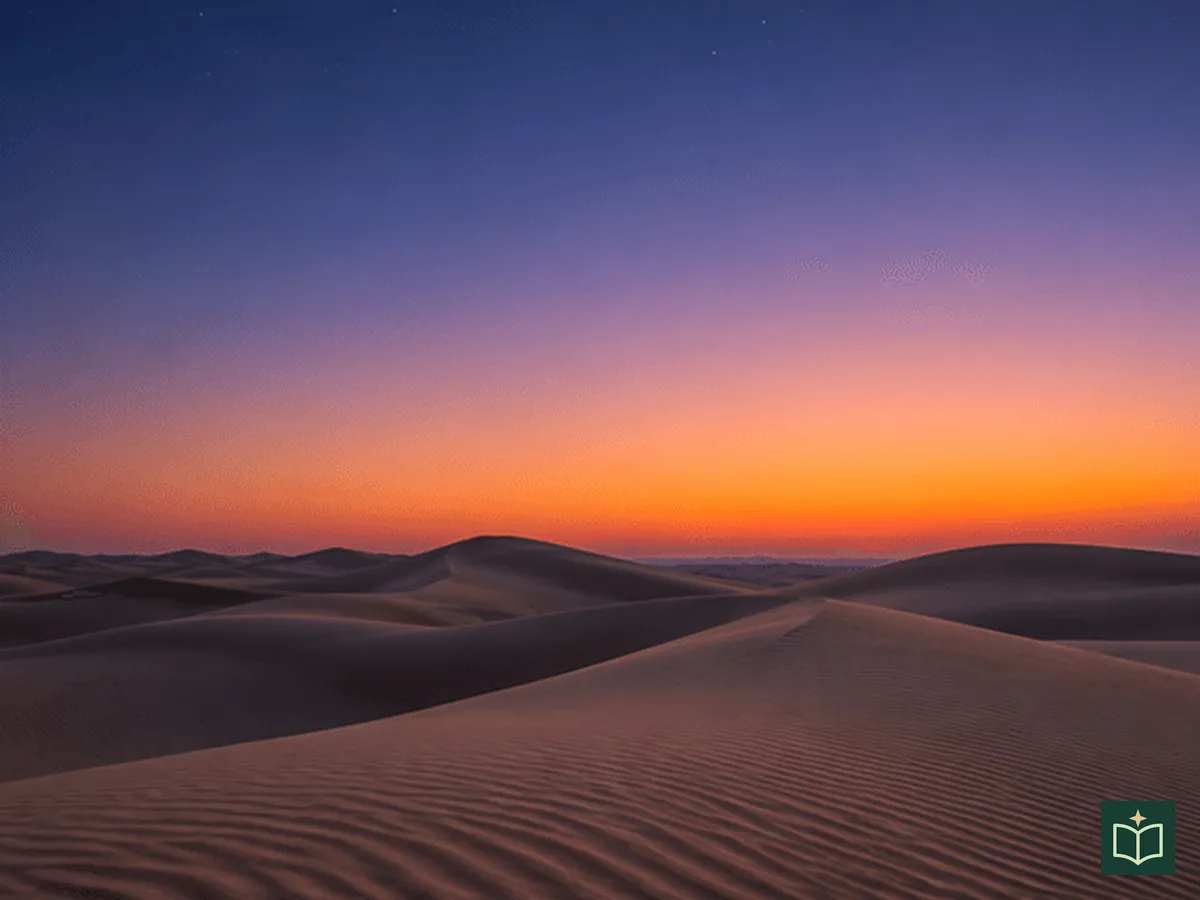
As dawn progresses, the sky shifts from deep blue through violet and pink to orange and gold. When the Sun is low or below the horizon, its light passes through a long path of atmosphere, and shorter blue wavelengths are scattered away, leaving the reds and oranges that colour clouds and the horizon. Dust and haze can intensify the effect, which is why Gulf sunrises in hazy summer months can glow deep orange. Overhead, the sky can stay surprisingly blue during twilight, partly because ozone absorbs some orange light. These changes happen in the same order every clear morning, a reminder that dawn is a process while sunrise is a single moment.
Sources & further reading
Figures are rounded and widely published; check the linked organisations for the latest editions. These organisations do not endorse this website.