Why look to space?
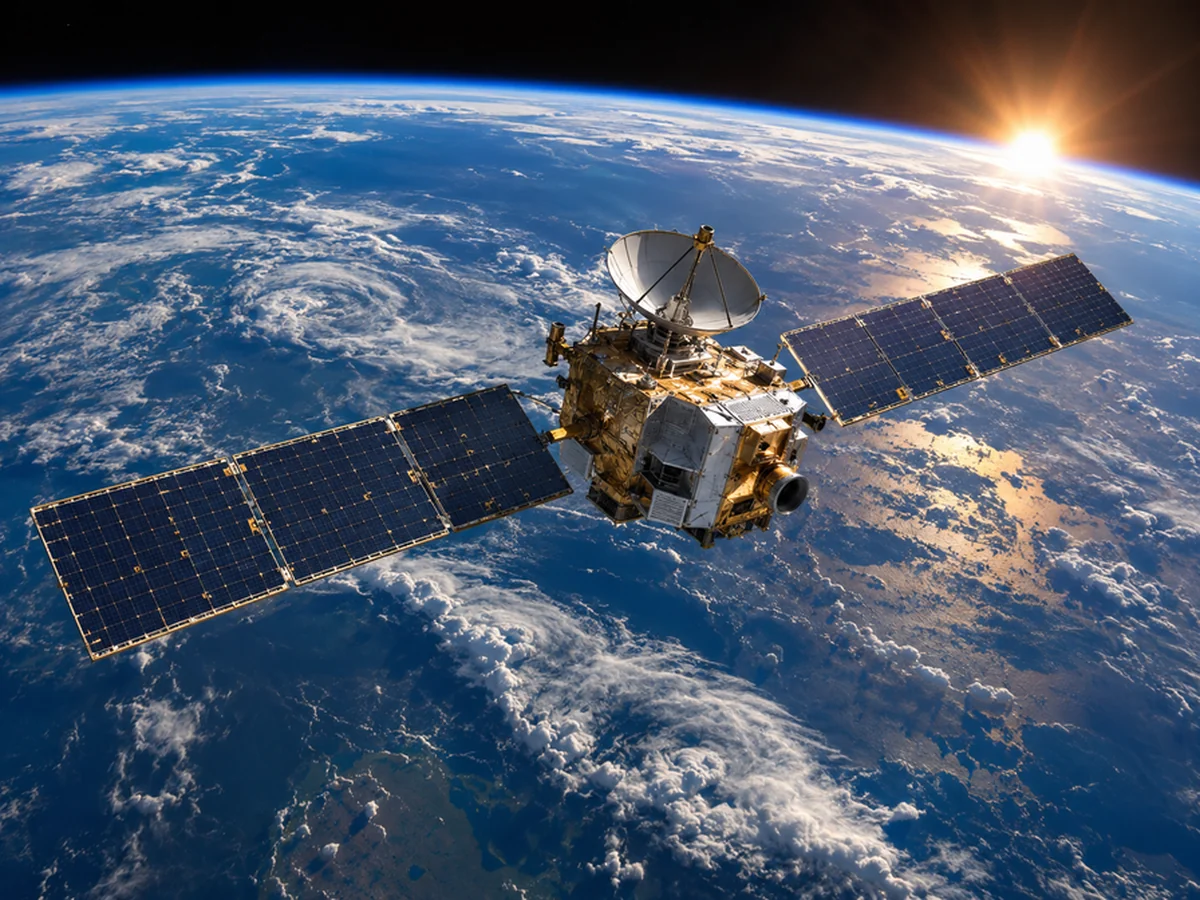
AI data centres need vast amounts of electricity, land and often water, and many communities are pushing back against new facilities. Electricity grids in some regions are struggling to keep up. In orbit, solar panels can receive sunlight for most or all of the time, depending on the orbit, and can produce several times more energy than the same panels on Earth, without needing batteries for the night. This has made space an intriguing option.
Project Suncatcher
In November 2025, Google announced Project Suncatcher, a research effort exploring whether networks of solar-powered satellites carrying its Tensor Processing Unit AI chips could provide computing power in space. The satellites would fly in a sun-synchronous orbit to stay in near-constant sunlight and communicate with each other using laser links. Google described it as a moonshot, in the spirit of its self-driving car and quantum computing projects.
Testing the chips
Ordinary computer chips can be damaged by radiation in space. Google tested its Trillium TPU chips in a particle accelerator, exposing them to proton beams to simulate the radiation of low Earth orbit. It reported that the chips, including their sensitive high-bandwidth memory, held up better than expected and could potentially operate for years in orbit. Google planned to launch two prototype satellites with the satellite company Planet by early 2027.
Flying in formation
For satellites to work together as a single computer, they must exchange huge amounts of data quickly. Google's design envisions clusters of satellites flying just a few hundred metres apart, connected by optical laser links. It reported laboratory tests of such links achieving very high data speeds. Keeping many satellites in such close formation safely would be a major engineering achievement.
Starcloud
A start-up called Starcloud, based in the United States and backed by Nvidia's start-up programme, launched its first satellite, Starcloud-1, in November 2025, carrying an Nvidia H100 AI chip, which it said was the first such high-performance AI chip in orbit. The company has proposed eventually building very large space data centres with kilometres of solar panels and has raised funding to launch a larger cluster.
Others in the race
Other companies are also pursuing the idea. Axiom Space, a private space station company, placed data centre nodes in orbit in early 2026, according to reports. Elon Musk has said SpaceX plans to build data centres in space using future Starlink satellites, and Nvidia has announced chips designed for space. Chinese organisations have also announced plans for computing satellite constellations.
The cooling problem
Space is cold, but it is a vacuum, so heat cannot be carried away by air or water as on Earth. It can only be radiated away, which requires large radiator panels. AI chips produce a lot of heat, so space data centres would need very large radiators, adding weight and cost. Managing heat is one of the biggest engineering challenges for orbital computing.
Costs and other hurdles
Launching equipment into space is expensive, though costs have fallen sharply thanks to reusable rockets. Google's analysis suggested that space data centres might become cost-competitive if launch prices fall to around 200 dollars per kilogram, which it thought could happen by the mid-2030s. Other challenges include repairing or upgrading hardware in orbit, sending data to Earth, space debris and the environmental impact of many rocket launches.
Sceptical voices
Many experts are sceptical that space data centres will become practical at large scale soon. They argue that building more solar, wind, nuclear and geothermal power on Earth, improving chip efficiency and expanding grids are cheaper and faster solutions. Supporters respond that long-term AI demand could be so large that space eventually becomes necessary, and that early experiments are needed to find out.
Why it matters
The idea of data centres in space shows how much pressure AI's energy demands are placing on the planet's resources, and how far companies are willing to go to find solutions. Whether or not orbital computing succeeds, the research may produce useful advances in solar power, chips, cooling and communications. For now, it remains an exciting experiment rather than a replacement for data centres on Earth, and a reminder of how fast the field is moving.
Sources & further reading
- Google · Meet Project Suncatcher (2025) ↗
- Google Research · Exploring a space-based, scalable AI infrastructure system design (2025) ↗
- Data Center Dynamics · Project Suncatcher: Google to launch TPUs into orbit with Planet Labs (2025) ↗
Plans described are experimental and may change. Photograph: original AI-generated illustration (Adobe Firefly). Reference organisations do not endorse this website.