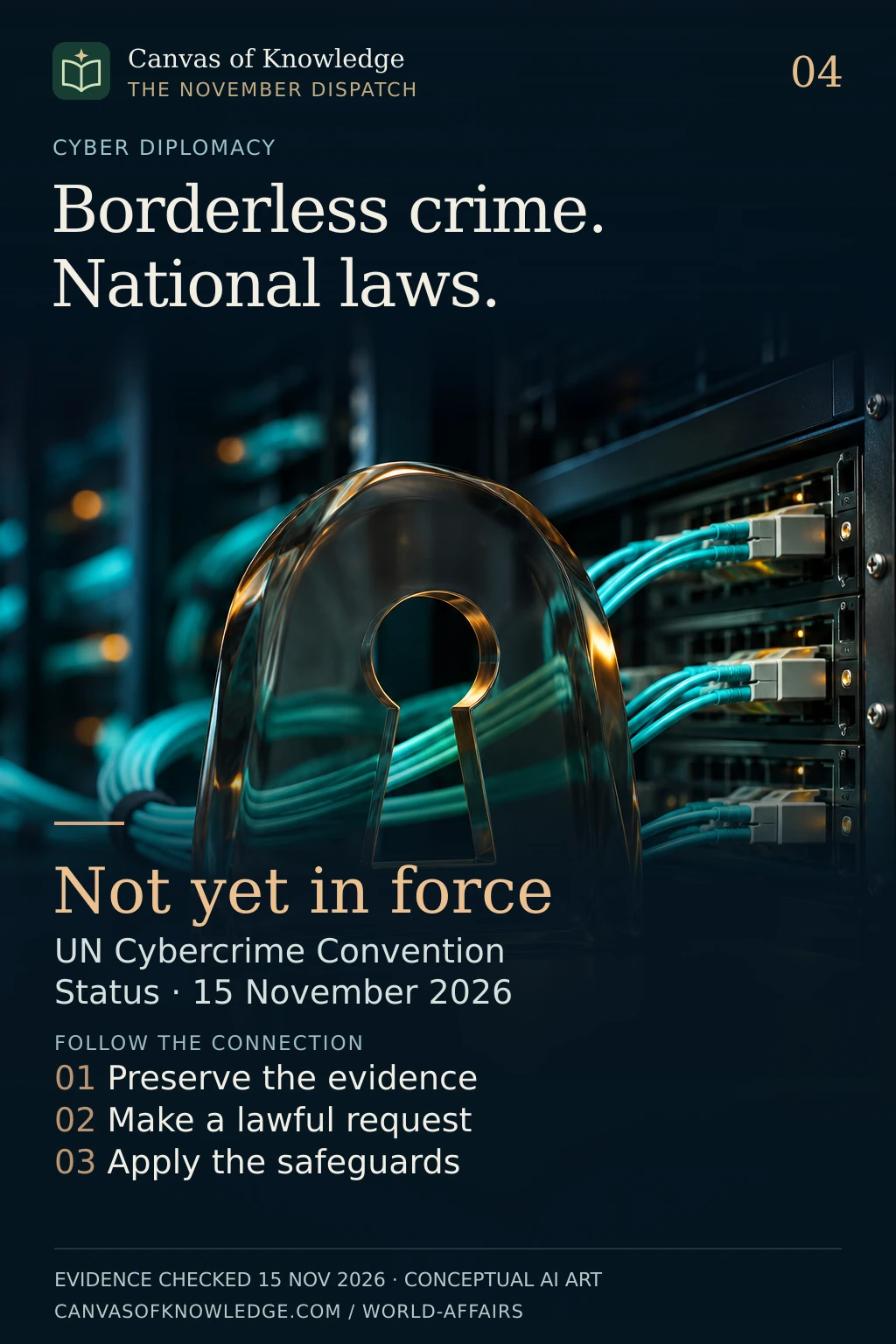
The border inside the network.
Digital evidence can cross continents in seconds. The authority to obtain and use it still depends on law.
 View full-size infographic
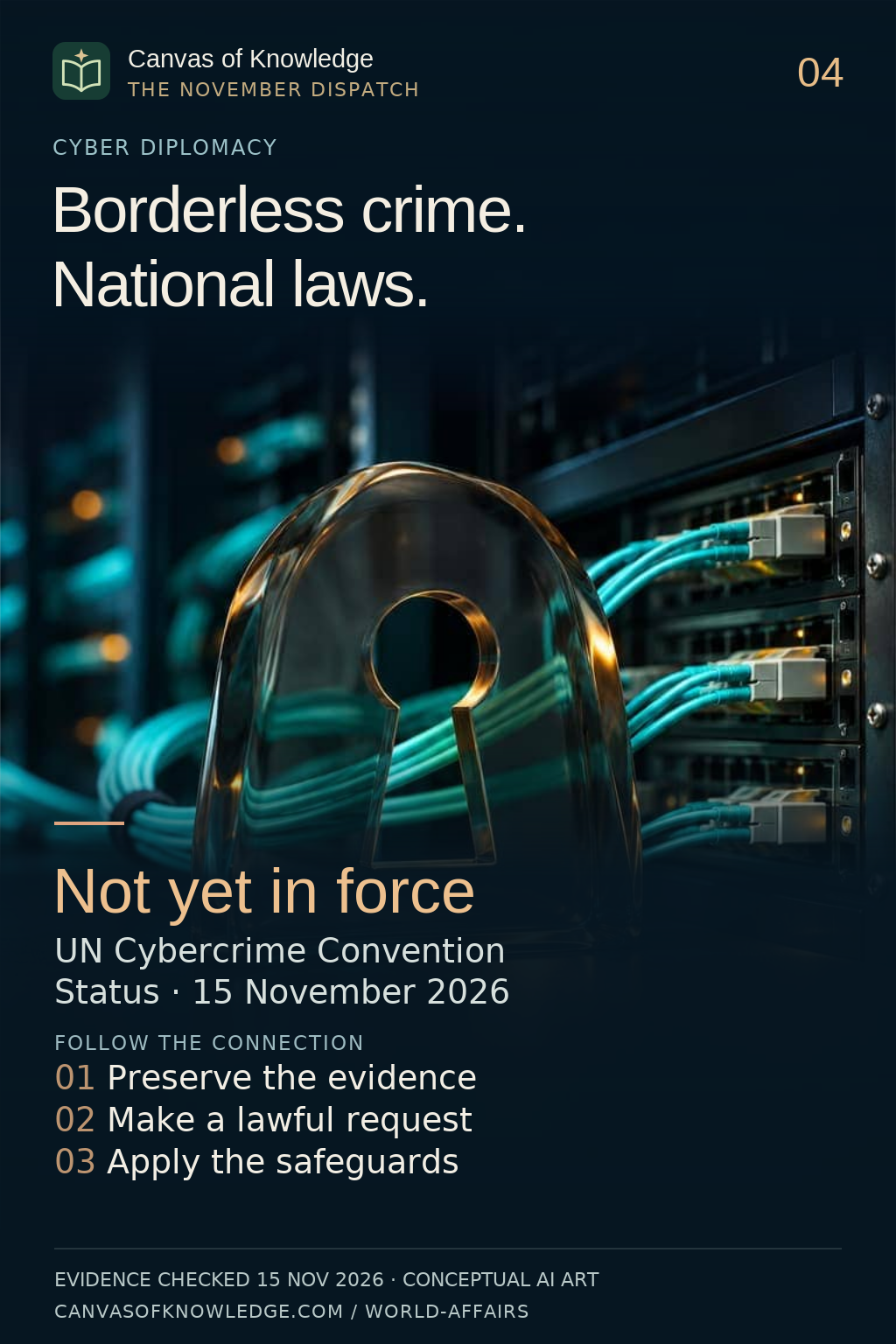
Borderless crime.
National laws.
UN Cybercrime Convention status on 15 November 2026
International cybercrime cooperation needs speed, compatible procedures and enforceable safeguards together.
UN depositary status checked 15 November 2026; treaty adopted 24 December 2024
The UN depositary lists 96 signatories and three parties to the Cybercrime Convention on 15 November. Signature remains open until 31 December 2026, but the treaty is not yet in force. This is a useful moment to distinguish a diplomatic endorsement from an operating legal framework, and a legal framework from an investigation that succeeds.
- 01
Preserve the evidence
Electronic records may disappear or change while authorities seek assistance. The convention provides for expedited preservation and a network of round-the-clock contact points. Preserving specified data keeps a potential evidential trail available; it is not identical to authorising its disclosure or proving what happened.
- 02
Make a lawful request
UNODC’s account of international cooperation explains that a formal request needs a defined authority, purpose, offence and requested procedure. The other jurisdiction must be able to act on it. Translating an urgent technical problem into a legally usable request is part of the work, not an optional administrative extra.
- 03
Apply the safeguards
The convention’s procedural powers are subject to human-rights obligations and proportionality. Article 24 addresses safeguards including appropriate independent review and effective remedies. Article 36 addresses personal-data protection. These conditions matter because an investigative shortcut can expose people far beyond the suspected offender.
A signature is not an entry-into-force date
The convention was adopted in December 2024 and opened for signature in Hanoi in October 2025. Article 65 requires the fortieth qualifying instrument of ratification, acceptance, approval or accession, followed by 90 days, before entry into force. The depositary’s three parties are therefore not forty operating participants. Nor should 96 signatories be described as 96 countries already applying the treaty: the signatory list also includes the European Union. The threshold has not been reached in this snapshot.
Why one investigation can involve many legal systems
Consider a hypothetical fraud: a victim lives in one country, an account is operated from another and relevant records are held elsewhere. UNODC’s digital-evidence teaching materials explain that cloud data can be distributed among providers and locations. An investigator therefore has two separate questions: which information would help establish the facts, and which lawful process can obtain it? A visible username, server location or payment record is a lead. None, on its own, establishes the identity or guilt of a particular person.
Judge implementation by trust as well as throughput
More exchanged data is not automatically better cooperation. UNODC’s legal-cooperation material recognises human-rights obligations and grounds for refusing requests, as well as delays in formal processes. Our analytical test is to look for a system that can handle urgency without making scrutiny disappear. Can the requesting authority explain necessity? Can the receiving authority assess the request? Can a court rely on how the evidence was obtained? These questions connect operational competence with public legitimacy; a treaty signature cannot settle them by itself.
Better questions.
A clearer picture.
- How many qualifying instruments are deposited, rather than announced or signed?
- Do national implementation measures provide meaningful review and remedies?
- Are cooperation channels staffed and trained to produce reliable, admissible evidence?
Sources & dates.
- UN Treaty Collection · Convention against Cybercrime, status
Published: Live depositary record, checked 15 November 2026
Evidence period: Status on 15 November 2026 - UN General Assembly · Resolution 79/243 and Convention text
Published: 24 December 2024
Evidence period: Adopted treaty text, especially articles 24, 36, 41 and 65 - UNODC · Formal international cooperation mechanisms
Published: June 2019
Evidence period: Background on cooperation procedures, not current treaty participation - UNODC · Handling of digital evidence
Published: Teaching material; checked 15 November 2026
Evidence period: Background on distributed data and evidence handling
Checked 15 November 2026. Conditions can change after publication. These organisations do not endorse Canvas of Knowledge.