Two kinds of current
Electric current is the flow of electric charge, usually electrons moving through a wire. In direct current, or DC, the flow goes in one direction at a steady voltage. Batteries, solar panels and fuel cells all produce DC. In alternating current, or AC, the direction reverses repeatedly. The voltage rises to a peak, falls through zero, reaches a negative peak and returns, tracing a smooth wave. The number of complete cycles per second is the frequency, measured in hertz. The UAE, Europe and most of Asia and Africa use 50 hertz; North America and parts of South America and Saudi Arabia use 60.
Why grids chose AC
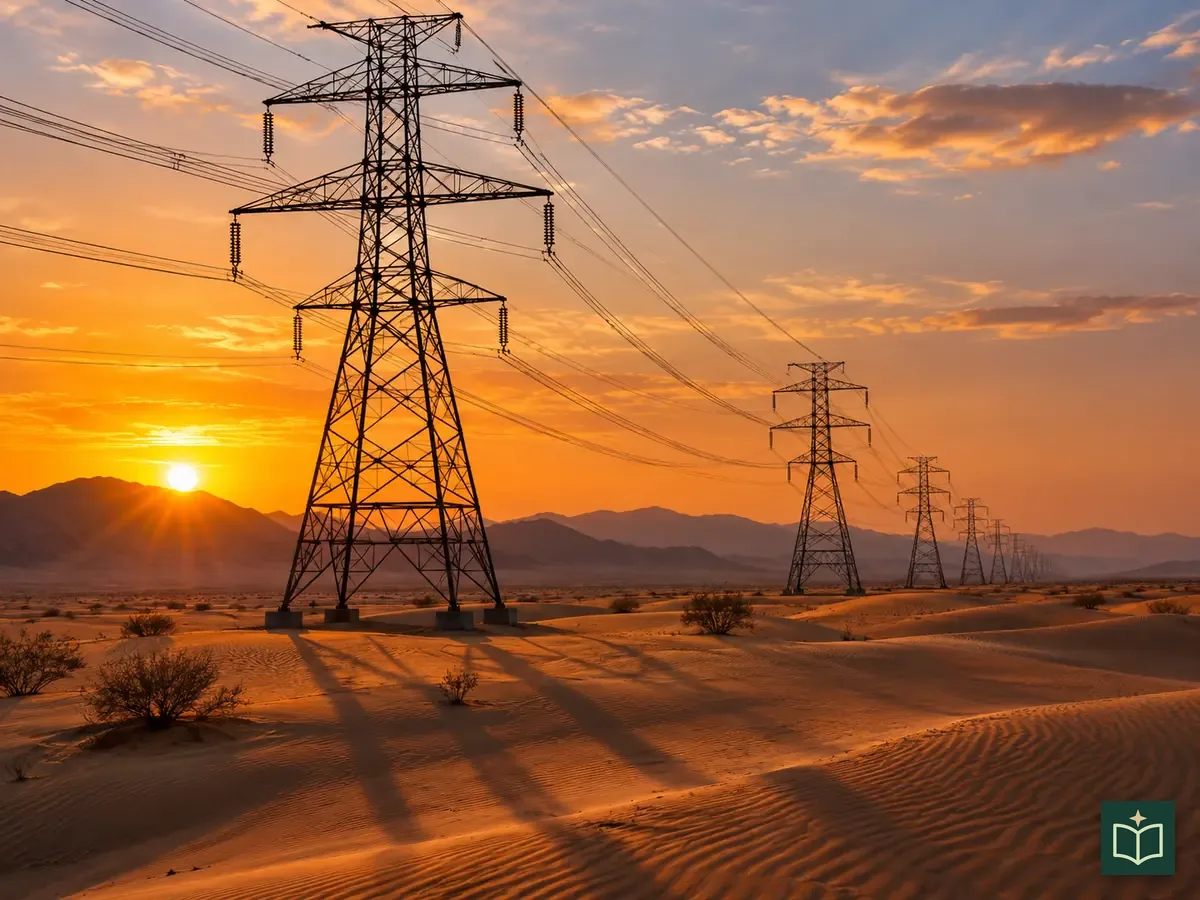
The decisive advantage of AC is that its voltage can be changed easily and efficiently with a transformer, a simple device of two coils around an iron core. Power stations step voltage up to hundreds of thousands of volts for long-distance transmission. At high voltage, the same power can travel with a smaller current, which reduces energy lost as heat in the wires. Substations then step it down for distribution, and finally to about 230 volts for homes. AC also suits large spinning generators and electric motors, which naturally produce and use alternating current. That is why national grids have relied on AC for more than a century.
The War of the Currents
In the 1880s, Thomas Edison's company promoted DC networks for electric lighting, while George Westinghouse, using designs by Nikola Tesla, backed AC. Edison's DC systems could only serve customers within a short distance of each power station, because voltage could not be easily raised for transmission. AC could send power over long distances. A high-profile moment came in 1896, when an AC system began carrying electricity from hydroelectric plants at Niagara Falls to the city of Buffalo, around 40 kilometres away. Within a few decades AC had become the global standard for public electricity grids. Edison remained committed to DC long after the contest had been settled.
Where DC dominates
Modern electronics run on DC. Inside a phone, laptop or television, transistors need a steady, low voltage. Every charger and power brick contains a rectifier and other circuitry that converts mains AC into DC. Electric vehicles store energy in DC batteries, and rooftop and utility solar plants produce DC that inverters turn into AC for the grid. LED lights also run on DC internally. Very long-distance links increasingly use high-voltage direct current, or HVDC, because over hundreds of kilometres, especially under the sea, it loses less energy than AC. Several subsea cables in Europe and Asia already work this way.
Where they are similar
Both are forms of the same thing: moving electric charge that delivers energy. Both are measured in volts and amperes, and both obey the same basic laws relating voltage, current and resistance. Both can power heating elements, such as kettles and irons, equally well, because heat depends on the energy delivered, not the direction of flow. Both can be dangerous at high voltage. Modern power electronics have blurred the boundary further: semiconductor switches can convert between AC and DC efficiently in both directions, so most systems today use a mix of the two. Both can be dangerous, so electrical work should be left to qualified electricians.
Why it matters
The balance between AC and DC is shifting. Solar panels, batteries, electric cars and data centres all work in DC, which has prompted research into DC distribution within buildings to avoid repeated conversions. Grid operators are building more HVDC links to connect distant renewable sources and neighbouring countries. Yet AC remains the backbone of national grids, including the GCC Interconnection that links the six Gulf states, although its connection to Saudi Arabia's 60 hertz grid passes through a DC converter station. Understanding the two currents explains why your charger gets warm, why travel adapters exist and how the energy transition is changing the way power moves. The two will continue to work side by side.
Sources & further reading
- US Department of Energy · The War of the Currents ↗
- Britannica · Alternating current ↗
- IEA · Electricity ↗
Figures are rounded and widely published; check the linked organisations for the latest editions. These organisations do not endorse this website.