A climate pledge is not a power line.
Inside the gap between a diplomatic finance goal and infrastructure that protects people or cuts emissions.

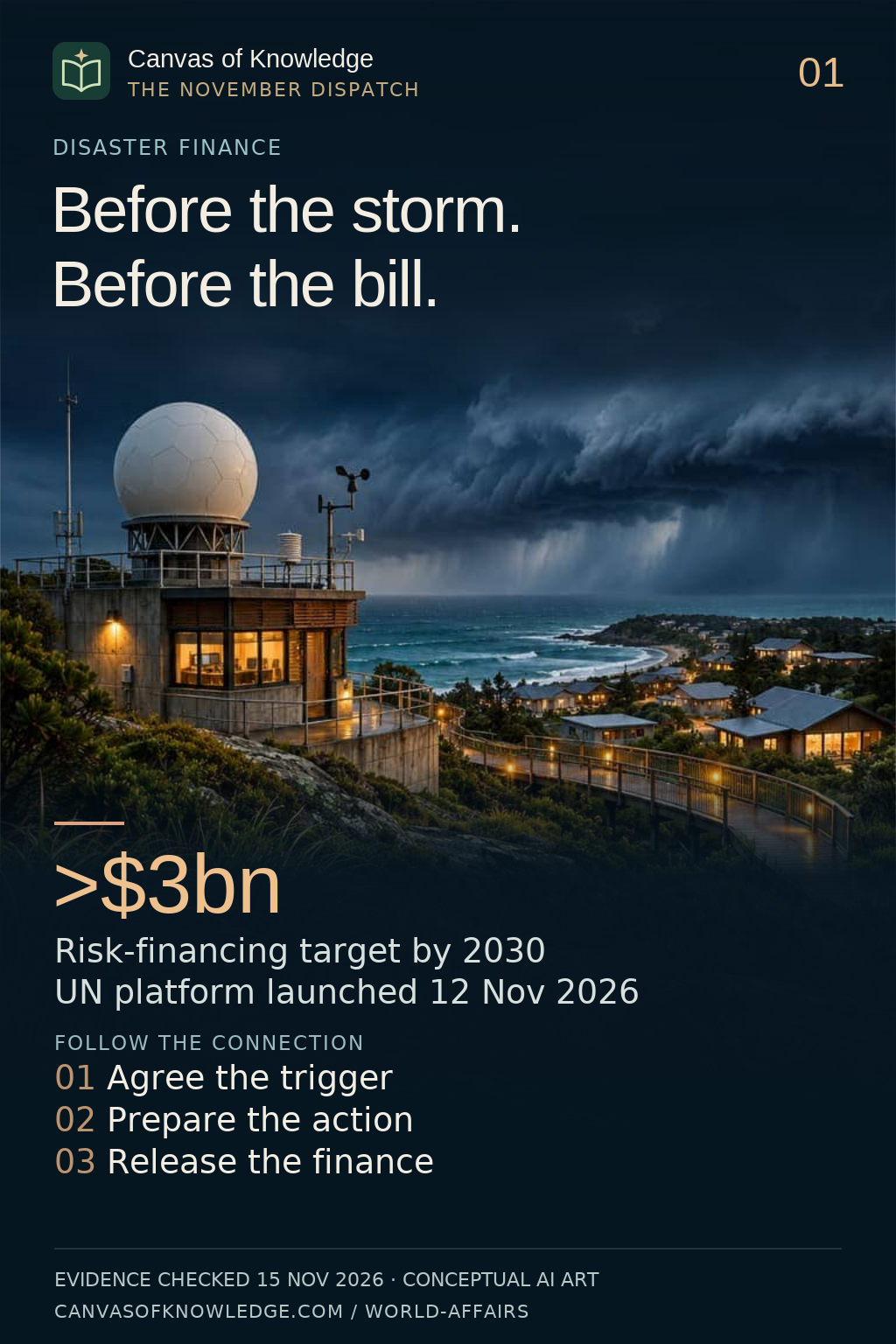
Conceptual AI illustration; not a documentary photograph.
Evidence: COP31 snapshot checked 15 November 2026; finance goals refer to 2035
COP31 is scheduled for 9–20 November 2026 in Antalya. As of this 15 November snapshot, the conference is under way. Finance is on its adopted agenda; no final COP31 outcome is claimed here.
- 01
Set the goal
An international agreement establishes a direction and a financing ambition. It does not, by itself, approve a national project, sign a contract or transfer a payment.
- 02
Build a workable programme
Translate a national priority into an implementable proposal: a responsible institution, realistic costs, technical capacity and a plan for maintaining the asset.
- 03
Finance, deliver, verify
The practical test follows the money into delivery. Distinguish an announcement, an approval, a disbursement and a completed result; each is a different milestone.
A goal within a wider ambition.
- Developed countries taking the lead · finance goal300USD billions per year by 2035
- All actors, public and private sources · scaling ambition1300USD billions per year by 2035
Overlapping goals with different scopes; do not add them. Both concern finance for developing countries. Neither is an amount already disbursed.
Evidence period: COP31 snapshot checked 15 November 2026; finance goals refer to 2035 · Source details below
Two numbers, different scopes
The COP29 finance framework includes a goal of at least USD 300 billion annually by 2035, with developed countries taking the lead, and a broader effort by all actors to enable at least USD 1.3 trillion a year from public and private sources. These are overlapping goals, not two separate pots to add together. Neither number represents money already delivered.
The terms matter as much as the total
In remarks at COP31 on 13 November, the UN climate chief emphasised affordable terms, simpler access and stronger national institutions. His argument was that a headline financial target can still fail to meet countries’ practical needs. The distinction is concrete: a grant, a commercial loan and a guarantee can have different effects on debt, risk and who ultimately pays.
Look for an implementation chain
Our interpretation: follow one priority from promise to service. For a hypothetical flood-resilience programme, ask who designs it, who finances it, who maintains it and how reduced exposure will be evaluated. An impressive announcement without those connections is incomplete. The Baku to Belém roadmap focuses on scaling finance for low-emissions and climate-resilient development, including national climate and adaptation plans.
Better questions.
A clearer picture.
- Are reported amounts commitments, approvals or money disbursed?
- Do funding terms fit a country’s debt position and the project’s purpose?
- Are delivery milestones and measurable benefits reported after the announcement?
Sources & dates.
- UNFCCC · COP31 adopted agenda
Published: Adopted 9 November 2026
Evidence period: COP31, 9–20 November 2026 - UNFCCC · Climate-finance remarks at COP31
Published: 13 November 2026
Evidence period: COP31 remarks and 2035 goals - UNFCCC · Baku to Belém Roadmap to 1.3T
Published: Roadmap information; checked 15 November 2026
Evidence period: Financing ambition for 2035 - UNFCCC · COP29 climate-finance agreement
Published: 24 November 2024
Evidence period: Goals for 2035, reaffirmed in COP31 remarks on 13 November 2026
Checked 15 November 2026. Conditions can change after publication. These organisations do not endorse Canvas of Knowledge.