Three ways to be highest
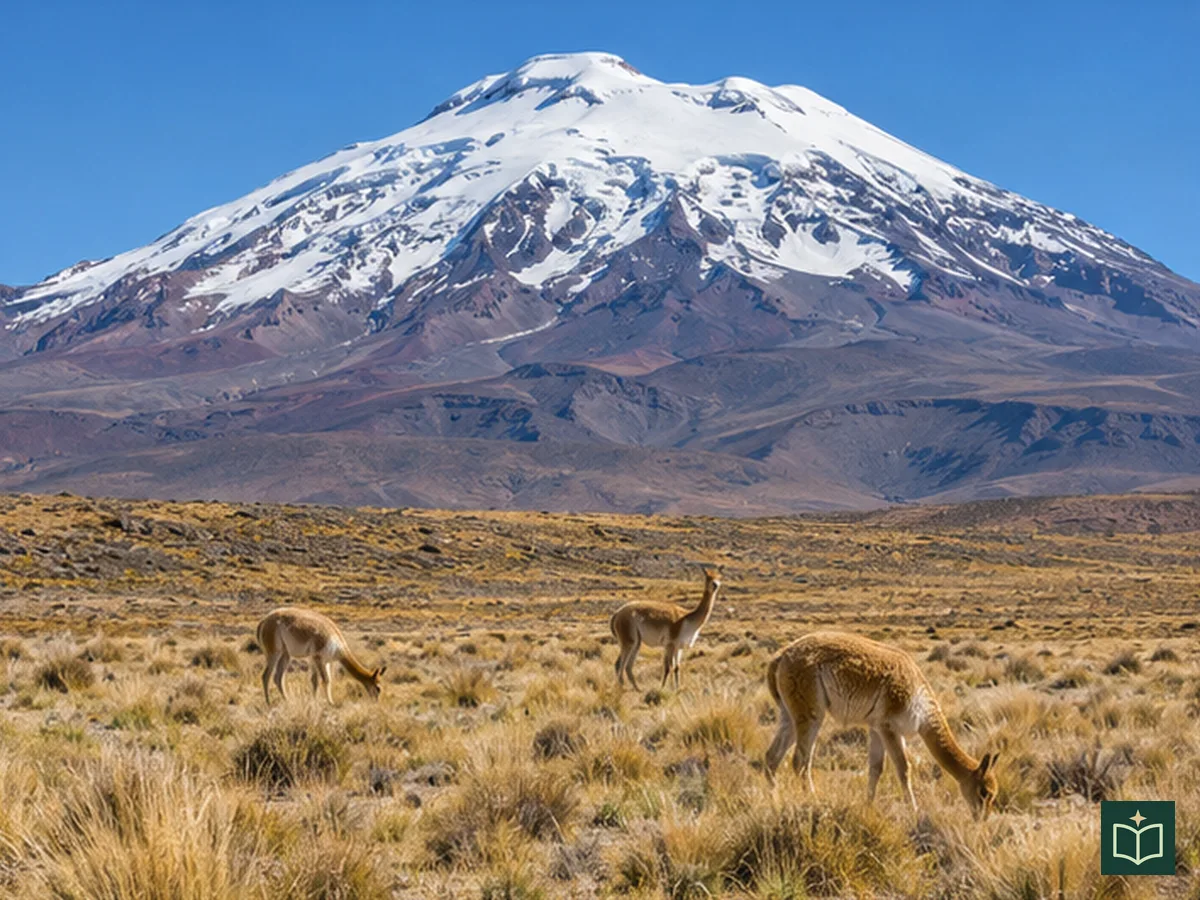
Ask which mountain is the highest and the usual answer is Everest, at about 8,849 metres above sea level. That is true by the standard measure. But there are other ways to compare mountains. Measured from base to summit, Mauna Kea in Hawaii is the tallest, rising around 10,000 metres from the floor of the Pacific, though most of it lies underwater. Measured from the centre of Earth, the winner is a glacier-capped volcano in the Ecuadorian Andes that most people have never heard of: Chimborazo, which stands about 6,263 metres above sea level, more than 2,500 metres lower than Everest.
A planet that bulges
The explanation lies in Earth’s shape. The planet is not a perfect sphere. Its rotation makes it bulge slightly at the equator and flatten at the poles, forming what geodesists call an oblate spheroid. The radius at the equator is about 6,378 kilometres, while the distance from the centre to the poles is about 6,357 kilometres, a difference of roughly 21 kilometres. Sea level follows this shape. So a point at sea level on the equator is already much farther from Earth’s centre than a point at sea level in the Himalaya, which lies around 28 degrees north of the equator. Mountains near the equator get a head start.
Doing the sums
Chimborazo sits just over one degree south of the equator, close to the widest part of the bulge. Everest lies at about 28 degrees north, where sea level is noticeably closer to the centre. Using a standard model of Earth’s shape, sea level beneath Chimborazo is about 6,378 kilometres from the centre, and adding the mountain’s height takes its summit to roughly 6,384.4 kilometres. Sea level beneath Everest is about 6,373.5 kilometres from the centre, and its greater height brings the summit to about 6,382.3 kilometres. The difference is about two kilometres in Chimborazo’s favour. The equatorial bulge more than makes up for Everest’s extra 2,586 metres.
Measuring the summit
Chimborazo’s height has been measured carefully. A joint French and Ecuadorian survey in 2016 used satellite positioning on the summit to confirm a height of about 6,263 metres above sea level. Surveys have also refined Everest’s height, most recently agreed by China and Nepal in 2020 at 8,848.86 metres. Neighbouring Andean peaks benefit from the equatorial bulge too: Huascarán in Peru and Cotopaxi in Ecuador also rank among the points farthest from Earth’s centre. But Chimborazo remains the record holder, which also makes it the place on land closest to outer space, if distance is measured outward from the planet’s centre.
Once thought the highest
Chimborazo has a long place in the history of science. In the early nineteenth century, before the Himalaya had been properly measured, it was widely believed to be the highest mountain in the world. In 1802 the naturalist Alexander von Humboldt climbed to a height of more than 5,800 metres on its slopes, a record at the time. His observations of how plants changed with altitude on the mountain helped found the study of plant geography. The first recorded ascent to the summit came in 1880, led by the English climber Edward Whymper with two Italian guides. Today, Chimborazo is a protected reserve with glaciers that are shrinking.
Why the distinction matters
The Chimborazo fact is more than trivia. It shows that height depends on the reference used. Sea level is practical for climbers, pilots and engineers, because it relates to air pressure and the shape of the land. Distance from Earth’s centre matters in geodesy, satellite orbits and gravity measurements, where the planet’s true shape counts. Base-to-summit height reflects how a mountain rises from its surroundings. None of these measures is wrong; each answers a different question. Everest is still the highest point above sea level, with the thinnest air and the greatest challenge for climbers. Chimborazo simply stands on the widest part of a spinning planet.
Sources & further reading
Figures are rounded and widely published; check the linked organisations for the latest editions. These organisations do not endorse this website.