Circles seen from orbit
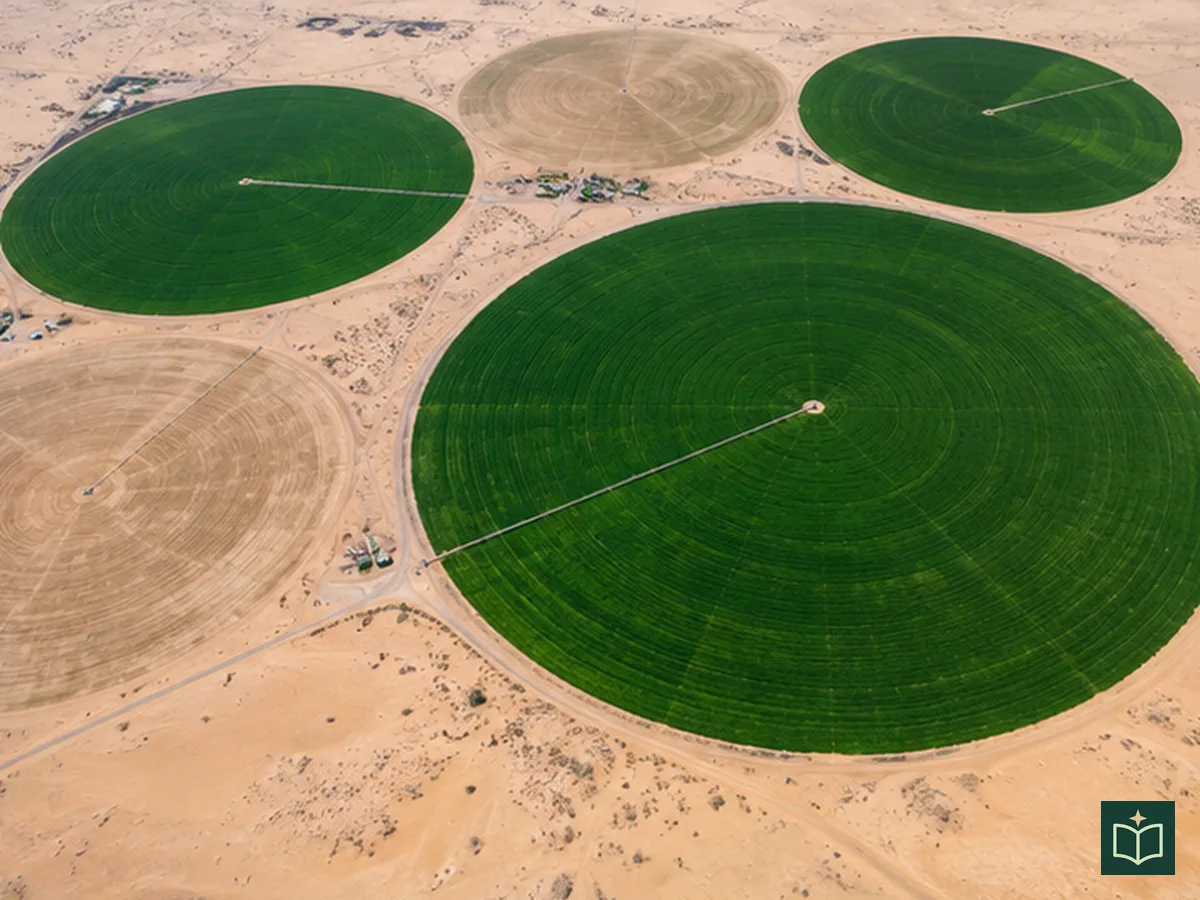
Satellite images of northern Saudi Arabia, Egypt's Western Desert, Libya and the Great Plains of the United States show something that looks almost artificial: fields arranged as perfect green discs, sometimes hundreds side by side. These are centre-pivot fields. Their shape is a direct result of the machine that waters them. A long steel pipe is fixed at one end to a central pivot supplied with water, and it rotates slowly around that point on a line of wheeled towers. Sprinklers along its length water the ground beneath. After one full rotation, the watered area forms a circle, and the crops grow in exactly that shape.
Who invented it
The system was invented in the late 1940s by Frank Zybach, a farmer in Colorado and Nebraska, who patented it in the early 1950s. Before that, irrigating large areas required levelling land and digging ditches, or moving sprinkler pipes by hand. Centre pivots could water uneven ground automatically, with little labour. Modern machines are typically a few hundred metres long, with towers driven by electric motors that keep the pipe straight as it turns. One rotation can take from under a day to several days, depending on how much water is applied. Farmers control them by computer or phone and can vary the amount of water around the circle.
The geometry of the field
The circle carries a built-in trade-off. A common machine is about 400 metres long. The area it waters is pi multiplied by the radius squared: about 3.14 times 160,000 square metres, or roughly 50 hectares. The square of land that encloses it, 800 metres on each side, covers 64 hectares. So the circle uses about 79 per cent of that square, leaving dry corners. In the American Midwest, those corners may be farmed without irrigation or left as habitat; some machines add swinging corner arms. In the open desert, land is cheap and water is the real constraint, so farmers simply space the circles apart.
Saudi Arabia's wheat circles
Saudi Arabia offers one of the most striking examples. From the late 1970s, the kingdom encouraged large-scale wheat farming in regions such as Al-Jawf, Tabuk and Wadi As-Sirhan, pumping water from deep aquifers to thousands of pivots. Production rose so fast that by the early 1990s Saudi Arabia was exporting wheat. But much of that water is ancient, stored in sandstone aquifers when Arabia was wetter, and is barely replenished today. Water tables fell sharply. Recognising the cost, the government phased out subsidised wheat production, ending it around 2016, though fodder and other crops continued for some years. Satellite images document circles appearing and fading over the decades.
Efficient, but not free
Centre pivots are more efficient than flooding fields, because they apply water evenly and in controlled amounts. Newer designs drop the nozzles close to the crop, reducing losses to wind and evaporation, which can be large in hot, dry air. Yet efficiency at the field does not guarantee sustainability. Where pivots draw on fossil groundwater, every season reduces a store that will not refill in human time. In the American High Plains, centre pivots tapping the Ogallala Aquifer have lowered water levels in parts of Kansas and Texas. Salt can also build up in soils when irrigation water evaporates and leaves its dissolved minerals behind.
What the circles tell us
The green circles have become a visual shorthand for the tension between food and water in dry lands. Satellites track how many are active, giving scientists and governments a way to monitor groundwater use in remote areas. Some Gulf countries now prefer to import grain or invest in farmland abroad rather than deplete their aquifers, while improving the efficiency of what is grown at home. In the UAE, treated wastewater and drip irrigation supply many farms and parks. The circles remain a remarkable feat of engineering, but each one is a reminder that, in a desert, the scarce resource is rarely land.
Sources & further reading
Figures are rounded and widely published; check the linked organisations for the latest editions. These organisations do not endorse this website.