Thousands of beginnings
A river's mouth is easy to find: it is where the water meets the sea or a lake. Its source is harder. A big river is the product of a whole drainage network, with countless springs, streams and tributaries joining as it flows downstream. Trace it back, and at every junction you must choose which branch to follow. Geographers usually call the starting point the source or headwater, but there is no single natural rule for picking it. The answer depends on whether you prefer the longest branch, the one carrying the most water, or the one that history and local naming have treated as the main river.
Three ways to choose
The most common modern rule picks the headwater farthest from the mouth, measured along the channel. That gives the river its greatest length. A second approach follows the branch with the largest flow at each junction, which better reflects where most of the water comes from. A third simply follows tradition and naming, which explains why maps sometimes treat a shorter tributary as the main river. The Mississippi is a classic case: its traditional source is Lake Itasca in Minnesota, identified in 1832, but the Missouri, which joins it, is longer. Measured from the Missouri's headwaters, the combined system is one of the longest in the world.
The search for the Nile
The Nile's source was one of geography's great puzzles. Ancient writers speculated about mountains of the moon, and Egyptian and Roman expeditions never reached it. In the nineteenth century, European explorers competed to find it. In 1858 John Hanning Speke reached Lake Victoria and declared it the source, a claim disputed bitterly at the time. Lake Victoria is the source of the White Nile in the sense that the river flows out of it, but the lake itself is fed by rivers. The longest of these, the Kagera, rises in the highlands of Rwanda and Burundi, and the Nile's farthest headwaters are now placed there, though the exact spring is still debated.
The Amazon's moving source
The Amazon's source has shifted with better maps. For much of the twentieth century, it was placed on the slopes of Nevado Mismi in the Peruvian Andes, at the head of the Apurímac River, a location identified by expeditions in the 1970s and confirmed in later surveys. In 2014, researchers using satellite data and field work argued that the Mantaro River, also in Peru, has a farther headwater during part of the year, which would make it the true source. The question matters partly because it affects whether the Amazon or the Nile is considered the longest river, a contest that depends on where each is measured from and how meanders are counted.
Rules matter, and so does culture
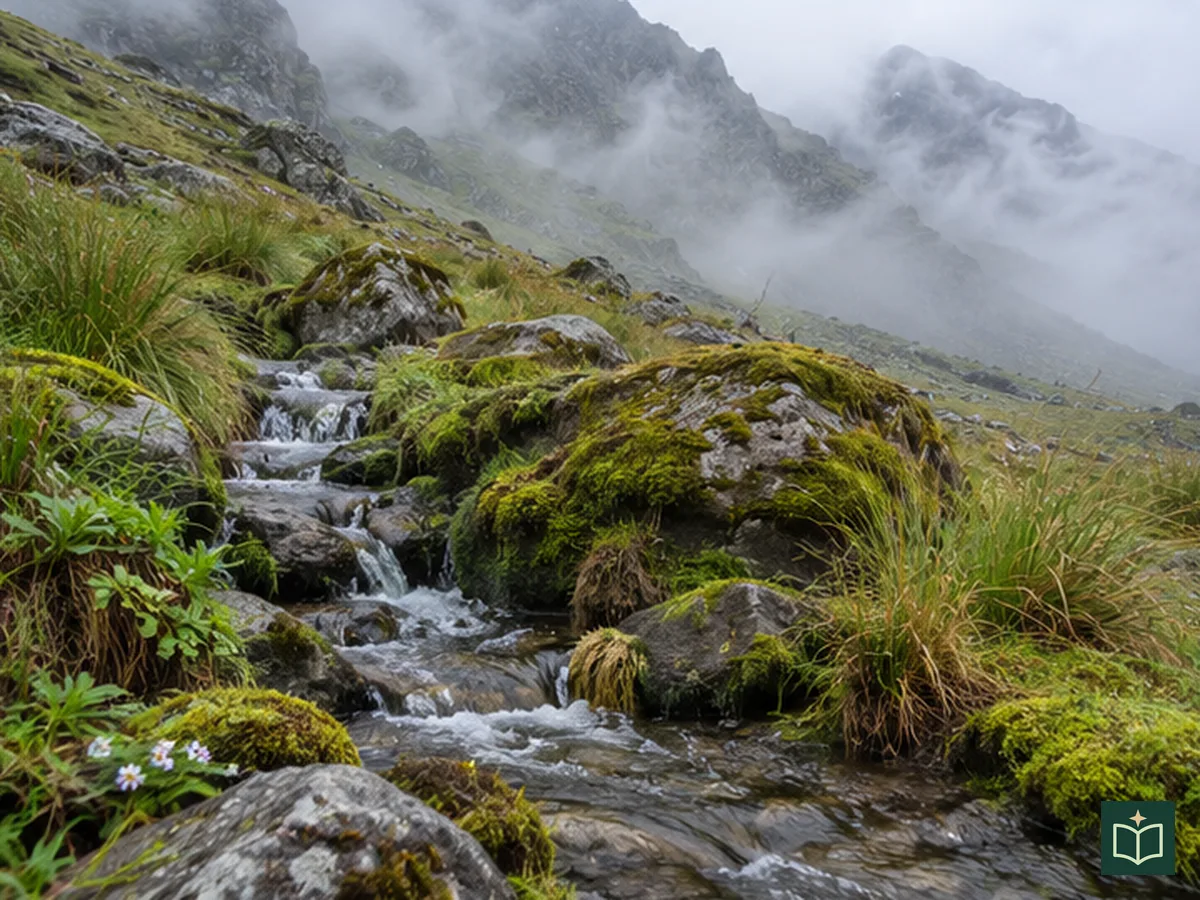
In practice, sources often reflect cultural meaning as much as measurement. In India, the Ganges is traditionally said to begin at Gaumukh, the snout of the Gangotri Glacier, where the Bhagirathi River emerges. Hydrologically, the Alaknanda, which joins it at Devprayag, is longer and carries more water, but the Bhagirathi holds religious significance. Many rivers also have seasonal headwaters that dry up in summer, so their length changes through the year. In Arabia, wadis lack permanent sources entirely, flowing only after storms. A common misconception is that a river begins at a single dramatic spring. Usually, it begins as a scatter of trickles across a wide upland.
Why sources still matter
Defining a river's source is not only a matter of record books. Headwater areas are where much of a river's water and sediment originate, and they are often fragile: mountain springs, wetlands and glaciers. Protecting them helps secure water supplies far downstream. Agreements between countries that share rivers, such as those along the Nile, depend on understanding where water comes from and how much each tributary contributes. Satellite mapping, GPS and digital elevation models now let scientists trace channels more precisely than ever, revising old figures. Yet the core lesson remains: every great river begins as many small streams, and which one gets the title is partly a human choice.
Sources & further reading
- Britannica · Nile River ↗
- Britannica · Amazon River ↗
- USGS · Water Science School: rivers and streams ↗
Figures are rounded and widely published; check the linked organisations for the latest editions. These organisations do not endorse this website.