A story from the fog
Percy Shaw, a road contractor from Halifax in northern England, is said to have been inspired when his headlights reflected in a cat's eyes on a dark night. In 1934 he patented a road stud with glass reflectors set in a rubber dome inside a cast-iron base. The design became famous during wartime blackouts.
Retroreflection
Unlike a mirror, a retroreflector sends light straight back the way it came. Cat's eyes use glass lenses with a reflective backing; many modern studs use plastic prisms shaped like the corner of a cube. Drivers therefore see a bright point of light even from far away with dipped headlights.
Self-cleaning design
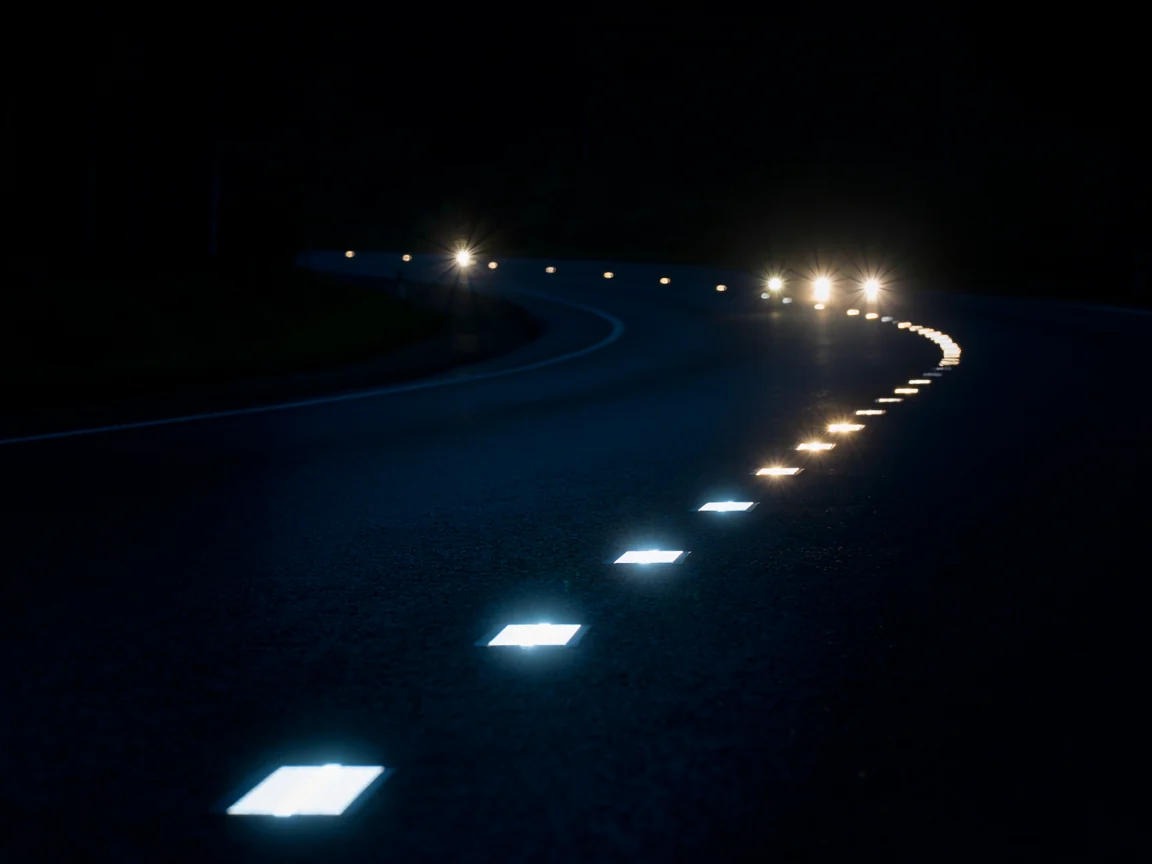
In Shaw's design, the rubber dome is pushed down when a vehicle drives over it, and rubber wipers clean the glass lenses. Rainwater collected in the base helps wash them. Modern studs come in many forms, from simple stick-on markers to solar-powered LED studs that glow on their own.
A colour code
In the UK, white studs mark lane lines, red mark the left edge, amber the edge of the central reservation, and green show junctions and lay-bys. Other countries use different systems, but the principle is the same: give drivers a clear outline of the road in darkness, rain and fog.
Sources & further reading
Colour schemes vary between countries. Photograph: original AI-generated illustration (Adobe Firefly). Reference organisations do not endorse this website.