A typewriter that scrambles
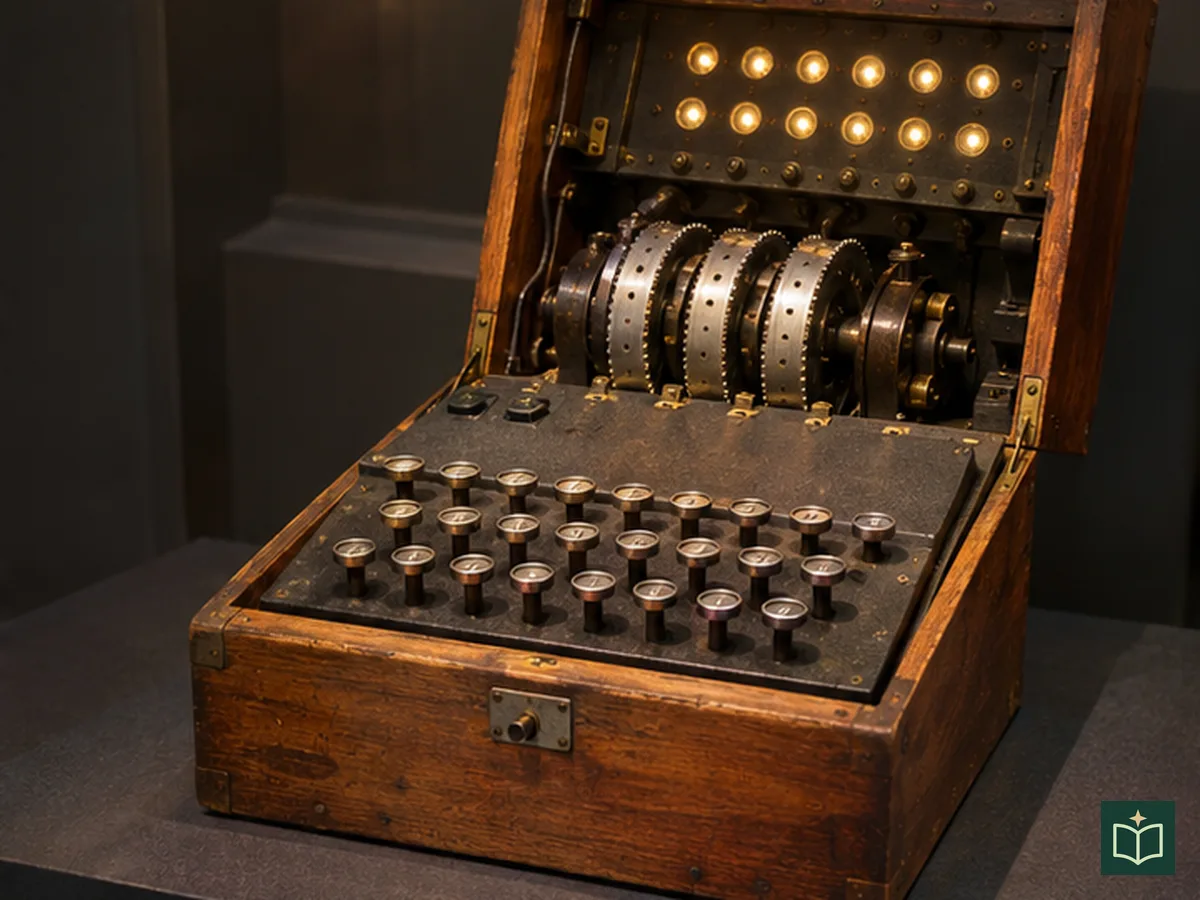
Enigma was an electromechanical cipher machine adopted by the German armed forces between the world wars. It looked like a typewriter in a wooden box. Pressing a key sent an electric current through a plugboard, then through three rotors, each wired to swap letters, then into a reflector that sent the current back through the rotors by another path. A lamp lit up showing the encrypted letter. Crucially, the right-hand rotor stepped forward with each key press, and the others turned over at intervals, so typing the same letter repeatedly produced a different result each time. The receiving operator, with the same daily settings, typed the ciphertext and read off the original.
Why it looked unbreakable
The number of possible settings was enormous. For the army version, operators chose three rotors from a set of five and put them in order, giving 60 arrangements. Each rotor could start at any of 26 positions, giving 17,576 combinations. The plugboard, with ten cables swapping pairs of letters, added about 151 million million possibilities. Multiplied together, that comes to roughly 159 million million million daily settings, about 1.6 × 10²⁰. Checking them one by one by hand was impossible. The navy later added a fourth rotor, multiplying the difficulty further. German planners reasonably believed that, without the daily key sheets, nobody could read the traffic in time for it to matter.
The Polish breakthrough
The first great breaks came not in Britain but in Poland. In 1932 the mathematician Marian Rejewski, working for the Polish Cipher Bureau, used group theory and some documents obtained by French intelligence to reconstruct the wiring of the military rotors. With colleagues Jerzy Różycki and Henryk Zygalski, he developed methods and machines to recover daily keys. As the Germans tightened procedures, the work became harder. In July 1939, weeks before the invasion of Poland, the Poles shared their reconstructed machines and methods with British and French intelligence. That gift gave Bletchley Park, the British codebreaking centre in Buckinghamshire, a head start it could not otherwise have had.
Bletchley’s bombes
At Bletchley, Alan Turing and Gordon Welchman designed an electromechanical machine called the bombe, the first entering service in 1940. It relied on cribs: guesses about words in a message, such as weather reports or standard formal phrases. Enigma had a structural flaw, because the reflector meant no letter could ever be encrypted as itself, which helped codebreakers position a crib correctly. The bombe then raced through rotor orders and positions, rejecting any that led to a logical contradiction with the crib. Surviving settings were tested by hand. Captures of codebooks and machine parts from ships and submarines, at considerable risk, helped break the harder naval keys.
A factory of intelligence
By the end of the war Bletchley Park and its outstations employed about 10,000 people, roughly three-quarters of them women. They operated bombes, sorted intercepts, translated and analysed messages, and passed intelligence, given the cover name Ultra, to commanders under strict rules to hide its source. Intercepts collected by radio listening stations arrived around the clock. Historians generally credit this work with helping to win the Battle of the Atlantic against German submarines and with shortening the war, although by how much is debated. The staff were sworn to secrecy, and the full story only began to emerge in the 1970s, decades after the events it described.
Myths and legacy
A common misconception is that Colossus, the famous electronic computer built at Bletchley, broke Enigma. In fact Colossus, operational from early 1944, attacked a different German cipher, the Lorenz teleprinter system used by high command. Another myth is that one person cracked the code; the effort depended on Polish groundwork, many mathematicians and engineers, and thousands of operators. The lessons endure. Strong mathematics is not enough if a system has structural shortcuts or users follow predictable habits. Modern encryption is designed so that knowing how it works does not help an attacker, and only the secret key matters. Bletchley Park is now a museum telling this story.
Sources & further reading
Figures are rounded and widely published; check the linked organisations for the latest editions. These organisations do not endorse this website.