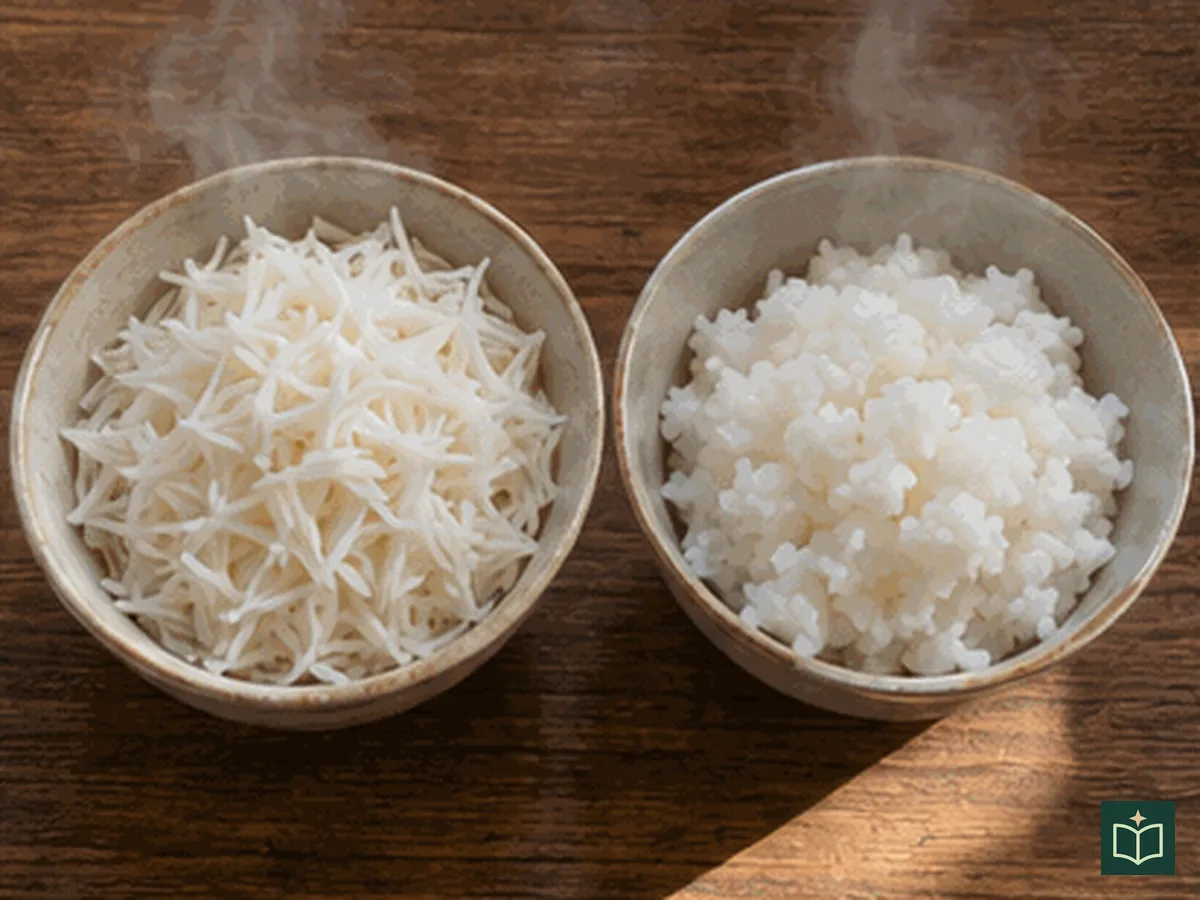
Two fragrant long grains
Basmati and jasmine are the two best-known aromatic rices, and both belong to the same species, Oryza sativa. Raw, they can look similar: long, slim, translucent grains. Cooked, they behave very differently. Basmati grains stretch lengthways, stay firm and fall apart from one another, so a spoonful of well-cooked basmati looks like a pile of separate needles. Jasmine grains swell, soften and cling lightly together, giving a moist, tender mouthful that is easy to pick up with chopsticks or a spoon. Their names also hint at origin. Basmati is often translated from Hindi as 'full of fragrance', while jasmine rice, known in Thailand as Hom Mali, is named for its white colour as much as its scent.
Where each grows
True basmati comes from the Indo-Gangetic plains at the foot of the Himalayas, in northern India and the Punjab region of Pakistan. Both countries protect the name with geographical indication rules, much as Champagne is protected in Europe. Basmati is often aged for months or even a year after harvest, which dries the grains and helps them cook up fluffier and more separate. Jasmine rice is grown mainly in Thailand, especially in the north-east, and also in Cambodia, Laos and Vietnam. It is usually sold and eaten fresh, within a year of harvest, when its fragrance is strongest. New-crop jasmine is prized, while new-crop basmati can cook up sticky.
The chemistry of texture
The main reason for the difference is starch. Rice starch comes in two forms: amylose, a long straight chain, and amylopectin, a branched one. Amylose resists swelling and sets firm as rice cools, keeping grains distinct. Amylopectin absorbs water readily and turns soft and sticky. Basmati typically contains around a fifth to a quarter of its starch as amylose, while jasmine contains noticeably less. Basmati grains also elongate dramatically, often nearly doubling in length, while widening little. The two rices share an aroma compound, 2-acetyl-1-pyrroline, also found in pandan leaves and freshly baked bread. Its strength, and the other volatile compounds alongside it, give each rice its own scent.
Why the Gulf chose basmati
In the UAE, Saudi Arabia and across the Gulf, basmati is the everyday rice for biryani, machboos, kabsa and mandi. These dishes cook rice with spiced stock, meat or fish, and the grains need to absorb flavour without collapsing into a paste. Long-standing trade across the Arabian Sea also played a part, linking Gulf ports with the rice-growing regions of India and Pakistan for centuries. Today Gulf countries are among the largest buyers of Indian and Pakistani basmati, and supermarket shelves carry many grades, from premium aged long grain to cheaper broken or sella varieties. Sella, or parboiled, basmati is partly cooked in the husk, which firms the grain further for long-simmered dishes.
Cooking each well
Because of their different starches, the two rices are cooked differently. Basmati benefits from rinsing to remove surface starch and often from soaking for 20 to 30 minutes, which helps the grains lengthen without breaking. It is then boiled in plenty of water and drained, or steamed with a measured amount of liquid. Jasmine is usually rinsed lightly, not soaked, and cooked by the absorption method with a little less water than basmati, often in a rice cooker. Its slight stickiness suits Thai curries, stir-fries and dishes eaten from a shared bowl. Swapping one for the other is possible, but a jasmine biryani will be softer and clumpier than tradition expects.
Nutrition and misconceptions
Nutritionally, white basmati and white jasmine are similar in calories and protein. One measurable difference is how quickly they raise blood sugar. Basmati's higher amylose makes it digest more slowly, so it generally has a lower glycaemic index than jasmine, which tends to rank high. Portion size and what the rice is eaten with matter more than the variety, however, and brown versions of both add fibre. A common misconception is that any long-grain rice is basmati; much 'long-grain' rice is a different, less aromatic type. Another is that jasmine is sticky rice. True glutinous rice, used in mango sticky rice, is a separate kind with almost no amylose at all.
Sources & further reading
Figures are rounded and widely published; check the linked organisations for the latest editions. These organisations do not endorse this website.