Similar at a glance
Falcons and hawks are both birds of prey with hooked beaks, sharp talons and superb eyesight, and in everyday speech the words are often swapped. In English the word hawk is sometimes used loosely for any small or medium raptor. Biologists draw a clear line. True hawks belong to the family Accipitridae, which also includes eagles, kites, harriers and Old World vultures. Falcons belong to a separate family, Falconidae, alongside kestrels, hobbies and caracaras. Once you know what to look for, the two groups are easy to tell apart in the sky. Their differences in shape and behaviour reflect two distinct ways of catching prey, refined over millions of years of separate evolution.
Wings built for different jobs
A falcon's wings are long, narrow and pointed, like a swept-back jet. They allow fast, efficient flight and powerful dives over open country, desert and sea. Their tails are relatively short. A hawk's wings are broader and rounder, often with separated primary feathers at the tips that look like fingers, and its tail is long. That shape trades top speed for agility. Hawks of the genus Accipiter, such as the sparrowhawk and goshawk, can twist through branches and swerve around obstacles in woodland. Buzzards, which Americans often call hawks, have broad wings for soaring on rising warm air. In silhouette, the falcon is a blade and the hawk a paddle.
Different ways to kill
The two groups also finish their prey differently. Hawks rely on their feet. Their strong, often long toes and talons grip and squeeze, and the prey is usually killed by the pressure. Falcons tend to strike or grab prey in flight, often after a fast chase or a steep dive called a stoop, and then kill it with a bite to the neck. Their upper beak carries a sharp notch, the tomial tooth, which helps sever the spine. Falcons usually have dark eyes and many show a dark 'moustache' stripe below the eye. Many hawks have yellow, orange or red eyes as adults. These small details help birdwatchers and falconers confirm what they see.
A surprising family tree
For most of the twentieth century, falcons and hawks were grouped together in one order because they look and behave alike. Large genetic studies published from 2008 onwards overturned that view. They showed that falcons are more closely related to parrots and songbirds than to hawks and eagles. The resemblance is a case of convergent evolution: two unrelated lines developing similar tools, such as hooked beaks and talons, because they solve the same problem of catching and eating animals. Taxonomists now place falcons in their own order, Falconiformes, while hawks and eagles sit in Accipitriformes. The split shows how appearance can mislead, and how DNA evidence has redrawn the bird family tree.
Why Arabia prized the falcon
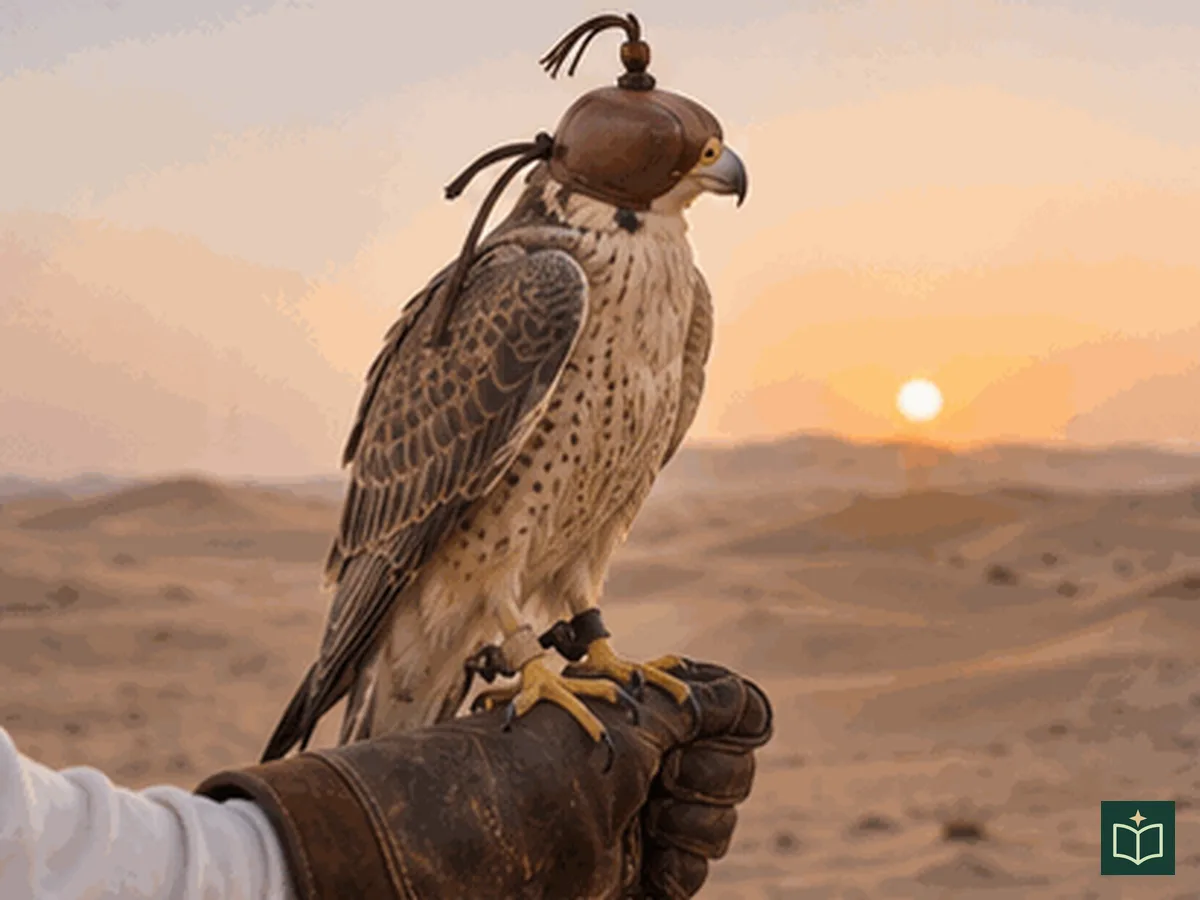
In the Arabian Peninsula, falconry developed as a way to hunt houbara bustards, hares and other game across open desert, where a fast, long-winged bird excels. Bedouin hunters traditionally trapped wild falcons on migration, trained them over the winter and often released them in spring. The saker falcon and the peregrine are the classic species, and gyrfalcons and hybrids are now common. A hawk, built for woodland ambush, would be at a disadvantage on wide, treeless plains. The UAE today issues falcon passports, runs specialised falcon hospitals and hosts falconry competitions. In 2010 falconry was inscribed on UNESCO's list of intangible cultural heritage in a nomination led by the UAE.
Hawks in falconry elsewhere
Falconry is not only about falcons. In Europe, North America and Japan, falconers have long flown hawks, especially the goshawk, sometimes called the cook's bird for the rabbits and pheasants it brought home. The Harris's hawk, from the Americas, has become popular with beginners because it is sociable and can hunt in groups. Hawks suit wooded and enclosed country, where short, explosive chases matter more than long flights. Many traditions therefore distinguish long-winged birds flown in open country from short-winged birds flown near cover. The choice of bird reflects landscape and quarry. In the open sands of Arabia, the falcon's speed and stoop made it the natural partner.
Sources & further reading
Figures are rounded and widely published; check the linked organisations for the latest editions. These organisations do not endorse this website.