The smallest piece of an element
An atom is the smallest unit of a chemical element that still behaves as that element. At its centre sits a tiny, dense nucleus of protons and neutrons, surrounded by electrons that occupy most of the atom's volume. The number of protons, called the atomic number, decides which element it is: one proton makes hydrogen, six make carbon, eight make oxygen. Atoms are extraordinarily small. A typical atom is around a tenth of a nanometre across, so a line of about ten million of them would span a single millimetre. There are 118 known elements, and so 118 basic kinds of atom, from which every material on Earth is assembled.
When atoms join hands
A molecule forms when two or more atoms bond by sharing pairs of electrons, a link chemists call a covalent bond. The shared electrons hold the atoms at fixed distances and angles, so a molecule has a definite shape and formula. It then behaves as a single particle: it moves, collides and reacts as a unit. The atoms in a molecule can be of the same element or different elements. Two oxygen atoms bonded together make an oxygen molecule, O₂. One carbon and two oxygen atoms make carbon dioxide, CO₂. Molecules range from these simple pairs and trios to proteins and DNA containing many thousands, even millions, of atoms.
Water, oxygen and the air we breathe
Water is the textbook example. Each molecule contains one oxygen atom bonded to two hydrogen atoms, set at an angle of about 104.5 degrees, which makes the molecule slightly bent. That shape gives water many of its unusual properties, including its high boiling point for such a small molecule. Oxygen shows why the words can overlap. The oxygen in the air is not loose atoms but O₂ molecules, pairs of atoms bonded together. High in the atmosphere, ultraviolet light splits some of them into single atoms, which join other O₂ molecules to form ozone, O₃. The same element can therefore exist as atoms, as two-atom molecules or as three-atom molecules.
Salt: a crystal, not a molecule
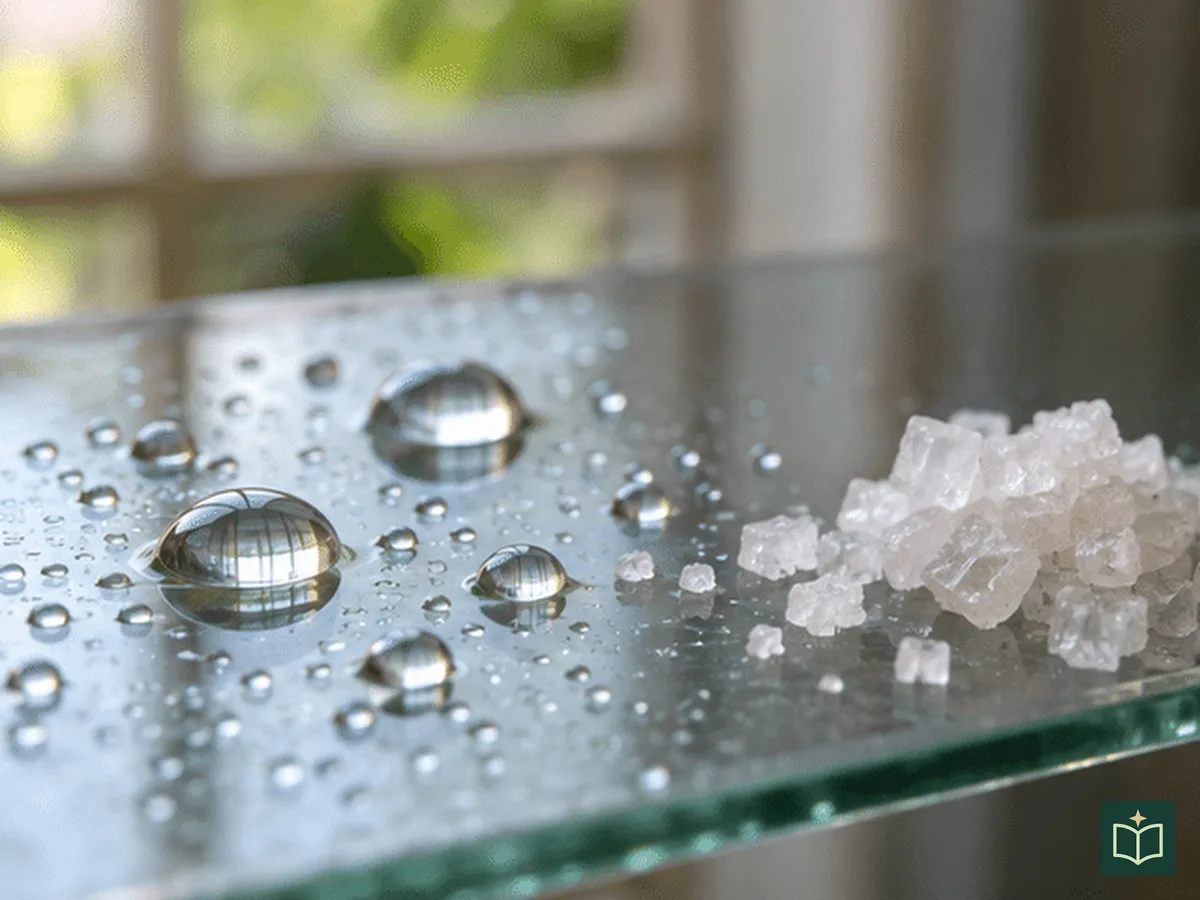
Table salt, sodium chloride, is often written NaCl, but it contains no molecules in the strict sense. Sodium gives up an electron to chlorine instead of sharing it, producing charged particles called ions. These ions do not pair off into separate units. Instead, each sodium ion is surrounded by six chloride ions and each chloride by six sodium ions, in a repeating cubic lattice that extends through the whole crystal. The formula NaCl describes the ratio of ions, one to one, not a discrete particle. Chemists call this a formula unit. Metals, diamond and quartz are also giant structures, held together throughout rather than divided into individual molecules.
From Dalton to modern imaging
The idea of indivisible particles goes back to Greek thinkers such as Democritus, but it became science only in the early nineteenth century. John Dalton argued that each element has its own kind of atom and that compounds form when atoms combine in fixed, simple ratios. Amedeo Avogadro then suggested that gases such as oxygen are made of molecules containing more than one atom, an idea largely ignored for decades until it resolved confusing results about the weights of gases. In the twentieth century physicists showed that atoms themselves have parts. Today, specialised microscopes can image individual atoms on a surface and even the bonds within a single molecule.
Why the distinction matters
Getting the words right helps explain everyday chemistry. When water boils, the molecules separate from one another, but each H₂O stays intact, which is why steam is still water. When hydrogen burns, by contrast, the bonds inside the molecules break and the atoms rearrange into new molecules, a chemical change. Medicines are designed molecule by molecule, because a drug's shape decides which proteins in the body it can fit. The common shortcut of calling every tiny particle an atom hides these differences. A useful rule of thumb: atoms are the letters of chemistry, molecules are words with fixed spellings, and crystals like salt are patterns repeated across a page.
Sources & further reading
Figures are rounded and widely published; check the linked organisations for the latest editions. These organisations do not endorse this website.