Read the coat first
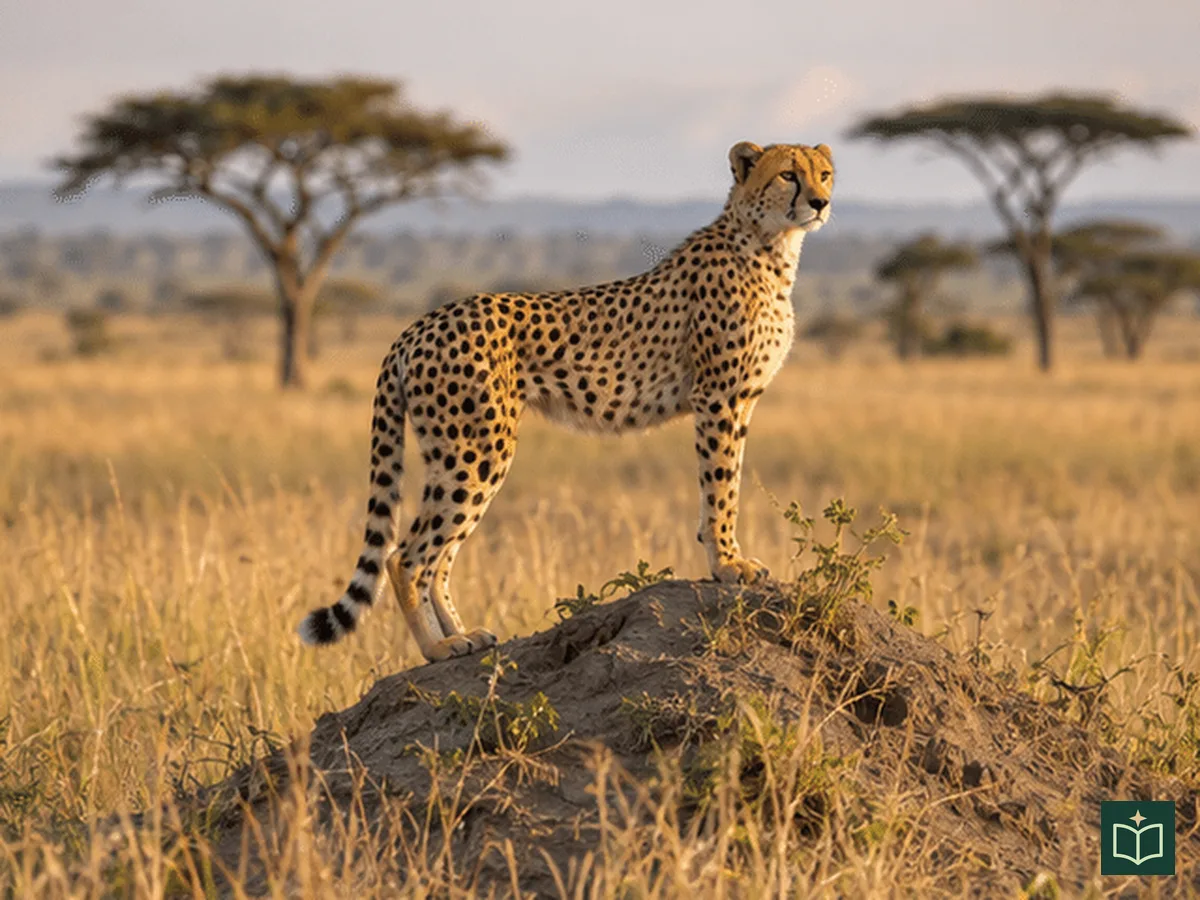
The quickest way to separate the three is to look closely at the markings. A cheetah's coat is covered in solid black spots, round and evenly scattered, like ink dropped on paper. A leopard has rosettes: rings of small black marks around a centre slightly darker than the background, with no spot inside. A jaguar also has rosettes, but they are larger, more angular and often contain one or more small black dots in the middle. Cheetahs also have a black line, the tear mark, running from the inner corner of each eye down to the mouth. Black individuals, often called black panthers, occur among leopards and jaguars, though their rosettes still show faintly in good light.
Built for different jobs
Their bodies reflect their hunting methods. The cheetah is a sprinter: long thin legs, a deep chest, a small head and a long flattened tail that acts as a rudder in sharp turns. Its claws are only partly retractable, giving grip like running spikes. Adults usually weigh around 35 to 65 kg. The leopard is a climber and stalker, muscular and low-slung, with a broad head and strong shoulders. Males may weigh 60 kg or more. The jaguar is the heaviest of the three, a stocky, barrel-chested cat with short powerful legs and a massive head. Large males in parts of South America can exceed 100 kg, rivalling small lions.
Where each one lives
Geography settles many doubts. Wild jaguars live only in the Americas, from northern Mexico through Central America to northern Argentina, with the Amazon basin and the Pantanal wetlands as strongholds. Cheetahs survive mainly in eastern and southern Africa, with a tiny, critically endangered population in Iran. Leopards have the widest range of any wild cat, across much of sub-Saharan Africa and parts of Asia, from the Caucasus to Java. The Arabian leopard, a small subspecies once found in the mountains of the UAE, Oman, Yemen and Saudi Arabia, is critically endangered, with conservation breeding programmes in the region. A spotted cat photographed in Africa or Asia cannot be a jaguar.
Three ways to kill
Each cat has its own hunting style. A cheetah stalks to within close range of gazelles or impala, then sprints at speeds of about 100 km/h for a chase that typically lasts well under a minute, tripping the prey and suffocating it with a throat bite. Exhausted afterwards, it often loses its kill to lions and hyenas. A leopard ambushes, creeping close before pouncing, and often hauls its prey up a tree to keep it from scavengers. The jaguar has the strongest bite for its size of any big cat. It frequently kills by biting through the skull of capybara or deer, and can pierce the shells of river turtles and the hides of caimans.
Water, trees and open plains
Habitat and behaviour separate them further. Cheetahs favour open savanna and grassland, where their speed can be used, and they hunt mainly by day to avoid larger predators that are active at night. Leopards are adaptable, living in rainforest, mountains, scrub and even on the edges of cities, and they are largely nocturnal. Jaguars are strongly tied to water. They swim well, hunt along rivers and in flooded forests, and readily take fish, turtles and caimans. Unlike the others, the jaguar is the only big cat native to the Americas, and in many indigenous cultures it was a powerful symbol of rulers and the spirit world.
Why the confusion persists
Brand names, cartoons and loose language add to the mix-up. In everyday speech any spotted cat may be called a leopard, and the term panther is applied to black leopards, black jaguars and even the pumas of Florida. Zoo visitors often cannot place the cats side by side, which hides the differences in build. The distinction matters for conservation. All three are listed as threatened or near threatened in parts of their ranges, but the pressures differ: cheetahs need vast open spaces and suffer from conflict with farmers, leopards from poaching and habitat loss, and jaguars from deforestation in the Amazon. Telling them apart is the first step to protecting each.
Sources & further reading
Figures are rounded and widely published; check the linked organisations for the latest editions. These organisations do not endorse this website.