Why Go was the ultimate challenge
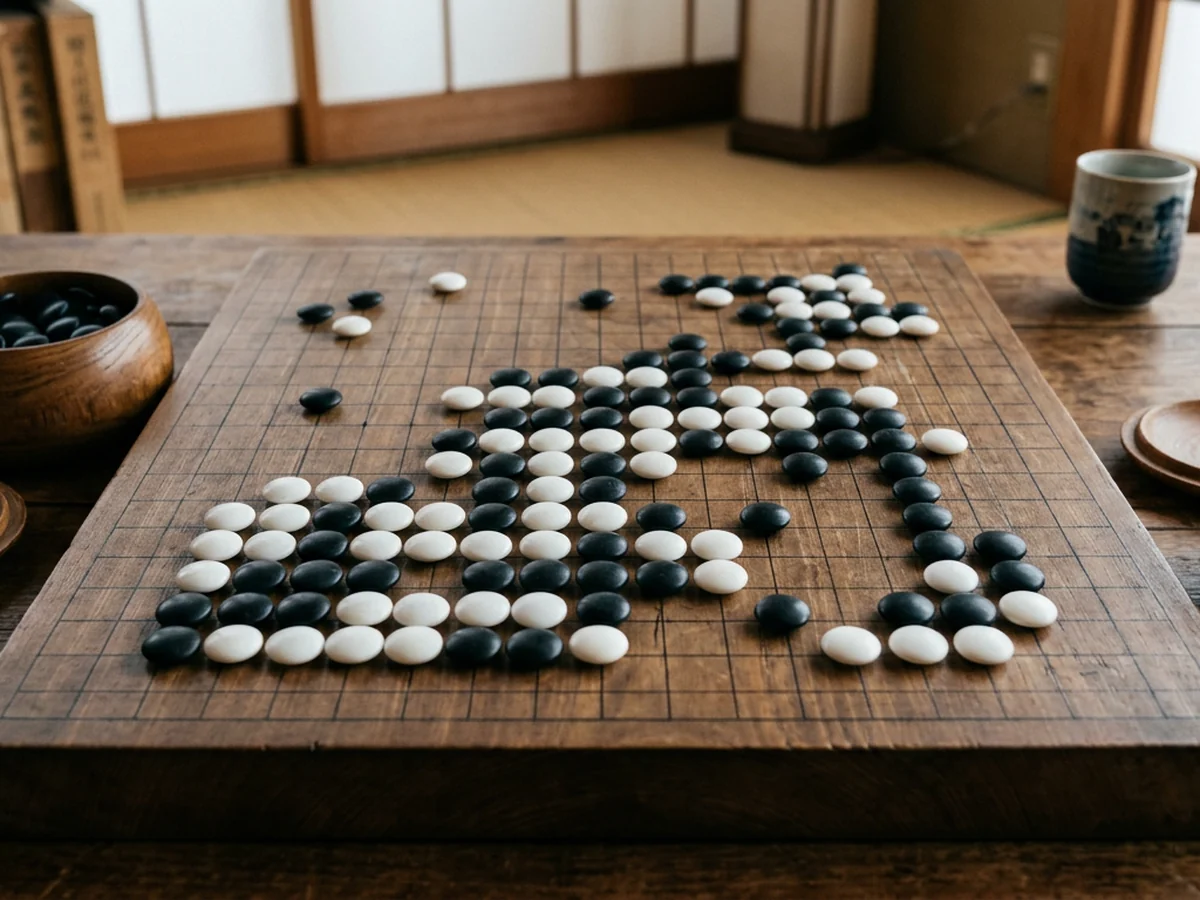
Go is an ancient board game from China, played on a 19-by-19 grid with black and white stones. Its rules are simple, but the number of possible positions is astronomically large, far greater than the number of atoms in the observable universe. After Deep Blue conquered chess in 1997, Go remained out of reach, because brute-force search could not cope and good moves often depend on subtle, intuitive judgements. Many experts believed a computer champion was at least a decade away.
How AlphaGo worked
DeepMind, a London AI company acquired by Google in 2014, combined deep neural networks with search. One network, the policy network, suggested promising moves; another, the value network, estimated who was winning from any position. AlphaGo first learned by studying around 30 million moves from expert human games, then improved through reinforcement learning, playing millions of games against versions of itself. During play, it used a search method called Monte Carlo tree search, guided by its networks.
The match in Seoul
In October 2015 AlphaGo quietly beat the European champion Fan Hui 5–0, the first time a computer had beaten a professional Go player on a full board without a handicap. The results were published in Nature in January 2016. Then, in March 2016, AlphaGo faced Lee Sedol, a South Korean holder of 18 world titles, in a five-game match in Seoul with a 1 million dollar prize. The match was broadcast live and followed by many millions of people, especially in East Asia.
Move 37
In the second game, on its 37th move, AlphaGo placed a stone on the fifth line from the edge, a move that commentators initially called a mistake because professionals almost never played there at that stage. AlphaGo's own estimate suggested that a human would have played it with a probability of about one in ten thousand. As the game unfolded, the move proved brilliant and decisive. Fan Hui, watching, called it beautiful. Move 37 became a symbol of AI producing genuinely new ideas.
Lee Sedol's reply
AlphaGo won the first three games, securing the match. In the fourth game Lee Sedol played his own extraordinary move, move 78, a wedge that AlphaGo had not anticipated, and the program faltered, losing its only game of the match. Lee's win was celebrated as a triumph of human creativity. AlphaGo won the fifth game to finish 4–1. In 2019 Lee Sedol retired from professional Go, saying that AI was an entity that could not be defeated.
Learning from scratch
DeepMind went further. In 2017 AlphaGo Master beat the world number one, Ke Jie, 3–0. Later that year AlphaGo Zero learned Go entirely by playing against itself, with no human games at all, and within days surpassed every previous version, beating the Lee Sedol version 100 games to none. AlphaZero then mastered chess and shogi the same way. These systems showed that reinforcement learning could discover knowledge beyond human experience.
A shock felt across Asia
Go has deep cultural roots in China, Korea and Japan, and AlphaGo's victory landed with particular force there. Within days of the match, the South Korean government announced roughly 1 trillion won, around 860 million US dollars, for AI research. In China, AlphaGo's later win over Ke Jie came shortly before the government published its New Generation Artificial Intelligence Development Plan in 2017, aiming for global AI leadership by 2030. Many analysts described the match as a wake-up call for national AI strategies.
How Go changed
Professional Go players studied AlphaGo's games and adopted its ideas, changing how the game is played at the highest level. AI training tools are now standard for professionals. Research published later suggested that human players' decision quality improved after the arrival of superhuman AI, partly because they began exploring more novel moves. As with chess, the game remains popular as a human contest, enriched rather than ended by machines.
From games to science
DeepMind saw games as a training ground for more useful problems. The same blend of neural networks, search and reinforcement learning fed into later work, including AlphaFold, which predicted protein structures and contributed to the 2024 Nobel Prize in Chemistry. AlphaGo's victory also helped convince investors, governments and the public that deep learning was a powerful general approach, contributing to the wave of AI investment that followed.
Sources & further reading
- Nature · Mastering the game of Go with deep neural networks and tree search (2016) ↗
- Google DeepMind · AlphaGo ↗
- Wikipedia · AlphaGo versus Lee Sedol ↗
Historical account. Photograph: original AI-generated illustration (Adobe Firefly). Reference organisations do not endorse this website.