What an astrolabe is
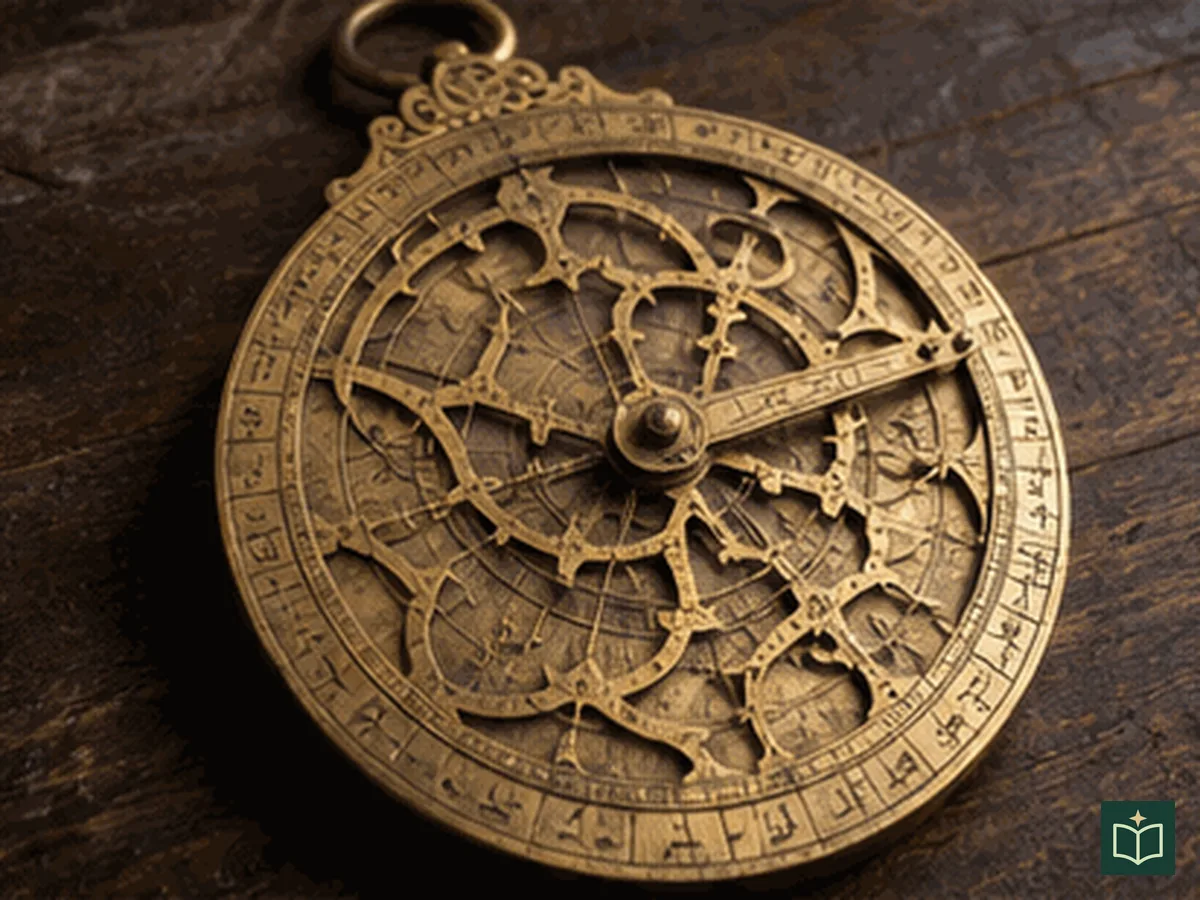
An astrolabe is a flat, usually brass instrument that models the sky. Its principle, a way of projecting a sphere onto a flat surface called stereographic projection, was known to Greek mathematicians, and the earliest surviving descriptions date from late antiquity. The instrument was developed much further in the Islamic world from the eighth century onwards, where it became the essential tool of astronomers, timekeepers and teachers. It spread to Europe through al-Andalus from the tenth and eleventh centuries. A typical astrolabe fits in two hands, though sizes ranged from pocket instruments to large ones for observatories. Many surviving examples are works of art as well as scientific tools.
The parts
The body, called the mater, is a thick disc with a raised rim marked in hours or degrees. Inside it sit one or more plates, each engraved with lines for a particular latitude: the horizon, circles of equal altitude and lines of direction. Over the plate turns the rete, an open metal framework that acts as a star map. Its pointers mark the positions of bright stars, and an off-centre ring shows the Sun's yearly path through the zodiac. On the back, a sighting rule with two small vanes, the alidade, pivots across a scale used for measuring angles. A pin and wedge, sometimes shaped like a horse, hold everything together.
Telling the time
To find the time, the user hangs the astrolabe from its ring so it falls vertical, then sights the Sun or a bright star through the alidade and reads its height above the horizon in degrees. Turning to the front, they rotate the rete until that star's pointer, or the Sun's position on the zodiac ring for that date, rests on the matching altitude circle of the plate. The rete now shows the sky as it actually is at that moment. A rule laid across the Sun's position points to the hour on the rim. The same setting shows which stars are rising or setting, and when dawn or nightfall will come.
Finding prayer times and qibla
In the Islamic world, the astrolabe served daily religious needs. The five daily prayers are set by the Sun's position, for example when shadows reach a certain length in the afternoon, and many astrolabes carried extra lines marking these times. Mosques employed timekeepers, called muwaqqits, who used astrolabes, quadrants and tables to announce prayer times precisely. Some instruments also helped determine the qibla, the direction of Makkah, by working out the angle between the local meridian and the direction to the city. Astronomers also used them to solve problems in spherical trigonometry, to cast horoscopes, to survey heights of buildings and wells, and to teach the structure of the heavens.
Makers and manuals
Skilled makers worked in Baghdad, Cairo, Damascus, Isfahan, Lahore and Toledo, often signing and dating their work. A woman instrument maker, Mariam al-Ijliya, worked for the ruler of Aleppo in the tenth century, one of the few named female makers of the period. Scholars wrote manuals describing how to build and use the instrument; the Persian polymath al-Biruni discussed many varieties. In Europe, Latin treatises followed, and in 1391 the English poet Geoffrey Chaucer wrote a guide to the astrolabe for a young boy. Museums including the History of Science Museum in Oxford and the National Maritime Museum in Greenwich hold large collections.
Limits and successors
The astrolabe was a calculator for positions, not a navigation device on rolling ships, where steady sightings were hard. Sailors later used a simplified mariner's astrolabe, a heavy open ring for measuring the Sun's altitude to find latitude, which is a different instrument. An astrolabe also only works accurately for the latitude its plate was made for, which is why travellers carried several plates. Over time, telescopes, printed tables, mechanical clocks and later sextants took over its tasks. Yet for about a thousand years it was one of the most important scientific instruments in the world, and the logic of its projection still underlies some modern map projections and planisphere star charts.
Sources & further reading
Figures are rounded and widely published; check the linked organisations for the latest editions. These organisations do not endorse this website.