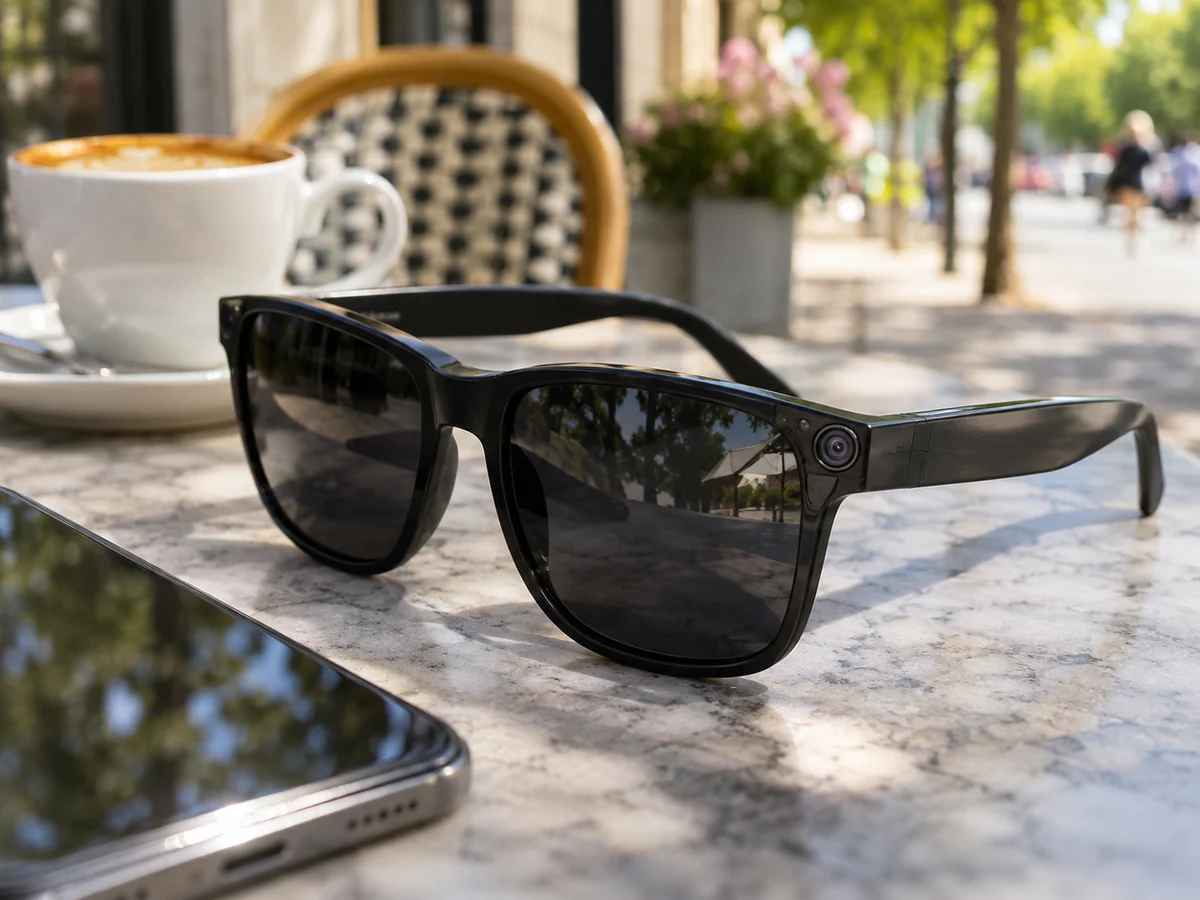
Glasses get smart
For years, smart glasses struggled. Google Glass, launched in 2013, attracted attention but was criticised for its looks, price and privacy concerns, and the consumer version was abandoned. A new generation of smart glasses looks much more like ordinary eyewear. Rather than trying to overlay complex graphics on the world, many focus on a camera, open-ear speakers, microphones and an AI assistant that can answer questions.
Meta and Ray-Ban
Meta partnered with EssilorLuxottica, the world's largest eyewear company and owner of the Ray-Ban and Oakley brands. Their first model, Ray-Ban Stories, launched in 2021. The improved Ray-Ban Meta glasses arrived in October 2023, adding Meta's AI assistant. Users can say a wake phrase and ask questions, take photos and videos, make calls, listen to music and share moments directly to social media, all without reaching for a phone.
Sales take off
In early 2025, EssilorLuxottica said Ray-Ban Meta glasses had sold 2 million units since their October 2023 launch. Then sales accelerated sharply. In its results for 2025, the company said it had sold more than 7 million AI glasses that year alone, more than triple its previous sales. New models launched in 2025 included a second generation of Ray-Ban Meta, sporty Oakley Meta models and a premium version with a display.
A screen in the lens
In September 2025, Meta launched the Meta Ray-Ban Display, priced at 799 dollars, with a small display in one lens that can show messages, directions, translations and answers from Meta AI. It is controlled partly with a wristband that detects subtle finger movements using signals from the muscles in the wrist. Such displays bring smart glasses closer to the long-held vision of augmented reality, overlaying digital information on the real world.
Seeing with AI
Multimodal AI, which can understand images as well as text and speech, makes glasses much more useful. Wearers can ask what they are looking at, such as identifying a landmark, reading a menu in another language, getting cooking help while looking at ingredients or asking for information about a product. Live translation can help people understand conversations in foreign languages. The glasses act like an assistant that shares your point of view.
Helping people who are blind
AI glasses can be particularly valuable for people who are blind or have low vision. Meta's glasses work with Be My Eyes, a service that connects users with sighted volunteers through video calls, and the built-in AI can describe surroundings, read text aloud and identify objects. Many blind users have described the hands-free experience as a significant improvement over holding up a phone, though AI descriptions are not always accurate.
Privacy concerns
The biggest concern is privacy. Glasses with cameras make it possible to photograph or film people discreetly in public places, shops, gyms or homes, without their knowledge. Meta's glasses include a small light that turns on when recording, but critics say it is easy to miss. In 2024, two university students demonstrated how such glasses could be combined with face recognition software to identify strangers, highlighting risks of misuse. Some venues ban camera glasses.
Rules and etiquette
Laws on recording people vary by country. In the UAE, privacy laws are strict, and photographing or filming people without their consent, or sharing such images, can be a criminal offence. Users of AI glasses need to be aware of local laws and respect others' privacy, for example by not recording in sensitive places. Businesses and public venues are also developing policies on smart glasses.
Competition grows
Meta dominates the market for now, accounting for the large majority of AI glasses shipped in 2025, according to market research firms. Competitors are preparing their own devices. Google and Samsung have announced glasses based on Google's Android XR platform with its Gemini AI, and Chinese companies such as Xiaomi, Alibaba and Rokid have launched AI glasses. Apple is also reported to be working on smart glasses.
Why it matters
AI glasses could become a new everyday way to use AI, always available and aware of what we see. They offer real benefits for convenience, translation and accessibility. But putting cameras and AI on people's faces raises important questions about privacy and consent for everyone around them. How companies, regulators and users answer those questions will decide whether AI glasses become as common as smartphones.
Sources & further reading
- UploadVR · Meta and EssilorLuxottica sold 7 million smart glasses in 2025 (2026) ↗
- Road to VR · Meta sold over 7 million smart glasses last year (2026) ↗
- Wikipedia · Ray-Ban Meta ↗
Respect local privacy laws when using camera glasses. Photograph: original AI-generated illustration (Adobe Firefly). Reference organisations do not endorse this website.