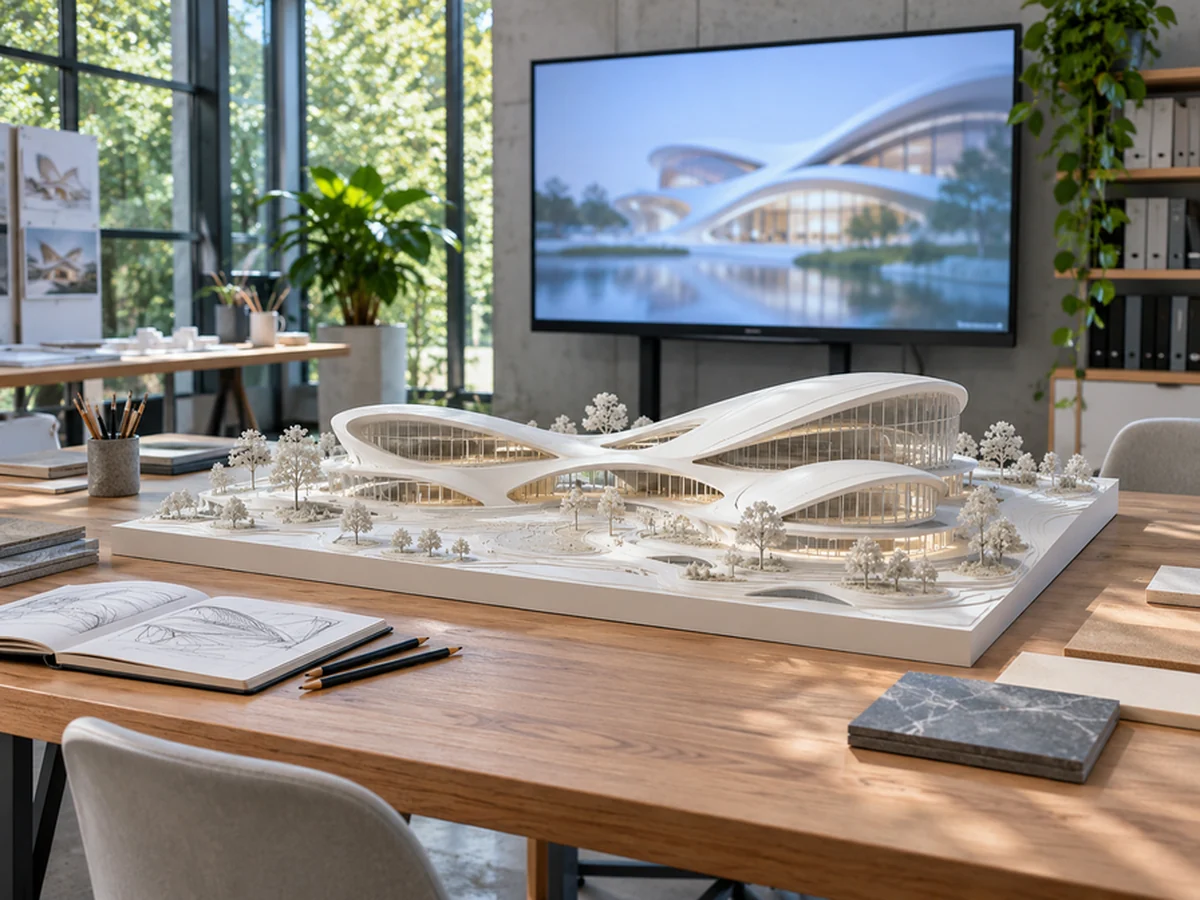
A profession of ideas
Architects spend much of their time exploring ideas: sketching options, testing how a building might look and work, and refining designs with clients. Early concept design can take weeks of drawings and models. Computers have helped architects for decades, through drawing software and 3D modelling. Generative AI and machine learning are now adding new capabilities, changing how designs are imagined and tested.
Image generators in the studio
AI image generators, such as Midjourney, DALL-E and Stable Diffusion, can produce striking architectural images from text descriptions in seconds. Architects use them to explore styles, materials, forms and atmospheres at the very start of a project, creating mood boards and visual ideas for clients. Some designers turn sketches, photos or even crumpled paper into building concepts, quickly generating options that would take far longer by hand.
Zaha Hadid Architects
In 2023, Patrik Schumacher, principal of Zaha Hadid Architects, the firm founded by the late Iraqi-British architect Zaha Hadid, said the studio was using AI image generators to develop ideas for most of its projects. He showed images of imaginary buildings created with prompts mentioning Zaha Hadid, which reproduced the firm's signature flowing forms. He said he felt empowered by the technology as a way of generating ideas quickly.
Surveys of the profession
The Royal Institute of British Architects, RIBA, surveys its members about AI. Its 2025 report found that the share of UK architecture practices using AI had risen from 41% in 2024 to 59% in 2025. Most architects expected AI to have a positive effect on productivity in construction, and 65% thought it would help the sector meet net-zero targets. A 2026 survey of leading international studios by the design magazine Dezeen found most were actively encouraging AI use.
Greener buildings
Beyond images, AI helps architects design better-performing buildings. Machine learning tools can quickly predict how a design will perform for energy use, daylight, heat gain, natural ventilation and comfort, allowing architects to compare many options early in the process. This is especially valuable in hot climates such as the Gulf, where shading, orientation and materials strongly affect how much energy buildings need for cooling.
Generative design
Generative design software uses algorithms to explore thousands of possible layouts or structures based on goals and constraints set by designers, such as maximising daylight, minimising material use or fitting a certain number of apartments on a site. Engineers use similar tools to design lighter, stronger structures. The designer then evaluates and selects among the options, combining computational exploration with human judgement.
Practical tasks
AI is also helping with less glamorous tasks that take up much of architects' time, such as writing reports, checking drawings against building regulations, producing specifications, managing documents and answering questions about projects. Many large firms, including Foster + Partners and Heatherwick Studio, have developed their own AI tools and policies. Architects say these tools can free up time for creative and client-focused work.
Concerns about imitation
Many architects worry about AI's effects on creativity and intellectual property. In RIBA's 2025 survey, 67% had concerns that AI would increase the risk of their work being imitated. Image generators are trained on vast numbers of images, including architects' designs, often without permission. There are also concerns that AI could make designs more uniform, or that clients might expect cheaper, faster work, putting pressure on fees and jobs.
Responsibility stays human
Buildings must be safe, legal, buildable and suitable for the people who use them, and architects carry professional responsibility for their designs. AI-generated images may look impressive but ignore structure, budgets, regulations and local context. Professional bodies stress that architects must check AI outputs carefully, protect client data and remain accountable. AI is a tool for exploration and efficiency, not a substitute for expertise.
Why it matters
Architecture shapes cities, homes and the environment for generations. AI could help architects explore more ideas, design buildings that use less energy and respond better to people's needs, while saving time on routine work. In fast-growing regions like the Gulf, with ambitious building projects and extreme climates, using AI wisely could make a real difference to how sustainable and liveable cities become.
Sources & further reading
- RIBA · Second RIBA AI Report shows surge in usage among UK architects (2025) ↗
- Dezeen · ZHA developing most projects using AI-generated images, says Patrik Schumacher (2023) ↗
- Dezeen · Architecture studios encouraging AI (2026) ↗
Survey figures are as reported by RIBA and Dezeen. Photograph: original AI-generated illustration (Adobe Firefly). Reference organisations do not endorse this website.