The world's first writing
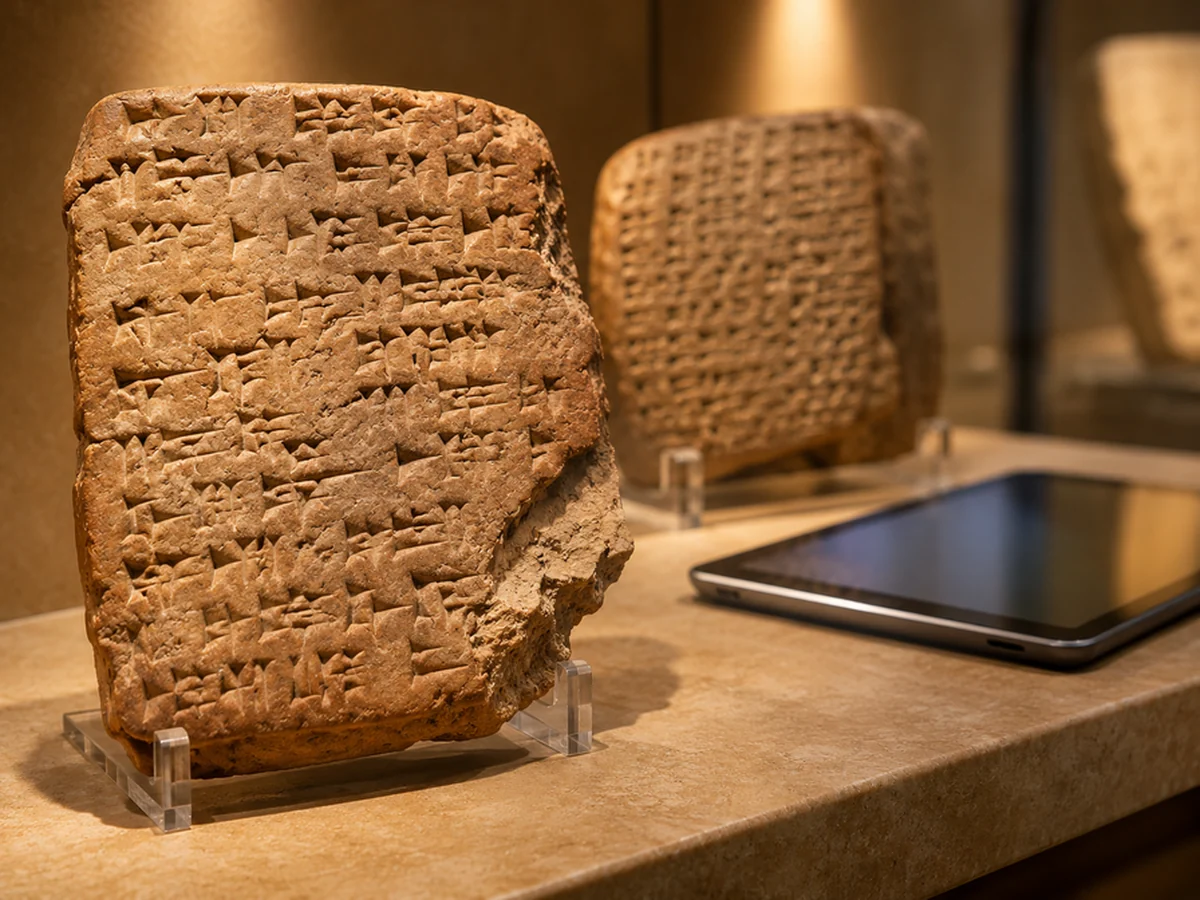
More than 5,000 years ago, in Mesopotamia, the land between the Tigris and Euphrates rivers in what is now Iraq, people developed one of the world's first writing systems. Scribes pressed a reed stylus into wet clay to make wedge-shaped marks, giving the script its name, cuneiform, from the Latin word for wedge. Cuneiform was used for about 3,000 years to write several languages, including Sumerian and Akkadian.
A vast archive
Because clay tablets are durable, especially when baked, an enormous number have survived. Archaeologists have found hundreds of thousands of tablets, and museums, libraries and universities hold more than half a million. They record everything from laws, contracts and letters to mathematics, astronomy, medicine and literature, including the Epic of Gilgamesh. Together, they offer an extraordinarily detailed picture of daily life in the ancient Middle East.
Too few readers
Reading cuneiform is extremely difficult. The script has hundreds of signs, each with several possible meanings and sounds, and its languages are long dead. Only a few hundred specialists, known as Assyriologists, can read Akkadian well. As a result, many tablets have never been translated or published, and the backlog grows as excavations continue. Scholars estimate it could take generations to read everything already found.
A translation model
In May 2023, a team of archaeologists and computer scientists from Tel Aviv University and Ariel University in Israel published research in the journal PNAS Nexus describing a neural machine translation model for Akkadian, the same type of technology used in tools such as Google Translate. The model was trained on texts from the Open Richly Annotated Cuneiform Corpus, an online database of cuneiform texts with existing translations.
Two versions
The researchers created two versions of the model. One translates Akkadian from transliterations, in which cuneiform signs are written in Latin letters, into English. The other translates directly from Unicode cuneiform, a digital representation of the original signs. The model performed best on formal texts, such as royal decrees and administrative records, which follow predictable patterns, and less well on literary and poetic texts.
Useful but imperfect
The translations were not perfect. In some sentences, the model produced hallucinations, output that read as correct English but did not match the meaning of the Akkadian. In most cases, however, the translations were usable as a first draft. The researchers proposed a human-machine collaboration, in which scholars correct and refine the AI's output, and the corrections are used to improve the model further over time.
Piecing fragments together
Many tablets survive only as broken fragments scattered across different museums. AI is also helping scholars match these pieces. Projects such as the Electronic Babylonian Library at Ludwig Maximilian University of Munich use computer methods to identify fragments that belong to the same text, and researchers have reported finding new pieces of famous works, including the Epic of Gilgamesh, in this way. Other AI tools help recognise signs in photographs of tablets.
A heritage of the region
Mesopotamian civilisation is part of the heritage of the Middle East, including Iraq and the wider Arab world. Its inventions include not only writing, but also early mathematics, astronomy and law codes, such as the Code of Hammurabi. Making these texts more accessible could help people in the region and worldwide learn about this history. Similar AI methods are also being applied to historical Arabic manuscripts and other ancient scripts.
Limits and cautions
Experts caution that AI translations of ancient texts must be treated carefully. Ancient languages have limited training data, meanings can depend on context and cultural knowledge, and errors could mislead people who cannot check the original. Scholars stress that AI is a tool to speed up their work, not a replacement for expertise. The quality of translations depends heavily on the quality of the digital transcriptions they start from.
Why it matters
Much of humanity's earliest written history remains unread, waiting in museum storerooms. AI could help scholars translate and study these texts far faster, revealing new knowledge about how people lived, worked, believed and governed thousands of years ago. It is a striking example of the newest technology helping us understand the oldest writing, bringing the voices of ancient Mesopotamia back to life.
Sources & further reading
- PNAS Nexus · Translating Akkadian to English with neural machine translation (Gutherz et al., 2023) ↗
- EurekAlert! · Machine translation for cuneiform tablets (2023) ↗
- Wikipedia · Cuneiform ↗
AI translations of ancient texts should be checked by specialists. Photograph: original AI-generated illustration (Adobe Firefly). Reference organisations do not endorse this website.