The cloud is competing for the grid.
The next contest in artificial intelligence runs through substations, power contracts and the communities around them.
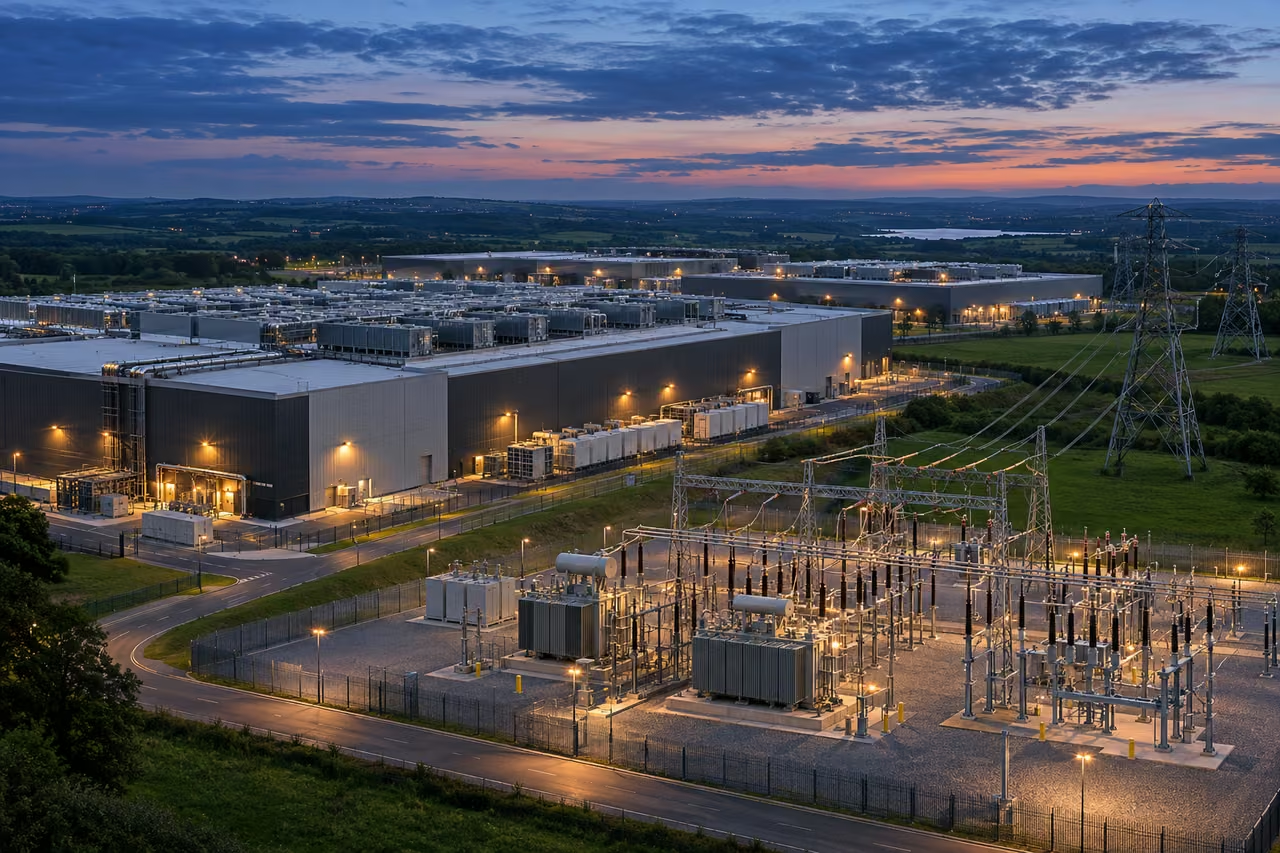
Conceptual AI illustration; not a documentary photograph.
Evidence: IEA April 2026 demand outlook · October 2026 policy assessment
The IEA’s October 2026 report puts data centres at the intersection of economic security and local electricity policy. Investment can move faster than the networks needed to connect it.
- 01
Request capacity
A data centre asks for a connection at a particular place. A global electricity total cannot reveal whether that local network has spare capacity.
- 02
Build or adapt
Generation, transmission, transformers and operational flexibility must support the new load. A server installation and a power-system expansion follow different timetables.
- 03
Allocate the risk
Contracts and network charges decide who funds upgrades, and who pays if a proposed facility uses less power than expected.
Global data-centre electricity consumption
- 2025 · estimate485TWh per year
- 2030 · projection950TWh per year
IEA April 2026 central projection. Includes all data centres, not only AI. The second bar is an outlook, not an observed result.
Evidence period: IEA April 2026 demand outlook · October 2026 policy assessment · Source details below
A projection, not a meter reading
The IEA’s April 2026 central outlook puts global data-centre electricity use at about 950 TWh in 2030, compared with 485 TWh in 2025. These totals cover data centres generally, not AI alone. The future figure is a scenario-dependent projection; financing, equipment constraints, utilisation and efficiency can change the outcome. It should never be labelled as consumption already observed.
Why local bills are not predetermined
The October IEA report explains that a new large customer can raise other consumers’ bills when its infrastructure costs are spread across them. Alternatively, fuller use of existing infrastructure, with appropriate cost recovery, can ease pressure on bills. The relevant question is therefore not simply whether a data centre arrives, but what capacity it requires and how the connection is priced.
From national ambition to a local agreement
Our reading is that digital sovereignty has a physical address. A government may want domestic computing capacity, while a community wants reliable power and fair treatment. Those ambitions need not be incompatible. A serious project assessment asks for the connection schedule, cost commitments, water and energy plans, and the conditions under which demand can be adjusted. Promised investment alone answers none of those questions.
Better questions.
A clearer picture.
- How many proposed megawatts have firm connection agreements?
- Who pays if a project is cancelled or uses less capacity?
- Are energy and water impacts assessed together?
Sources & dates.
- IEA · Key Questions on Energy and AI, executive summary
Published: 16 April 2026
Evidence period: 2025 estimated electricity use and 2030 central projection - IEA · Powering Artificial Intelligence, executive summary
Published: 14 October 2026
Evidence period: 2026 policy and regulatory assessment
Checked 15 November 2026. Conditions can change after publication. These organisations do not endorse Canvas of Knowledge.