
Why buildings sway
and how we calm them.
Every building moves. Wind, traffic and earthquakes make it shake.
Here is how engineers study that movement, and how they tame it.

A building that shakes too much can wear out its own steel, crack its frame and leave the people inside feeling unwell. Engineers fight this in two ways: they make buildings stiffer, or they add systems that soak up the movement.

People feel it first.
Swaying floors cause discomfort and tiredness. Research cited in the thesis links long-term exposure to building vibration with effects on the nervous system and the heart. [1]
The structure suffers too. Repeated loads cause fatigue: the material slowly tires and can fail at loads well below what it was designed for. Vibration can also make the ground under a building settle unevenly and crack it.
Vibration is a problem for both safety and comfort, not just a nuisance.

Earthquakes find the weak points.
In the 1994 Northridge earthquake (magnitude 6.7), an 18-storey steel office tower in Los Angeles cracked in the frames that resist sideways loads. In its lower floors it pounded against the car park next door. Higher up, the damage came from shaking that grew stronger in the building’s higher vibration modes. [1]
In Mexico City, four concrete buildings repaired after the 1985 earthquake were damaged again in 2017. Strengthening helped, but it was not the end of the story.
The lesson: buildings need room to move and a way to lose energy.
Stiffer, or smarter.
The old answer was to make buildings stiffer. That costs more and uses more material. Today the industry leans on damping: systems that take energy out of the movement.
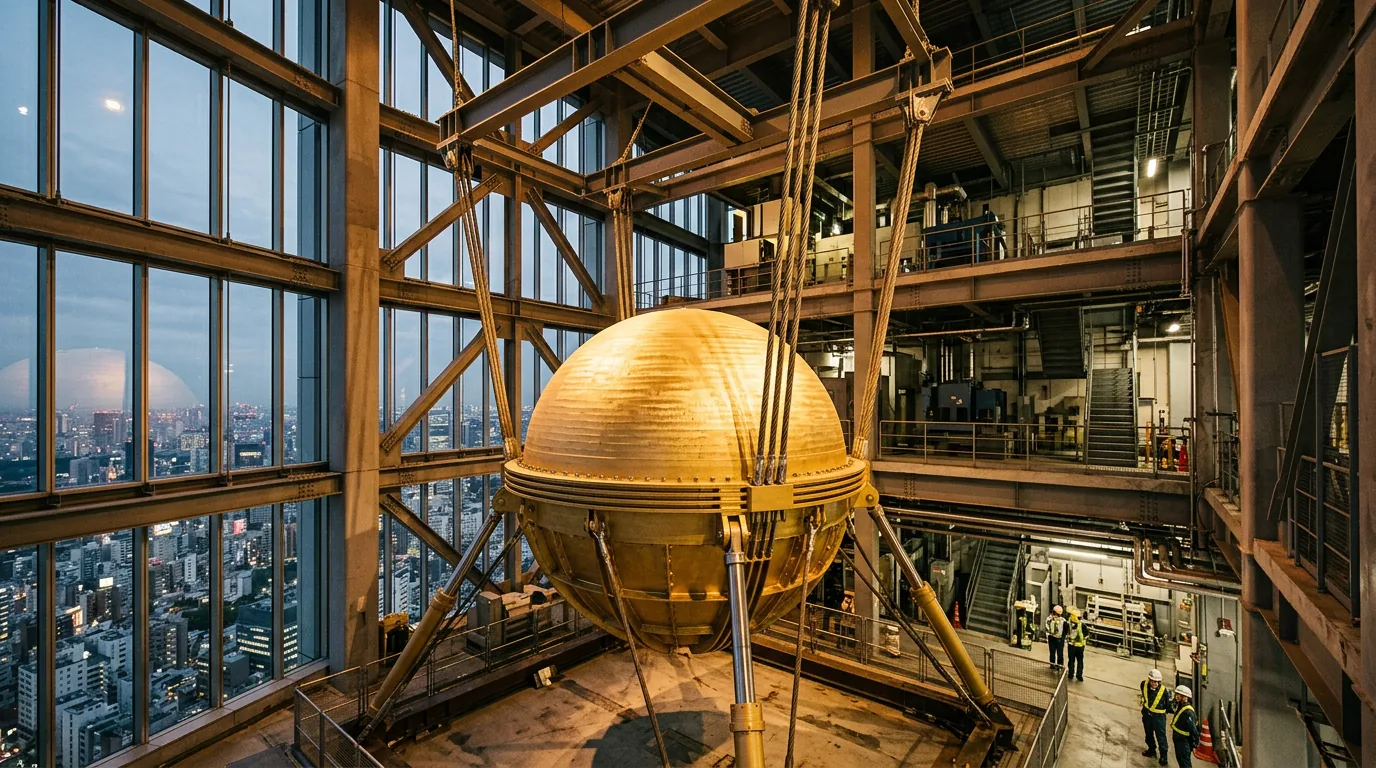
Passive dampers need no power. The best known is the tuned mass damper: a heavy mass on springs or cables that swings against the building’s motion. In one review of 208 case studies, 63% used passive tuned mass dampers. They are cheap and simple, but each is tuned to one frequency.
Active dampers use sensors and motors to push back in real time. They can handle several frequencies, but they need energy and cost more. [1]
Passive is simple and cheap. Active is flexible but power-hungry.
A building that fits on a table.
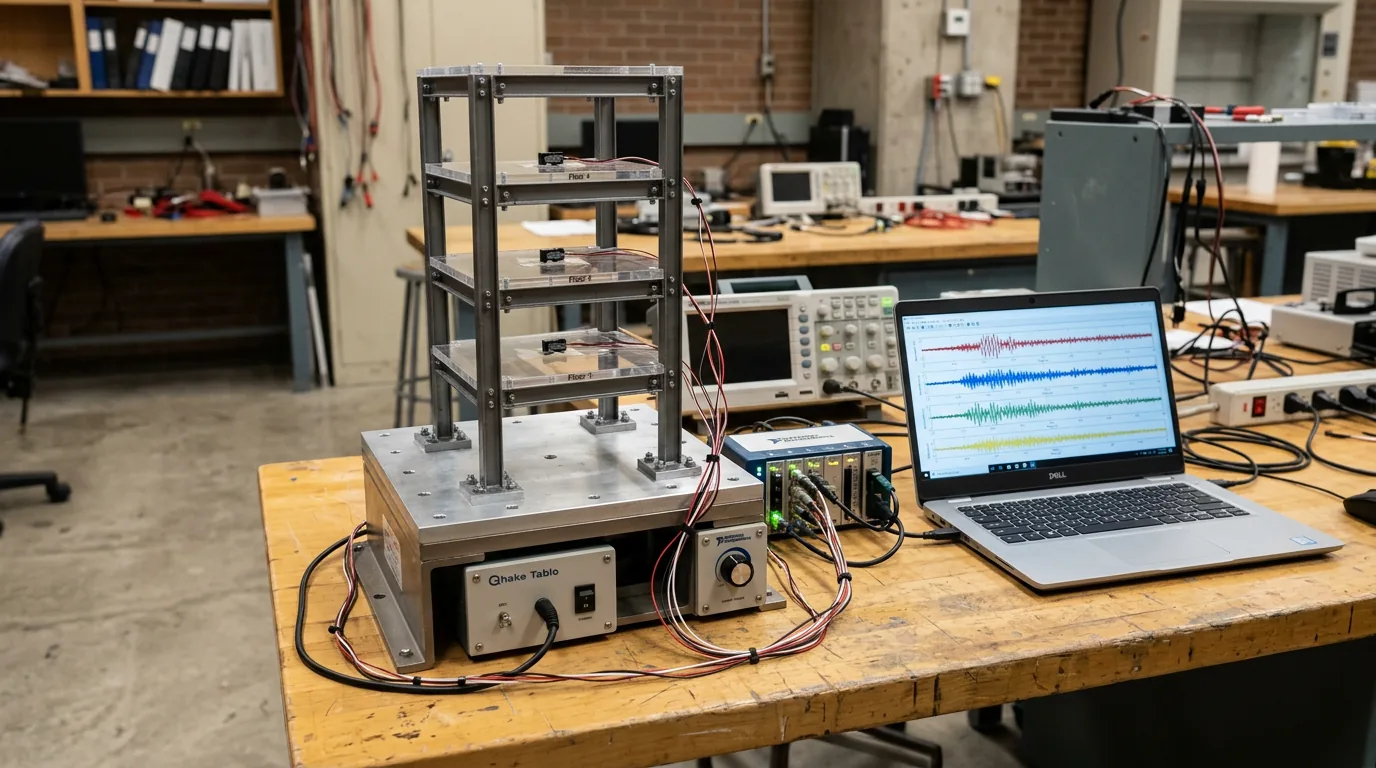
The study used a four-storey model: four plastic floor plates joined by steel threaded bolts, fixed to a shake table that can play back earthquakes and simple waves. Accelerometers recorded how each test made the model move.
Its active damper was home-built. An Arduino read the motion from an accelerometer and drove a stepper motor that slid a mass along a belt, pushing against the sway. [1]
The image is an illustration. The real model used yellow plastic floor plates.
One question, three answers.
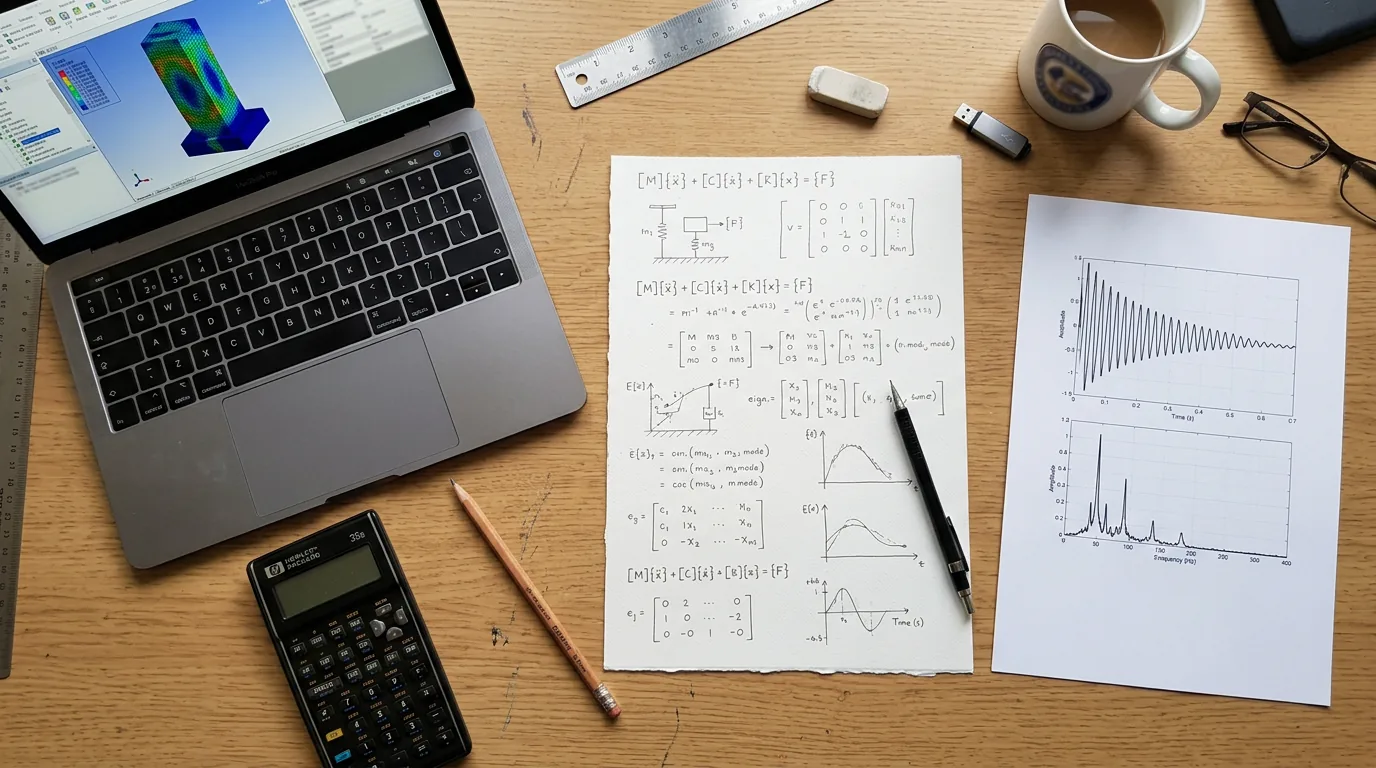
Every building has natural frequencies: the rates at which it prefers to shake. Shake it at one of those rates and the movement grows. The study measured the model’s first four, in three separate ways:
By hand and in MATLAB code (the ideal reference), with a computer structural model, and by shaking the real model in the lab. Using three methods at once is called a triangulated approach: if they agree, you can trust the result more. [1]
The shapes of the movement matched across the methods, which supported the approach.
Close, but not identical.
Natural frequencies of the four-storey model, in hertz (vibrations per second). The hand-calculated model is the reference.
| Mode | Calculated (reference) | Computer model | Lab test |
|---|---|---|---|
| 1 | 12.7 Hz | 23.4 Hz +84.3% | 15.0 Hz +18.1% |
| 2 | 36.6 Hz | 44.0 Hz +20.2% | 33.0 Hz −9.8% |
| 3 | 56.1 Hz | 60.0 Hz +7.0% | 45.0 Hz −19.8% |
| 4 | 68.8 Hz | 70.0 Hz +1.7% | 54.0 Hz −21.5% |
The computer model caught up.
It was far off at the first mode but within 1.7% by the fourth. It included twisting movement that the hand calculation left out. That matters most at low modes, where the whole building moves together. At higher modes each floor moves more on its own, so the two models agree.
The lab was steadily off.
Real tests were 9.8% to 21.5% away from the ideal numbers. That is expected: the base was not perfectly fixed, the bolts were not perfectly even, the model had its own damping and the lab was noisy.
Did the damper work?
Yes, a little. With the active damper switched on, the model’s mean damping ratio rose by 0.10% using one analysis method and 0.47% using another. Both showed the model settling back to rest faster than without it. The damper was added late in the project, so only limited tests were possible.
What comes next.
The thesis recommends adding twisting movement to the hand calculation, using specialist finite-element software, measuring every floor, filtering out noise, testing in a quieter room and comparing passive, semi-active and hybrid dampers too.
The research behind this story
Research and findings by Farjad Khan. All results, figures and methods in this story come from his thesis, Investigation of Passive and Active Vibration Control of Buildings, submitted to University College Dublin for the degree of ME in Structural Engineering with Architecture on 25 April 2025.
Canvas of Knowledge rewrote the research in plain language. The images are AI-generated illustrations made with Adobe Firefly, not photographs of the study, its lab or any real building.
- Khan, F. (2025) · Investigation of Passive and Active Vibration Control of Buildings. ME thesis, School of Civil Engineering, University College Dublin.
Source of every figure in this story. Case studies and literature (Rojas & Anderson 2012; Murcia-Delso et al. 2020; Koutsoloukas et al. 2022; Kovrova et al. 2024; Rainer 1982) are as reviewed in the thesis.