
Electric first.
Petrol when needed.
A bigger battery changes the role of a plug-in hybrid.
Here is what the engineering—and the numbers—actually mean.
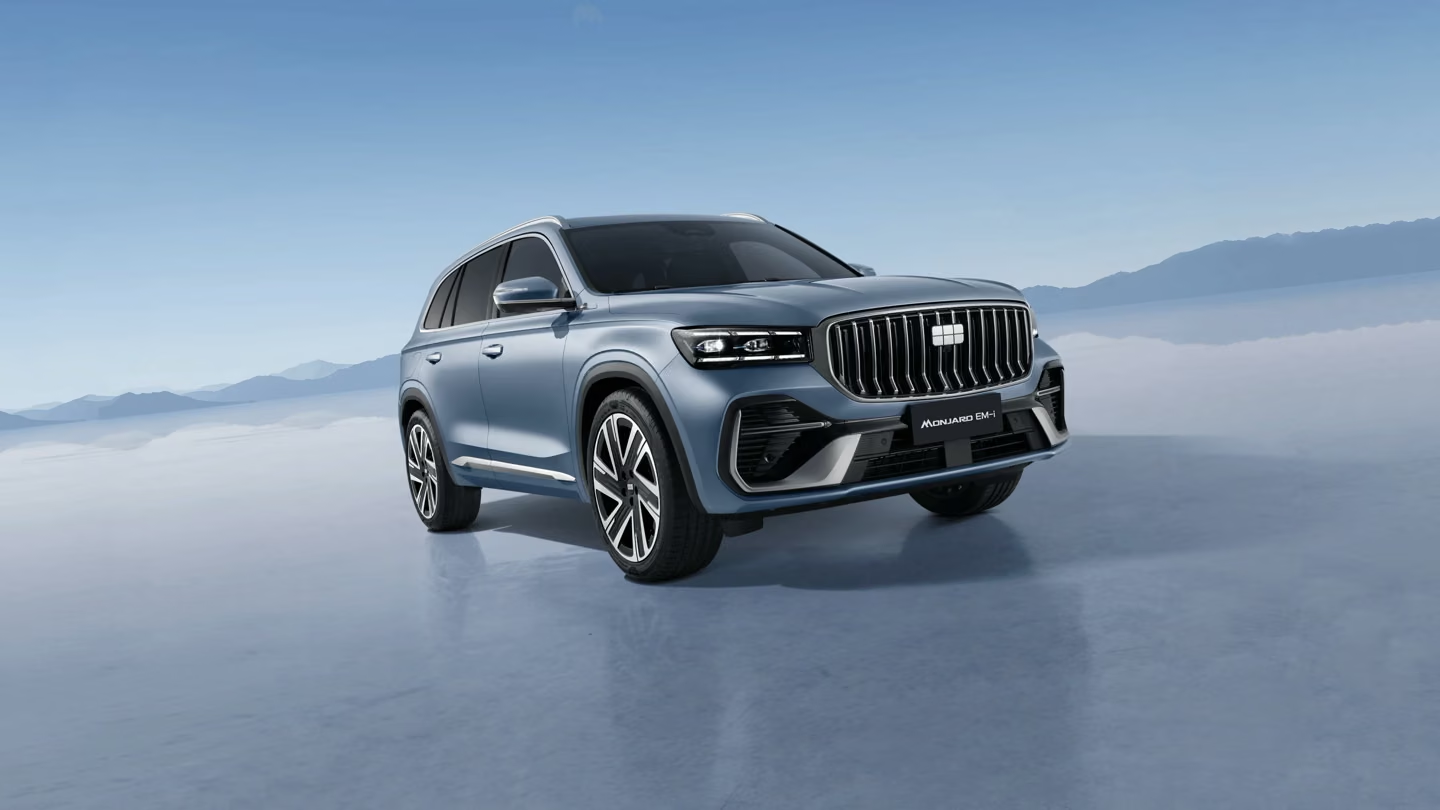
The interesting question is no longer simply whether a hybrid has a petrol engine. It is how often the driver needs it. With regular charging, a larger battery can move more everyday kilometres into the electric part of the journey.
One name.
Two configurations.
Manufacturer-listed UK figures. The electric range uses the WLTP laboratory cycle; total range includes petrol. Neither is a real-world guarantee. [1]
Everyday distance.
- UK grades
- Pro / Max
- Driven wheels
- Front
- Battery
- 30.7 kWh
- Electric range · WLTP
- Up to 85 miles
- Total range · petrol + electricity
- 706 miles
- System output
- 185 kW
- Peak DC charging
- 90 kW
Extra electric reach.
- UK grades
- Ultra / Hyper
- Driven wheels
- Front + rear
- Battery
- 40.1 kWh
- Electric range · WLTP
- Up to 105 miles
- Total range · petrol + electricity
- 689 miles
- System output
- Up to 241 kW
- Peak DC charging
- 120 kW
The AWD version’s larger battery gives it the higher electric-distance claim, yet its stated total range is lower. These are different measures of the complete vehicle; battery size alone cannot tell you how far a full battery and tank will take it.
For kilometre readers: 85 miles is about 137 km; 105 miles is about 169 km. These are rounded conversions, not separate test results.
Two energy stores.
One journey.
 Tap to enlarge ↗
The battery does the quiet work.
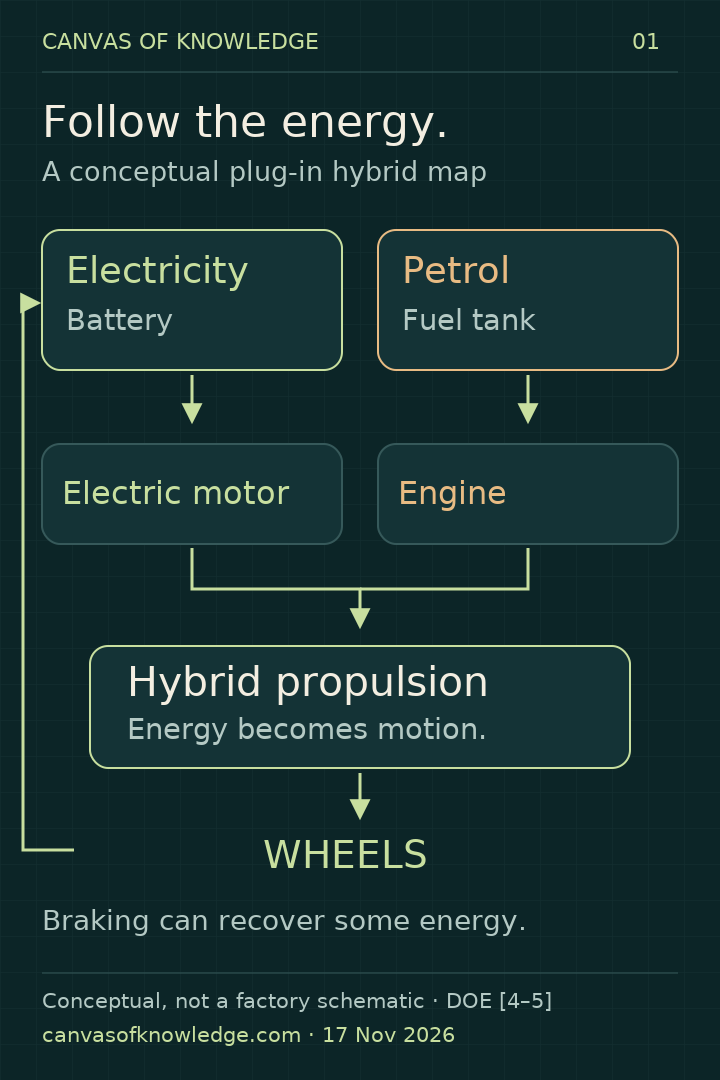
A plug-in hybrid carries two energy stores: electricity in a rechargeable battery and chemical energy in fuel. The motor turns electrical energy into rotation at the wheels. The petrol engine adds another way to supply propulsion when the operating conditions call for it. [5]
The control system decides.
Being within the advertised electric range does not guarantee that the engine will remain off. Charge level, acceleration demand and cabin heating or cooling can affect hybrid operation. The driver’s chosen mode and the vehicle’s control strategy also matter. [4]
Braking recovers a fraction.
During regeneration, the motor can act as a generator. Some of the vehicle’s motion becomes stored electrical energy again. Conversion losses, available grip and battery limits mean this is recovery, not an endless source of power. [4]
A short stop.
A specific promise.
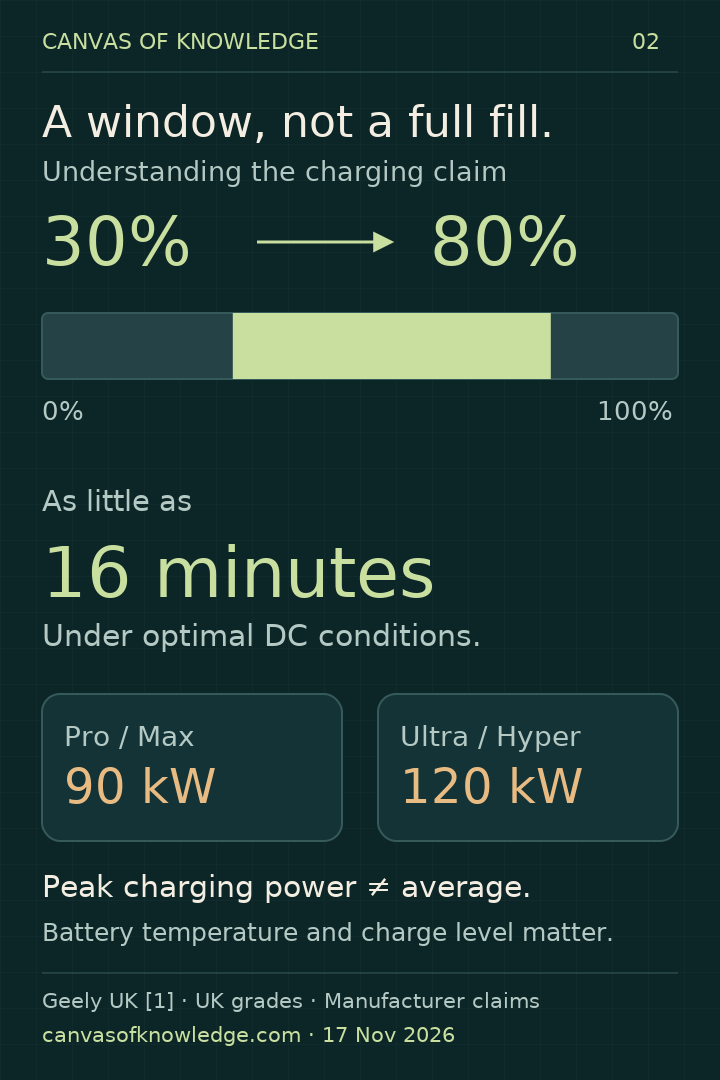
Geely quotes a 30–80% DC charging time as low as 16 minutes under optimal conditions. All UK grades support 6.6 kW AC charging. [1]
 Tap to enlarge ↗
kWh is a quantity. kW is a rate.
A battery capacity describes stored energy. Charging power describes how quickly energy can be transferred. Dividing a battery’s capacity by a peak charging figure cannot give an exact charging time: the rate changes during the session.
The charger is only part of the story.
A powerful charging station does not force the car to accept its full output. The vehicle and station negotiate a rate, while temperature, state of charge and system limits affect the result. A peak is a ceiling, not a flat line for the whole stop.
The most useful stop may be at home.
Regularly plugging in restores the electric portion of the next day’s driving. Leave a PHEV unplugged and its large battery cannot provide the same repeated grid-powered journeys. The benefit depends on the routine, not just the specification sheet. [4]
The technology
you live with.
Room, measured.
Geely’s UK page lists a body 4,800 mm long, 1,895 mm wide and 1,700 mm high. Luggage capacity is 633 litres with the seats up, increasing to 1,532 litres with the rear seats folded. [2]
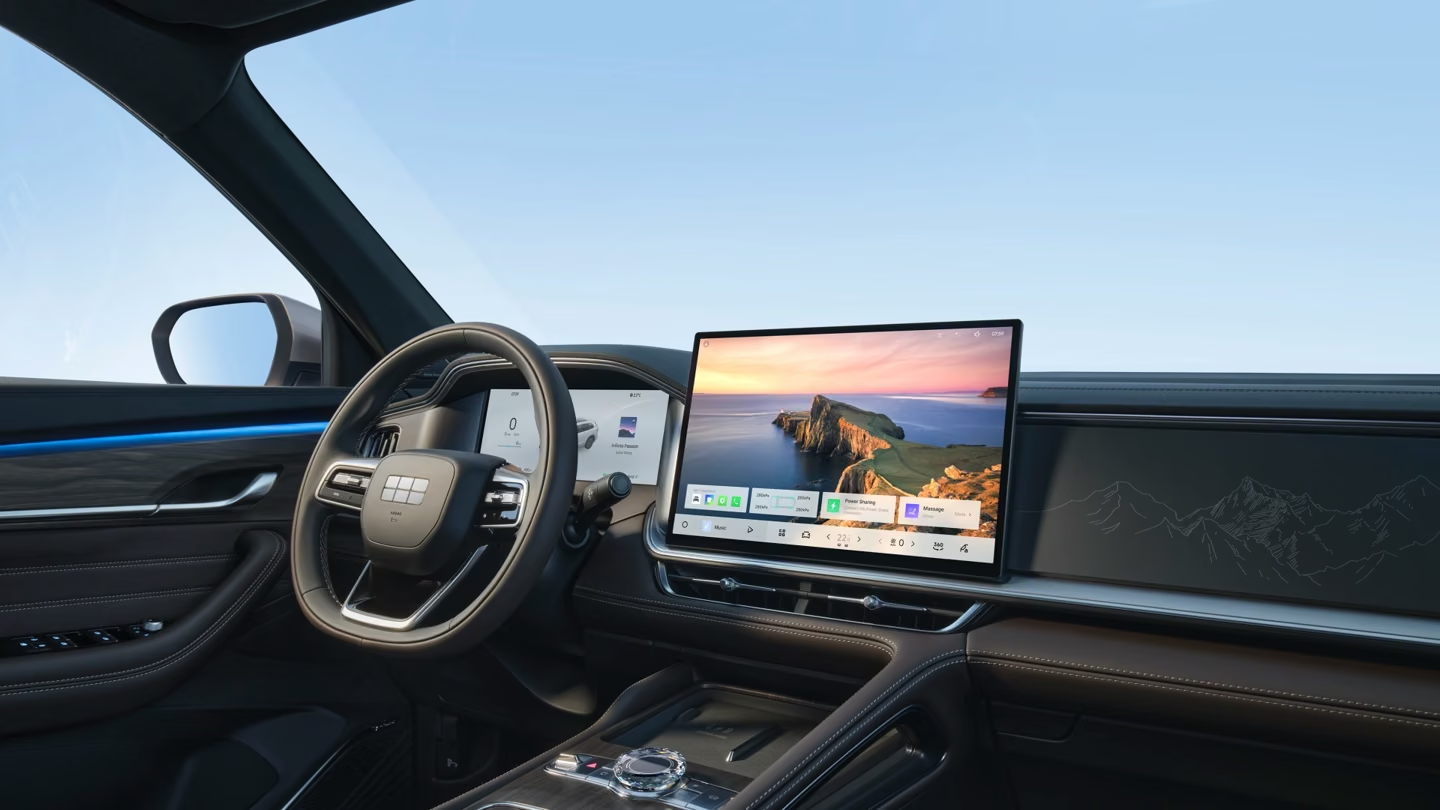
The image shows the cabin’s broad horizontal layout: instruments ahead of the driver and a large central screen. Screen size is only one part of usability; reach, visibility and the number of steps needed for everyday controls matter too.
Grip and comfort are different jobs.
The UK AWD layout uses a synchronous front motor and an asynchronous rear motor. The top Hyper grade adds continuously controlled damping. [1]
Drive torque changes the force delivered through the tyres. Damping controls how suspension movement settles. Both shape the driving experience, but adding driven wheels and changing damper behaviour solve different engineering problems.
Sources & image credits
Original editorial writing and vector illustrations by Canvas of Knowledge. Vehicle images © Geely. This is a specification-led explainer, not a road test. Figures were checked on 17 November 2026.
- Geely UK · Powertrain announcement ↗
17 November 2026 · UK grades, batteries, range, charging and chassis.
- Geely UK · Monjaro EM-i ↗
Dimensions, luggage capacity and official exterior imagery.
- Geely Global · Monjaro EM-i ↗
Official cabin imagery. Global-market equipment can differ.
- US Department of Energy · PHEVs explained ↗
Charging habits, regenerative braking and hybrid operating principles.
- US Department of Energy · The components ↗
Battery, motor, generator, power electronics and transmission.
- Auto Express · The original report ↗
The report that prompted this feature. Specifications here follow the newer UK manufacturer announcement.