Orbit is about speed, not height
Low Earth orbit begins only a few hundred kilometres up, a distance a car could drive in an afternoon. The hard part is sideways speed. To keep falling around Earth instead of back into it, a spacecraft must travel at about 7.8 kilometres per second, roughly 28,000 km/h. Climbing out of the atmosphere while fighting gravity adds losses, so a launch vehicle typically needs a total speed change, called delta-v, of about 9.4 km/s. Everything about rocket design follows from that number. The rocket must carry all the propellant it will burn, and at lift-off almost all of its weight is fuel and oxidiser waiting to be thrown out of the nozzle.
The tyranny of the equation
In 1903 the Russian teacher Konstantin Tsiolkovsky published the relationship now called the rocket equation. It says the speed a rocket gains equals its exhaust velocity multiplied by the natural logarithm of its starting mass divided by its final mass. The logarithm is the cruel part. Doubling the propellant does not double the speed; each extra kilometre per second demands exponentially more fuel. With a typical kerosene engine exhausting at about 3 km/s, reaching 9.4 km/s requires a mass ratio of nearly 23. In other words, around 96 per cent of the rocket at lift-off must be propellant, leaving just 4 per cent for tanks, engines, structure and the payload combined.
Working the numbers
Suppose tanks, engines and structure weigh one-tenth as much as the propellant they hold, a reasonable figure for a real vehicle. A single-stage rocket built that way could never exceed a mass ratio of 10, even with no payload at all, giving about 6.9 km/s: short of orbit. Now split the same job between two stages, each providing 4.7 km/s. Each needs a mass ratio of only about 4.8, which is easily achievable. Working through the sums, roughly 1.5 per cent of the lift-off mass reaches orbit as payload, so about 68 tonnes of rocket can deliver one tonne. That sounds wasteful, yet it is the difference between something and nothing.
Why dropping weight helps
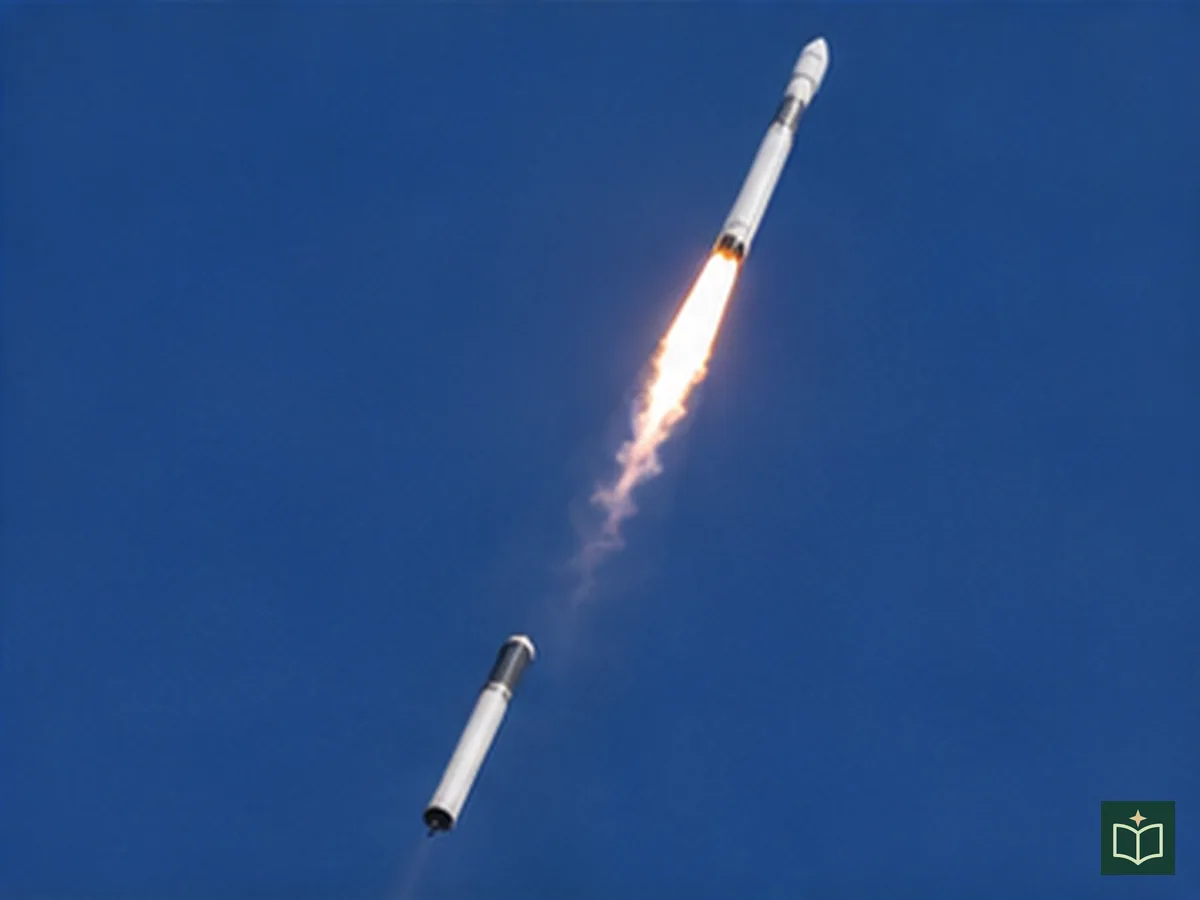
The trick is that an empty tank is pure penalty. Once the first stage has burned its propellant, carrying its heavy engines and hollow tanks any further would mean spending upper-stage fuel to accelerate scrap. Separating them resets the arithmetic: the upper stage begins its own burn with a fresh, favourable mass ratio. Stages can also be specialised. First-stage engines are built for high thrust in thick air at sea level. Upper-stage engines have larger nozzles tuned for the near vacuum of space, where they extract more speed from each kilogram of propellant. Some vehicles add strap-on boosters that burn alongside the core and drop away early, a variation on the same idea.
From rocket trains to Saturn V
Tsiolkovsky himself described 'rocket trains' in 1929, and multistage designs became standard as soon as engineers aimed for orbit. The Saturn V that carried Apollo crews to the Moon had three stages, the largest burning for only about two and a half minutes before falling into the Atlantic. Many modern launchers use two stages for low orbit and add a third or a kick stage for more distant destinations. Staging is not free. Every separation needs explosive bolts or pneumatic pushers, and every additional engine ignition in flight is another moment when something can go wrong, so designers balance the gain in performance against complexity and risk.
Could one stage ever be enough?
Engineers have long dreamt of a single-stage-to-orbit vehicle that takes off, reaches orbit and returns whole, like an aircraft. The rocket equation makes it brutally hard: structures would need to be extraordinarily light and engines extraordinarily efficient, leaving almost nothing for payload. Several projects were studied and cancelled. Instead, the industry has turned to reusing stages rather than eliminating them. Some boosters now fly back to land after separation, so the stage is dropped from the climb but not thrown away. Staging still governs the physics; reuse changes the economics. For missions beyond Earth orbit, to the Moon or Mars, extra stages or refuelling in orbit remain essential.
Sources & further reading
Figures are rounded and widely published; check the linked organisations for the latest editions. These organisations do not endorse this website.