A wave on paper
The story begins with equations rather than equipment. In the 1860s the Scottish physicist James Clerk Maxwell unified electricity and magnetism in a set of mathematical relationships. They implied something startling: a changing electric field creates a magnetic field and vice versa, so the two could chase each other through space as a wave. The predicted speed matched the measured speed of light, suggesting that light itself was such a wave and that others, invisible to the eye, might exist. Maxwell died in 1879 without seeing them demonstrated. The challenge for the next generation was to build a device that could make these waves on purpose and another that could notice them arriving.
Sparks in a laboratory
Between 1886 and 1888 the German physicist Heinrich Hertz did exactly that. A high voltage jumping across a spark gap set up rapidly oscillating currents that radiated waves. A few metres away, a simple loop of wire with its own tiny gap showed faint sparks when the waves arrived. Hertz showed the waves could be reflected, focused and polarised like light, confirming Maxwell. He reportedly saw no practical use for them. Others did. Édouard Branly in France built the coherer, a glass tube of metal filings that conducted better when waves struck it. Oliver Lodge in Britain and Alexander Popov in Russia refined such detectors in the mid-1890s, and Popov used one to record lightning.
Marconi's wireless telegraph
The young Italian Guglielmo Marconi brought the pieces together with commercial ambition. From 1895 he extended range by using tall antennas and earth connections, then moved to Britain, where he obtained a patent in 1897 and founded a company. His signals crossed the English Channel in 1899. On 12 December 1901 he reported hearing three faint clicks, the Morse letter S, in Newfoundland, sent from Poldhu in Cornwall roughly 3,500 kilometres away. Some historians doubt what he truly heard amid the noise, but reliable transatlantic services followed within a few years. Ships adopted wireless quickly, and in 1912 the distress calls of the sinking Titanic made its life-saving value clear to the world.
Credit is contested
Few inventions have such disputed parentage. Nikola Tesla patented tuned circuits and powerful oscillators in the 1890s. Popov's supporters argue his demonstrations came first. Jagadish Chandra Bose in India experimented with very short waves and sensitive detectors in the same years. Marconi shared the 1909 Nobel Prize in Physics with Karl Ferdinand Braun, whose tuned circuits greatly improved transmitters. In 1943 the United States Supreme Court ruled that key parts of Marconi's American tuning patent were not valid because earlier work, including Tesla's and Lodge's, had anticipated them. The fair summary is that radio emerged from many hands, and Marconi's distinctive contribution was turning laboratory physics into a working, worldwide communications business.
From dots and dashes to voices
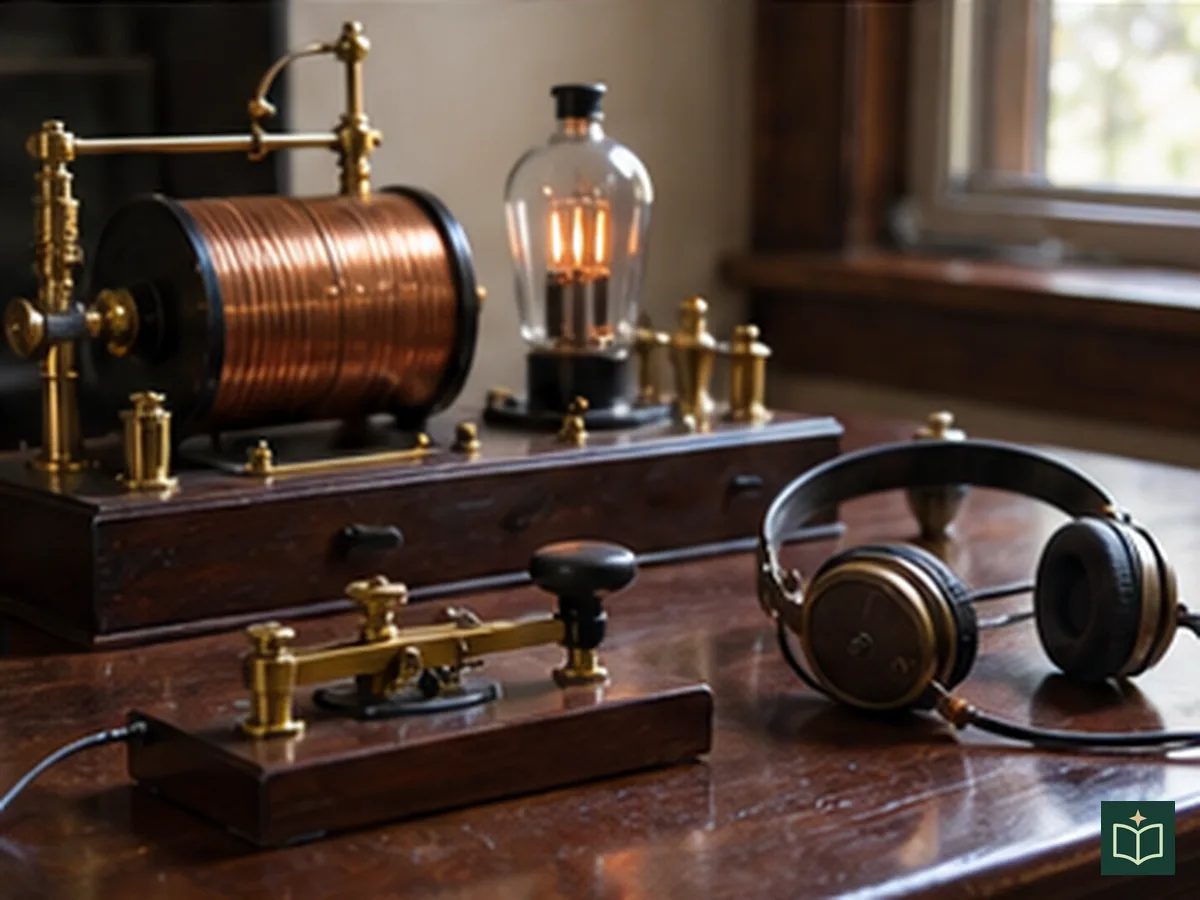
Spark transmitters spray energy across a wide band and can send only on-off pulses, which suits Morse code but not speech. Carrying a voice needed a smooth, continuous wave whose strength could be varied in step with sound, the principle of amplitude modulation. The Canadian-born engineer Reginald Fessenden is credited with early voice transmissions in 1906. The decisive tool was the vacuum valve: John Ambrose Fleming's diode of 1904 and Lee de Forest's three-element Audion of 1906, later developed into amplifiers and oscillators. After the First World War, stations began regular programmes. KDKA in Pittsburgh broadcast United States election results in November 1920, and the British Broadcasting Company began in 1922.
Why the story still matters
Radio turned communication from a point-to-point service into broadcasting, one voice reaching millions at once, reshaping news, politics, music and advertising within a generation. The same physics now carries mobile phone calls, Wi-Fi, satellite navigation and the signals from spacecraft far beyond the planets. Every one of those systems still relies on the core ideas worked out between Maxwell and the 1920s: generate an oscillation, radiate it from an antenna, tune a receiver to it and encode information by varying the wave. The history is also a reminder that breakthroughs rarely belong to one genius. They grow from theory, careful experiment and practical engineering building on one another.
Sources & further reading
Figures are rounded and widely published; check the linked organisations for the latest editions. These organisations do not endorse this website.