A network of networks
The internet is not one network but tens of thousands of separate ones: mobile operators, home broadband providers, universities, cloud companies and video services. For a message to travel from one person to another, those networks must hand traffic across. They can do this in two broad ways. A network can pay a larger carrier, a transit provider, to deliver traffic anywhere in the world. Or two networks can connect directly and swap traffic for each other's customers, often without charge, an arrangement called peering. Internet exchange points, known as IXPs, make peering easy by gathering many networks in one place where each needs only a single connection.
Inside an exchange
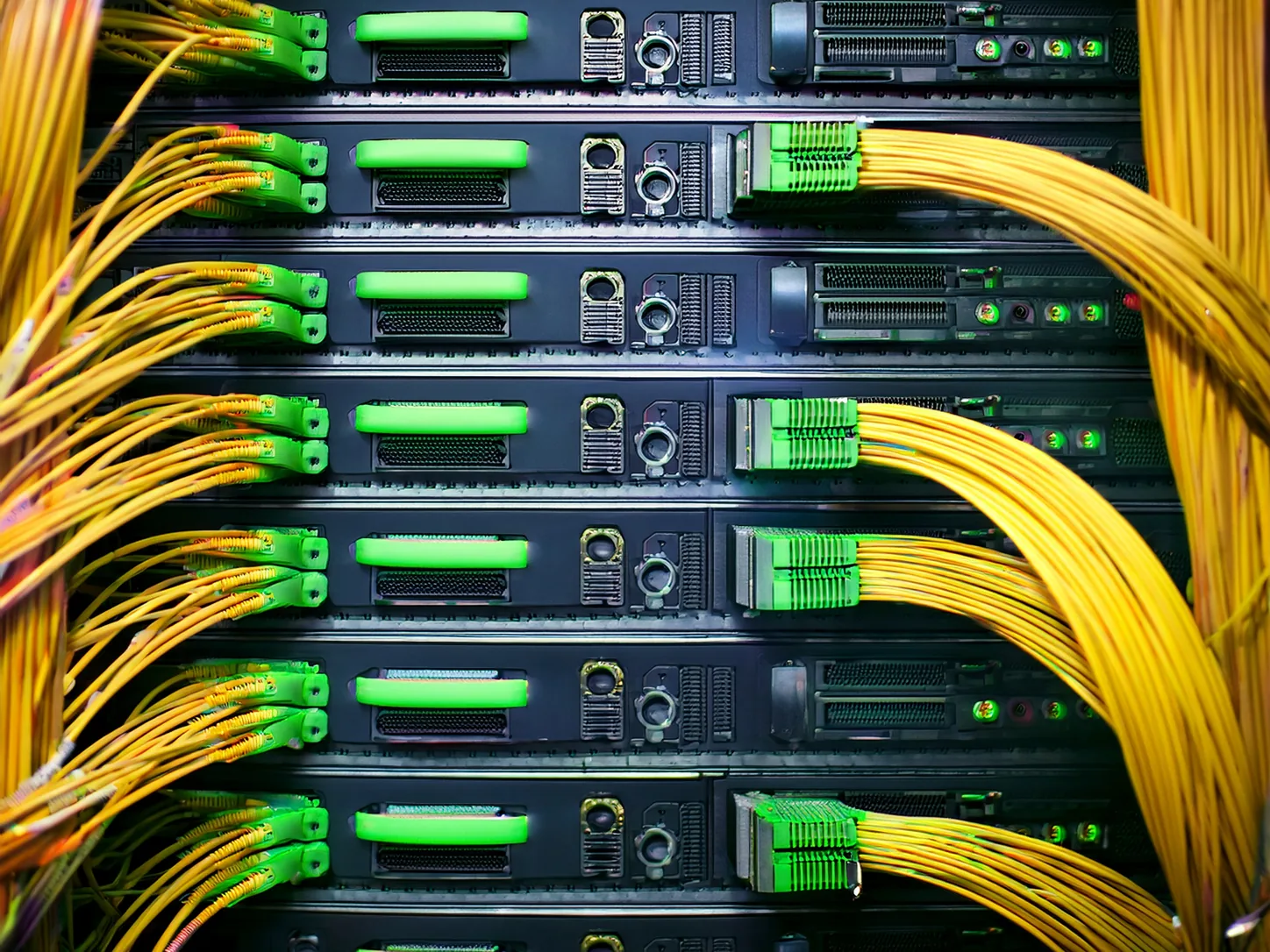
Physically, an exchange is usually a set of high-capacity switches in one or more carrier-neutral data centres. Each member installs a router in the building and connects it to the shared switch fabric. Once connected, a network can exchange traffic with dozens or hundreds of others across that one port, instead of laying separate cables to each. The exchange itself normally does not decide where data goes or inspect it; members announce which addresses they can reach and choose whom to peer with. Many exchanges are run as non-profits or member associations. The largest, in cities such as Frankfurt and Amsterdam, carry well over ten terabits per second at peak times.
The cost of a long detour
Without a local exchange, traffic between two neighbouring networks can loop through another continent, a pattern engineers call tromboning. Light in optical fibre travels at about 200,000 kilometres a second. If a message between two users in the same city detours to Europe along cables of roughly 6,000 kilometres each way, the round trip alone covers 12,000 kilometres and adds around 60 milliseconds, before any equipment delays. Kept local, the same exchange might take a millisecond or two. For browsing the difference is minor, but for video calls, online gaming and payments it is noticeable. Every detour also uses costly international capacity that local providers must pay for.
Why the Gulf became a hub
For years much traffic between Middle Eastern networks was exchanged in Europe. That began to change when UAE-IX opened in Dubai in 2012, set up with the national telecoms regulator and operated by the German firm DE-CIX. Exchanges have since grown in Saudi Arabia, Oman, Qatar and elsewhere in the region. Geography helps. The Gulf sits between Europe, Africa and Asia, and many submarine cables land on its coasts, including at Fujairah and in Oman. Large data centres built by cloud and content companies attract still more networks, because providers want to connect where the content is, creating a cycle in which each new member makes the exchange more valuable.
Content moves closer
An important effect of exchanges is that popular content lives nearby. Video platforms, cloud providers and content delivery networks connect at major exchanges or place servers inside local providers. When someone in Abu Dhabi streams a film or loads a news site, the data often comes from a building in the same country, reaching their provider through an exchange instead of travelling from another continent. That reduces delay and buffering and saves international bandwidth for traffic that genuinely needs to travel. It also adds resilience: if a submarine cable is damaged, as happens several times a year somewhere in the world, local traffic can keep flowing through the exchange.
Limits and misunderstandings
A common assumption is that internet traffic always travels the shortest path. It follows business agreements instead, so two networks that refuse to peer may still route traffic far away, even when both are present at the same exchange. Exchanges also concentrate infrastructure, which makes power, cooling and security at those buildings important to whole regions. They do not replace transit, since networks still need routes to the rest of the world. But the growth of exchanges is a useful measure of how mature a country's internet is. More local peering usually means faster, cheaper connections and a network less dependent on distant decisions.
Sources & further reading
Figures are rounded and widely published; check the linked organisations for the latest editions. These organisations do not endorse this website.