Sigma as a ruler for surprise
In statistics, sigma, the Greek letter σ, stands for the standard deviation, a measure of how much random results usually scatter around their average. Physicists borrow it to express how surprising a measurement is. If an experiment expects to see 1,000 background events and the typical random scatter is about 30, then seeing 1,150 is an excess of five standard deviations. The further a result sits from what pure chance predicts, the more sigmas it has. Saying a result has reached five sigma is a compact way of saying it would be extraordinarily rare if nothing new were happening in the experiment.
What the odds mean
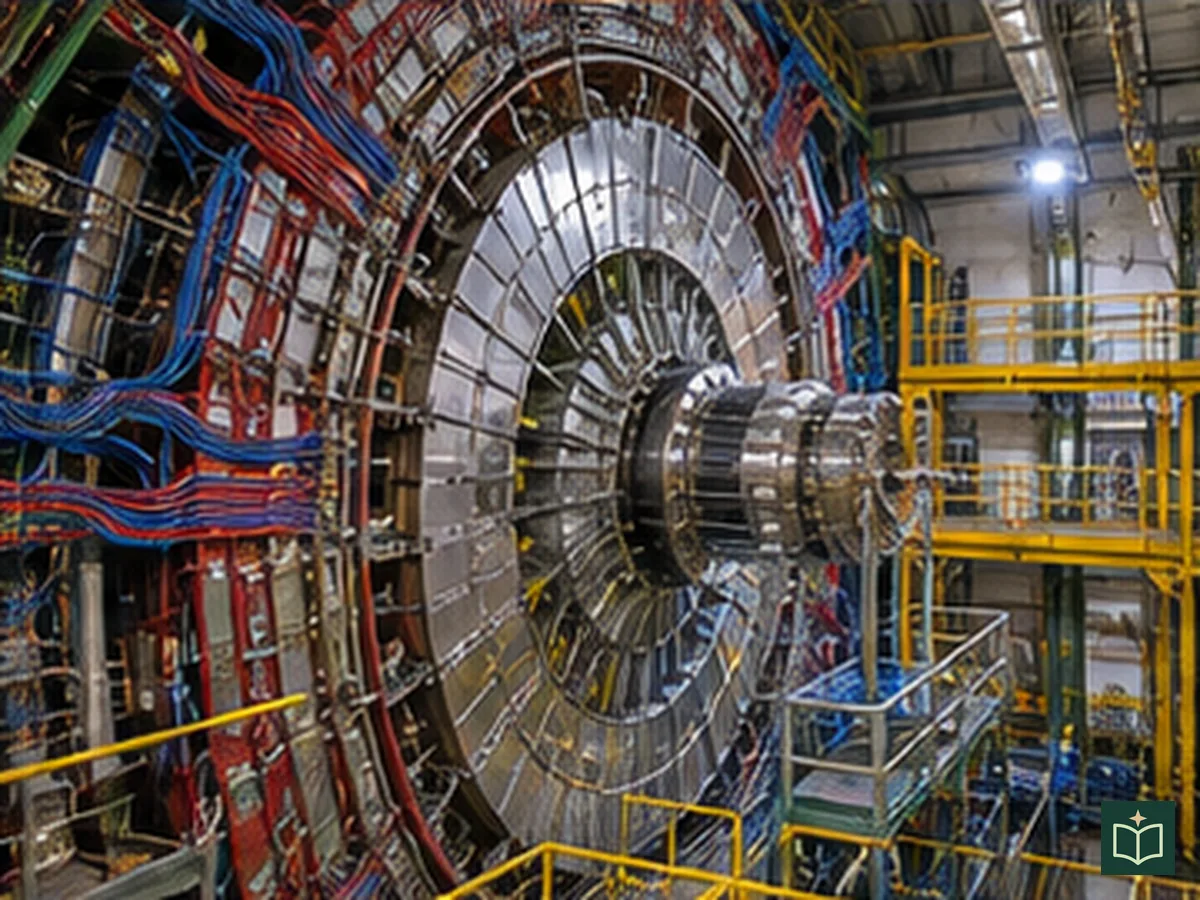
For a bell-shaped normal distribution, a fluctuation of at least five sigma in one direction happens about once in 3.5 million tries. Three sigma, by contrast, happens about once in 740. Particle physicists treat three sigma as evidence worth attention and five sigma as the threshold for announcing a discovery. The convention grew up because experiments search through huge amounts of data, and three-sigma bumps appear and vanish regularly. In July 2012, the ATLAS and CMS experiments at CERN each reported a new particle at around five sigma, and the world learned that the long-sought Higgs boson had almost certainly been found.
What it does not mean
A frequent error in reporting is to say five sigma means a 99.99997% chance the discovery is real. It does not. The figure is the probability of seeing data at least this extreme if there were no new effect. That is not the same as the probability that there is no new effect, given the data. Converting one into the other requires knowing how plausible the idea was before the experiment, which statistics alone cannot provide. A five-sigma claim for something that contradicts well-tested physics deserves more scepticism than a five-sigma confirmation of a long-predicted particle. Extraordinary claims still need extraordinary support from several directions.
The look-elsewhere effect
Large experiments scan many possible masses, energies or channels at once. Searching widely raises the chance that one of them will show a big random bump somewhere, just as rolling a die thousands of times will eventually produce long runs of sixes. Physicists call this the look-elsewhere effect and correct for it, quoting a local significance at a single point and a lower global significance across the whole search. In 2015 and 2016, a much-discussed excess in photon pairs at the Large Hadron Collider looked tantalising locally, then faded away as more data arrived. The episode is a reminder of why the bar is set high.
When sigma is not enough
Sigma measures only random error. It says nothing about systematic errors, such as a miscalibrated detector or a flawed assumption. In 2011, the OPERA experiment reported neutrinos apparently travelling faster than light at a significance of about six sigma. The team itself urged caution, and the cause was later traced largely to a loose fibre-optic cable affecting the timing. Results also need independent confirmation by other teams. The Higgs announcement carried weight partly because two separate detectors, built and run by different teams, saw the same thing. Good scientists treat five sigma as necessary for a discovery claim, not sufficient on its own.
Other fields, other bars
Five sigma is a convention of particle physics and some areas of astronomy. Many other fields use a far lower threshold, often a p-value of 0.05, roughly two sigma, which allows a one-in-twenty chance of a fluke. That difference partly reflects how data are collected: a collider can gather billions of events, while a medical trial may involve only a few hundred patients. When reading a science headline, check which threshold was used, whether the result has been replicated, and whether the researchers have discussed systematic errors. A big sigma number is impressive, but it is only one part of a convincing case.
Sources & further reading
Figures are rounded and widely published; check the linked organisations for the latest editions. These organisations do not endorse this website.