A backwards scale
Astronomers describe brightness using apparent magnitude, a system that dates back to ancient Greek star catalogues. It runs backwards: the smaller the number, the brighter the object. The brightest stars are around magnitude 0 or 1, Venus can reach about −4, and the full Moon is close to −13. On a truly dark night, people with good eyesight can see stars down to about magnitude 6. The scale is logarithmic. A difference of five magnitudes is a factor of exactly 100 in brightness, so each single step is about 2.5 times. A comet predicted at magnitude 4 is therefore about six times fainter than one at magnitude 2.
Why comets look fainter
A comet's magnitude can mislead because its light is spread out. A star is a point, so all its light reaches the eye at once. A comet's glowing head, called the coma, and its tail may cover an area larger than the full Moon. The quoted magnitude adds up all of that light as if it were concentrated in a single point. A comet of magnitude 5 can therefore look much dimmer than a star of magnitude 5, appearing as a faint smudge. Astronomers describe this as low surface brightness, and it is the main reason many headline naked-eye comets disappoint casual observers.
The trouble with predictions
Comet brightness is also notoriously hard to forecast. Comets are loose bodies of ice and dust, and their activity depends on how much fresh ice is exposed as they warm near the Sun. Some brighten far beyond expectations; others crumble. Comet ISON, promoted in 2013 as a possible comet of the century, broke apart close to the Sun and faded away. Others, such as Comet NEOWISE in 2020 and Comet Tsuchinshan-ATLAS in 2024, became genuinely impressive. Forecasts based on early observations carry wide uncertainty, so headlines months ahead of a comet's closest approach to the Sun should be treated as hopeful estimates.
City skies and twilight
Light pollution is the biggest obstacle for most viewers. In a brightly lit city, the sky glows so strongly that only stars brighter than about magnitude 3 or 4 may be visible, and sometimes fewer. A diffuse comet can vanish completely. Moonlight has a similar effect, so a comet near full Moon is harder to see. Comets are also brightest when they are close to the Sun in the sky, which means they often appear low on the horizon in evening or morning twilight, when the sky is not yet fully dark. Haze, dust and buildings near the horizon can block the view entirely.
The desert advantage
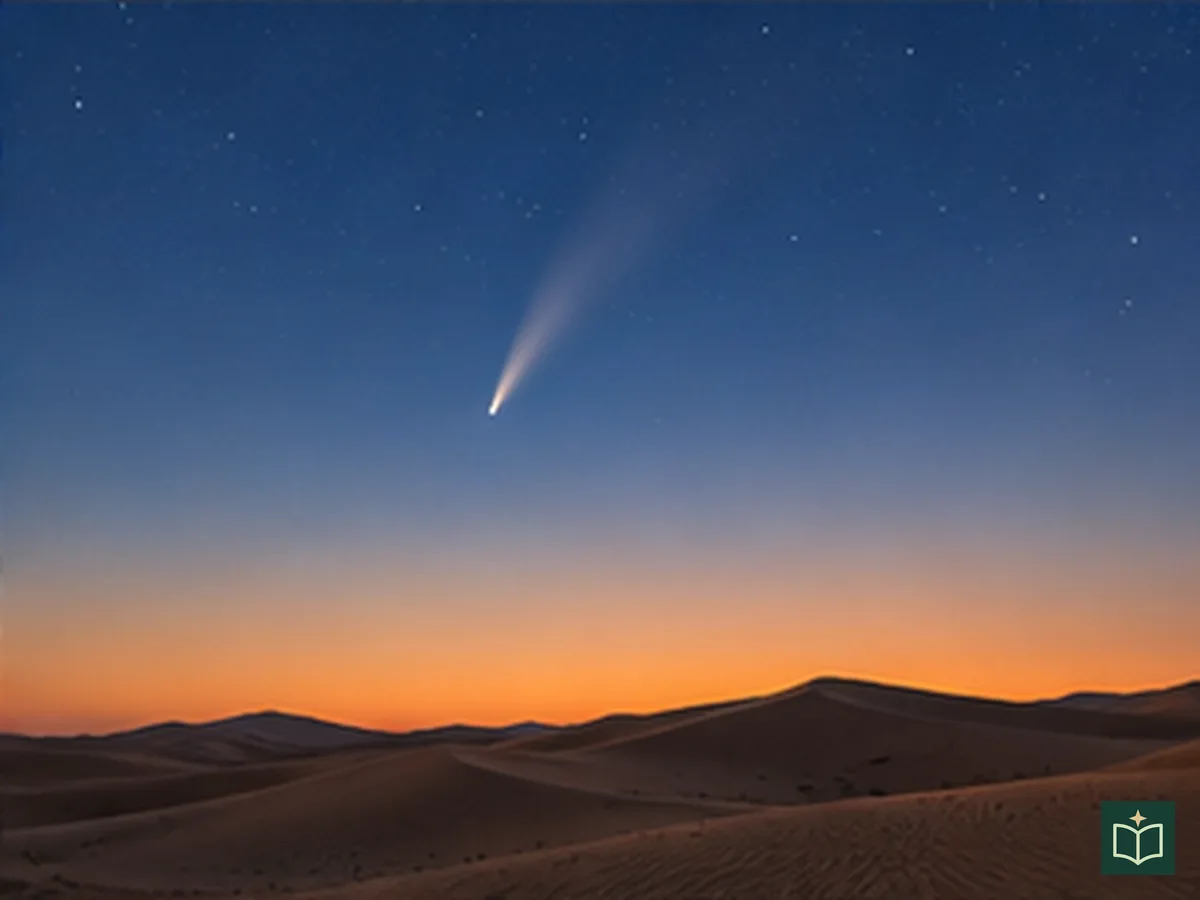
The UAE and its neighbours have an advantage: deserts with very little artificial light within an hour or two of the cities. Away from urban glow, the sky darkens dramatically and faint objects become visible. Dry, clear winter nights are often ideal, though dust and humidity in summer can reduce clarity, especially near the horizon. Astronomy groups in the region regularly organise observation trips to dark desert sites during notable comet appearances. For a comet low in twilight, choose a spot with an open western or eastern horizon, such as the open desert or a coastline facing the right direction.
How to read the headline
When a story says a comet will be visible to the naked eye, look for its predicted magnitude, the dates of best visibility and where it will appear in the sky. A magnitude of 3 or brighter is promising; 5 or 6 usually means binoculars are needed except under very dark skies. Check the Moon's phase and the time after sunset or before sunrise when the comet will be highest. Binoculars are the single best tool, revealing faint tails that the eye misses. Long-exposure photographs in news reports often show more colour and detail than a person will see directly.
Sources & further reading
Figures are rounded and widely published; check the linked organisations for the latest editions. These organisations do not endorse this website.