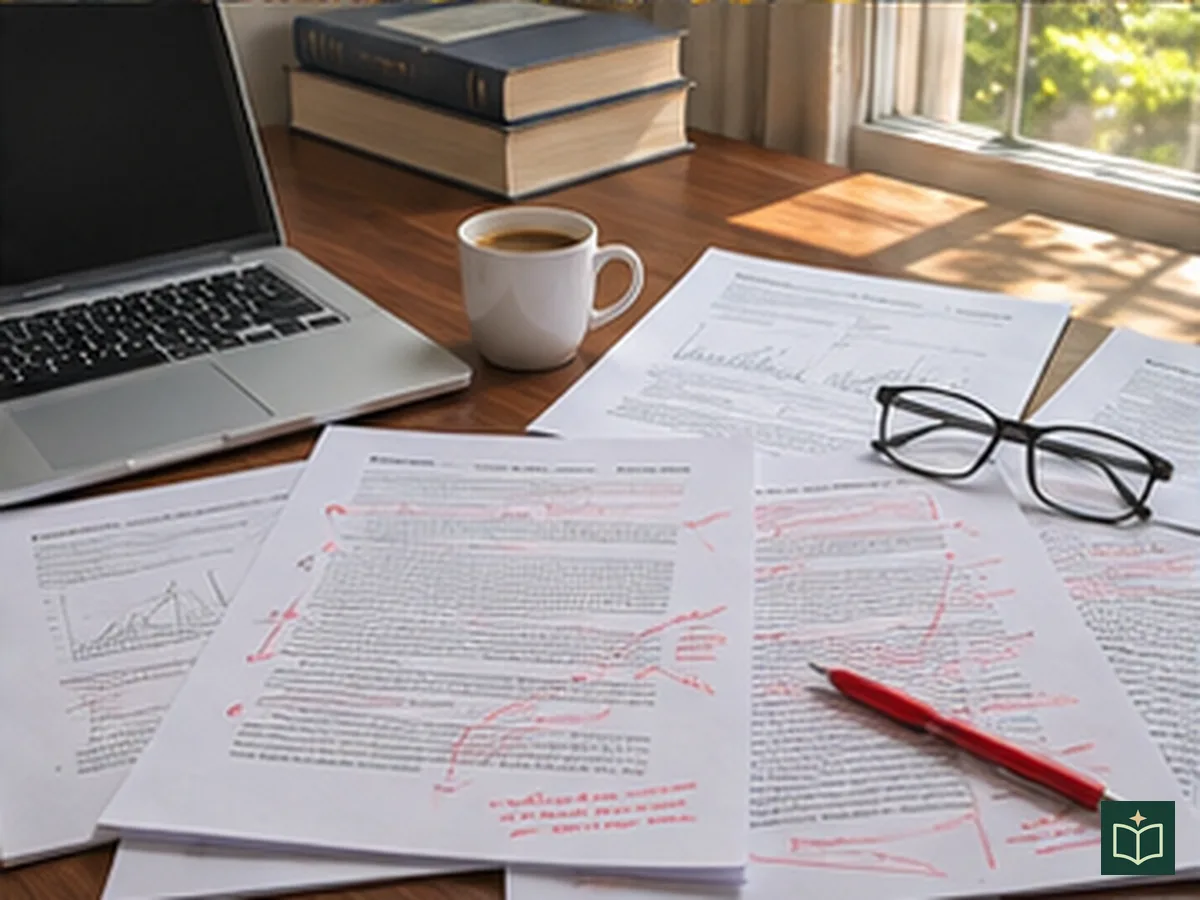
How peer review works
When scientists finish a study, they usually submit it to a journal. An editor first decides whether it fits the journal and is worth sending out. If so, the editor invites independent experts in the field, typically two or three, to read the manuscript. These reviewers assess whether the question is important, whether the methods are appropriate, whether the data support the conclusions, and whether the work is new. They write reports, often recommending revisions or additional analyses. The authors respond, and the cycle may repeat several times. In many journals, reviewers' names are hidden from authors, and sometimes authors' names are hidden from reviewers too.
What it can catch
Good peer review improves papers in many ways. Reviewers spot weak statistical methods, missing control groups, overstated conclusions and failures to cite relevant earlier work. They may ask for further experiments or a more cautious interpretation. Journals with strong review processes reject a large share of what they receive, filtering out work that is unoriginal or clearly flawed. The process also pushes authors to explain their methods clearly enough for others to follow. For readers, a peer-reviewed paper has at least passed the scrutiny of people who understand the field, which is a meaningful step beyond a press release or a social media post.
What it usually misses
Peer review has clear limits. Reviewers rarely see raw data or rerun experiments; they judge what is presented to them. Deliberate fabrication can therefore pass unnoticed, as many later retractions show. Reviewers are unpaid volunteers with limited time, and they can be biased in favour of familiar ideas or against surprising ones. Errors in complex code or large datasets are easy to overlook. And because the process happens before publication, it cannot test whether a result can be reproduced by other laboratories. Peer review is best understood as quality control at one point in time, not as proof that a finding is correct.
The rise of preprints
A preprint is a version of a scientific paper shared publicly before peer review. Physicists have shared them for decades; the arXiv server, launched in 1991, became the standard way to circulate new work in physics and mathematics. Biology followed with bioRxiv in 2013, and medicine with medRxiv in 2019. Preprints let researchers establish priority, gather feedback and share results months before a journal publishes them. Servers screen submissions for obvious problems, such as plagiarism or material that could cause harm, but they do not judge whether the science is correct. Many preprints are later published with only modest changes; some are never published at all.
The pandemic test
The COVID-19 pandemic brought preprints into the headlines. With a new virus spreading quickly, researchers posted thousands of studies on treatments, transmission and vaccines before review, and journalists reported on them rapidly. This sped up science in useful ways, allowing data on the virus's genetic code and on some effective treatments to spread within days. It also exposed weaknesses. Some widely publicised preprints, for example on certain drugs, turned out to be flawed or were withdrawn, yet their claims had already spread. Many news organisations now routinely state when a study is a preprint that has not yet been peer reviewed.
How to read a study headline
When a news story reports a new finding, check whether it comes from a peer-reviewed journal, a preprint or simply a press release or conference talk. A preprint is not necessarily wrong, but it has not been formally checked, so its claims deserve extra caution, especially in medicine. Even for a peer-reviewed paper, look for the size of the study, whether it has been replicated, and what independent experts say about it. A single study rarely settles anything. Confidence grows as different teams, using different methods, reach the same conclusion, and that process usually takes years, not days or weeks.
Sources & further reading
Figures are rounded and widely published; check the linked organisations for the latest editions. These organisations do not endorse this website.