An oval orbit
The Moon does not circle Earth at a fixed distance. Its orbit is an ellipse, so in each lunar month it passes through a closest point, called perigee, and a farthest point, called apogee. The distance between the centres of Earth and Moon ranges from roughly 356,000 km at the closest perigees to about 407,000 km at the farthest apogees. A supermoon is a full Moon that falls at or near perigee. The term did not come from astronomers but was coined by an astrologer, Richard Nolle, in 1979. Astronomers prefer the clumsier phrase perigee full Moon, but the popular name has stuck in newsrooms.
How much bigger it looks
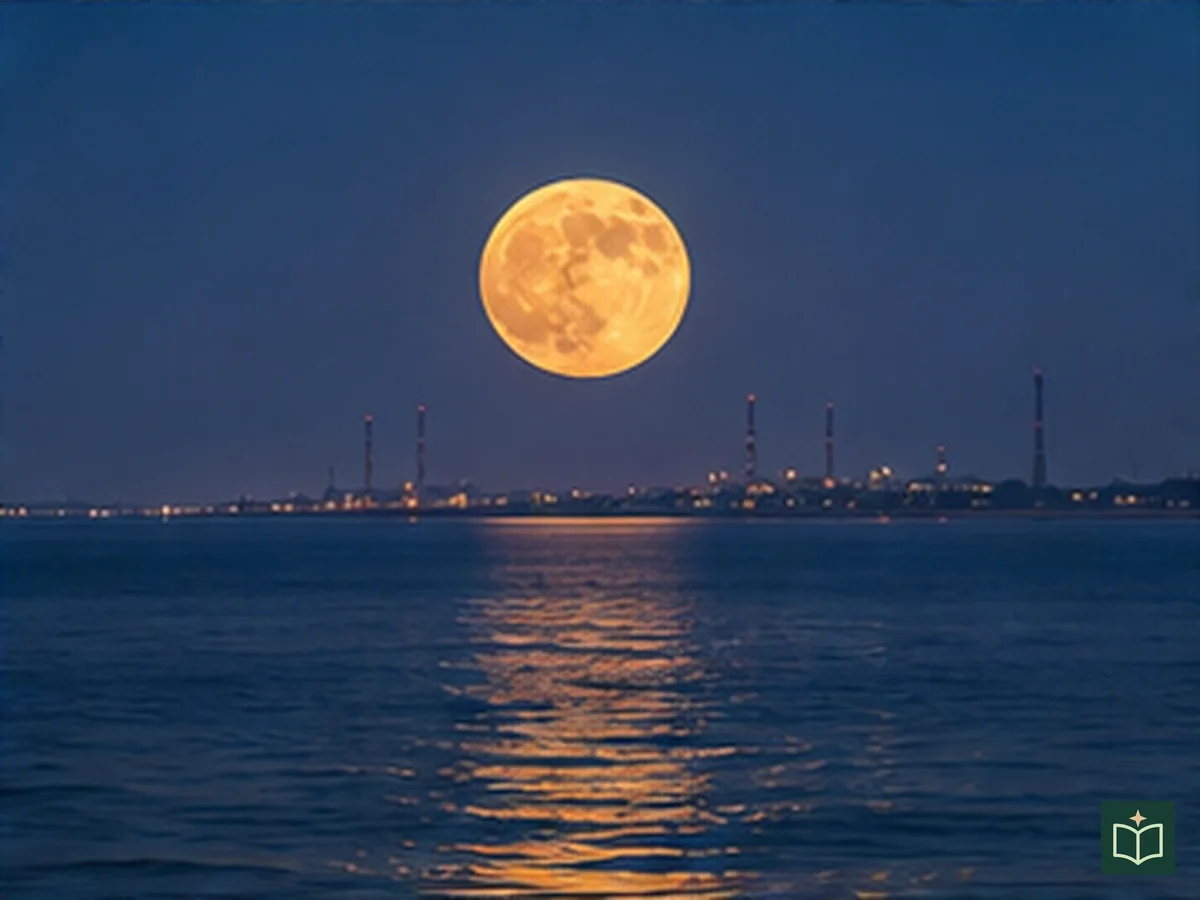
NASA's commonly quoted figures are that a supermoon looks about 14% larger and about 30% brighter than a micromoon, which is a full Moon near apogee. Compared with an average full Moon, the difference is roughly half of that. To the naked eye, this is hard to notice, because there is no other Moon in the sky to compare it with. The striking photographs that accompany supermoon stories usually rely on long telephoto lenses, which make a rising Moon look enormous next to distant buildings. Those pictures would look nearly as dramatic on any other full Moon night with the same lens.
The Moon illusion
Many people are sure the Moon looks huge when it is close to the horizon and smaller once it climbs high. Measurements show that its size in the sky barely changes; if anything, it is very slightly smaller near the horizon, because it is farther from the observer. The effect is called the Moon illusion, and psychologists still debate the full explanation. One idea is that the brain judges the low Moon against trees, hills and towers and perceives it as larger. Whatever the cause, the illusion is far stronger than the supermoon effect, which is why moonrise is the best time to look at any full Moon.
Tides and other claims
A full Moon near perigee does have a measurable physical effect. When the Sun, Earth and Moon are aligned and the Moon is close, the tides can be slightly higher than usual, an effect sometimes called a perigean spring tide. Along low-lying coasts, this can add a few centimetres to high water and worsen flooding if it coincides with a storm. Claims that supermoons trigger earthquakes, volcanic eruptions or changes in human behaviour are not supported by good evidence. Any tidal stress on the Earth's crust from a supermoon is tiny compared with the forces already building along fault lines.
Other Moon names
Headlines often attach other labels to full Moons. A blue Moon is usually the second full Moon in a single calendar month, which happens roughly every two to three years; an older definition refers to the third of four full Moons in one season. A blood Moon describes a total lunar eclipse, when the Moon turns coppery red as it passes through Earth's shadow and is lit only by sunlight bent through our atmosphere. A harvest Moon is the full Moon closest to the September equinox. Names such as wolf Moon or strawberry Moon come from folk traditions and describe the month, not any astronomical event.
How to enjoy one
The best way to see a supermoon is to watch it rise around sunset, when the Moon illusion is strongest and the landscape gives a sense of scale. In the UAE and wider Gulf, clear winter skies and flat horizons over the sea or desert make this easy, and coastal promenades offer good views as the Moon rises over the water. No equipment is needed, though binoculars show craters and the dark lava plains clearly. Remember that the following and preceding nights look almost identical, so cloud on the night itself is no great loss. The Moon will be close again in about a year, and the show will repeat.
Sources & further reading
Figures are rounded and widely published; check the linked organisations for the latest editions. These organisations do not endorse this website.