Two islands, two faunas
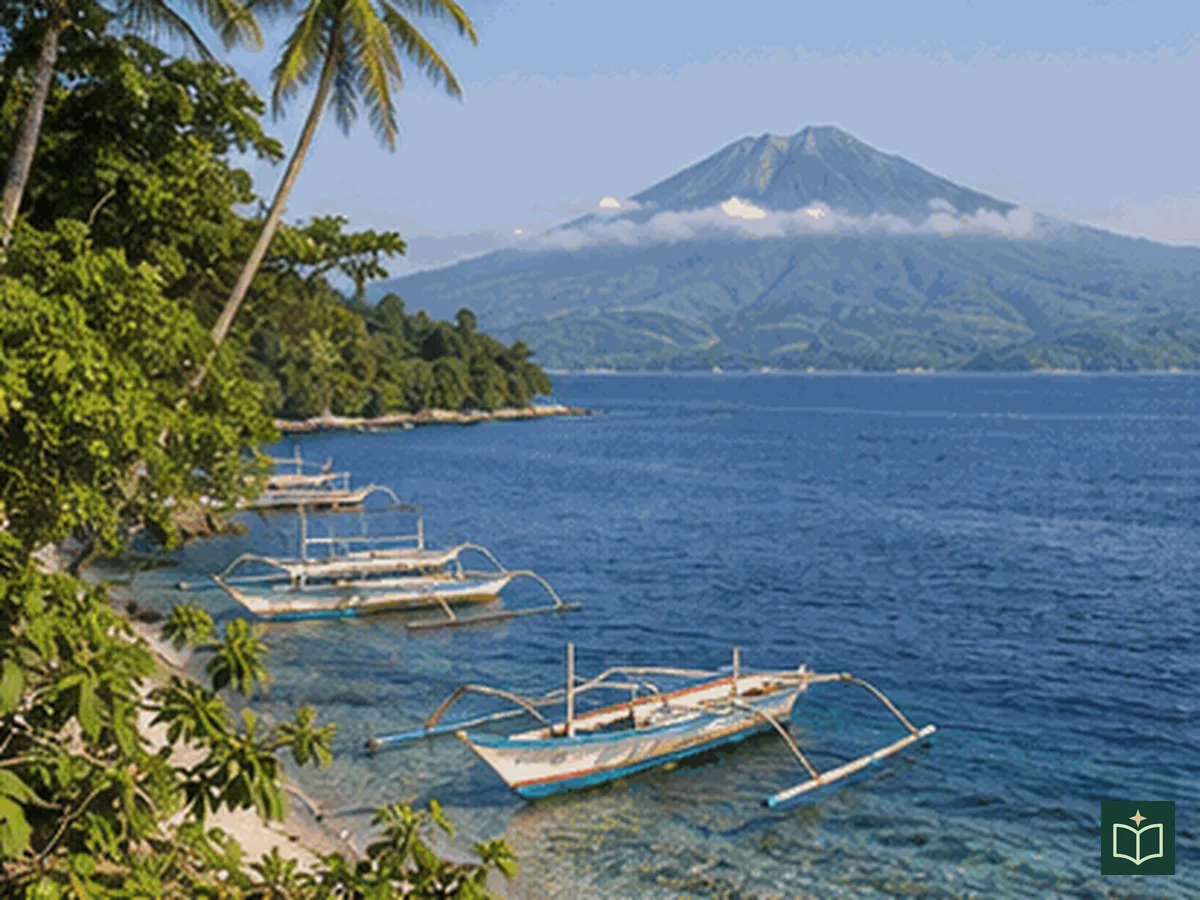
In 1856 the naturalist Alfred Russel Wallace sailed from Bali to Lombok, across a strait roughly 35 kilometres wide. He was struck by the change. On Bali he had seen birds typical of Asia, such as barbets and woodpeckers. On Lombok he found cockatoos, honeyeaters and megapodes, birds characteristic of Australia and New Guinea. Over eight years in the Malay Archipelago, Wallace mapped the boundary between these two worlds. It runs between Bali and Lombok, then north between Borneo and Sulawesi and on towards the Philippines. The line that now bears his name became one of the founding ideas of biogeography.
The role of the ice ages
The explanation lies in sea level and the shape of the sea floor. During the ice ages, so much water was locked in ice sheets that sea level dropped by about 120 metres. West of the line, the shallow Sunda Shelf emerged as dry land, joining Sumatra, Java, Bali and Borneo to mainland Asia. Tigers, rhinoceroses, elephants and monkeys could walk across. East of the region, the Sahul Shelf joined New Guinea to Australia, uniting kangaroo and cassowary country. But between them lay deep channels, including the Lombok Strait and the Makassar Strait, which remained under water even at the lowest sea levels.
Why depth mattered more than distance
The Lombok Strait is narrow, but it is also hundreds of metres deep, far deeper than the 120 metres by which the sea fell. It therefore never became a land bridge. Land mammals, freshwater fish and many reptiles could not cross it easily, so the faunas on either side evolved separately for millions of years. Even many birds, which could physically fly the gap, seem reluctant to cross open water and remained on their own side. Strong currents through the strait, carrying water from the Pacific to the Indian Ocean, add a further barrier. Distance alone would not explain the sharp divide; depth did.
Wallacea, the zone in between
In practice the boundary is less a single line than a transition zone. Sulawesi, the Lesser Sunda Islands and the Moluccas, never connected to either continent, are called Wallacea. Their animals arrived by rare crossings of open water and then evolved in isolation, producing unusual species. Sulawesi has the babirusa, a pig with tusks that grow through its snout, and the anoa, a dwarf buffalo. The Komodo dragon lives on a few islands of the Lesser Sundas. Other naturalists drew alternative boundaries, such as the Weber and Lydekker lines further east, marking where Asian and Australian influences balance and where Australian fauna dominates.
Wallace’s wider legacy
Wallace’s work in the archipelago did more than draw a line. While recovering from fever in the Moluccas in 1858, he conceived the theory of evolution by natural selection independently of Charles Darwin, and the two men’s ideas were presented together in London that year. His observations of how species are distributed across islands, and how barriers separate them, became central evidence for evolution. His book The Malay Archipelago, published in 1869, remains a classic of travel and natural history. Modern genetic studies have refined his line but confirmed his core insight: the deep sea floor shaped the evolution of life in the region.
Why the line matters today
The Wallace Line helps explain why Indonesia, the world’s largest archipelagic country, holds such extraordinary biodiversity: it spans two great continental faunas and a unique zone of island species between them. Conservationists use biogeographic boundaries like this to plan protected areas, because species on either side are not interchangeable. The line also matters for human history. Early humans reaching Australia, more than 50,000 years ago, had to cross open water through Wallacea, making their journeys among the earliest known sea crossings. A stretch of deep water only a few dozen kilometres wide has shaped the story of animals and people alike.
Sources & further reading
Figures are rounded and widely published; check the linked organisations for the latest editions. These organisations do not endorse this website.