Spots on the Sun
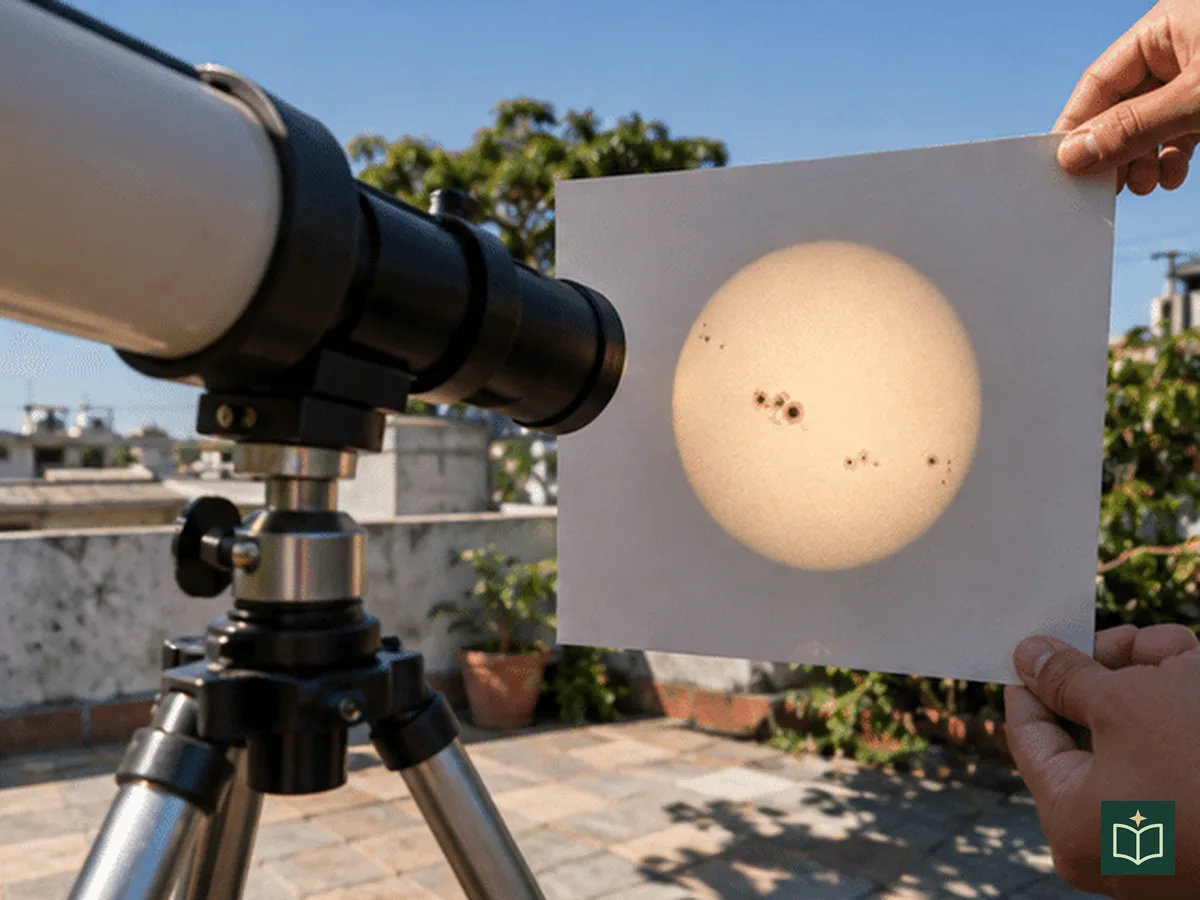
Sunspots are dark patches on the Sun's visible surface, often larger than Earth. They look dark only by comparison: at roughly 3,500 to 4,500°C they are cooler than the surrounding surface, which is around 5,500°C. They mark places where intense magnetic fields emerge from the interior and suppress the flow of heat from below. Astronomers have observed sunspots with telescopes since the early 1600s, and earlier records exist from Chinese observers who saw the largest ones with the naked eye through haze. Looking directly at the Sun is dangerous, however, and should only ever be done through certified solar filters or by projecting its image onto a card.
Discovering the rhythm
In 1843 the German amateur astronomer Heinrich Schwabe, who had counted sunspots for nearly two decades while searching for a planet near the Sun, reported that their number rose and fell over about ten years. Later work refined the average to around 11 years, and cycles have been numbered since 1755, when systematic records began. Cycle lengths vary from about nine to 14 years, and some peaks are much stronger than others. The current cycle, Cycle 25, began in December 2019, and in October 2024 NASA and the US National Oceanic and Atmospheric Administration announced that the Sun had reached the maximum period of its activity.
Why the cycle happens
The Sun is not solid, and it does not rotate as one piece. Its equator turns once in about 25 days, while regions near the poles take around 35 days. This differential rotation, together with churning motions of hot gas beneath the surface, stretches and twists the Sun's magnetic field lines, wrapping them around the star like thread around a spool. As the field tightens, bundles of it become buoyant and rise through the surface, creating pairs of sunspots of opposite magnetic polarity. Early in each cycle spots appear at mid-latitudes, around 30 degrees north and south, and later ones emerge progressively closer to the equator, forming a famous butterfly-shaped pattern when plotted over time.
The great flip
At the height of each cycle, the Sun's overall magnetic field reverses: the north and south magnetic poles swap places. Magnetic field from decaying sunspots drifts towards the poles, cancelling the old polarity and building the new one. Because of this, the Sun takes two 11-year cycles, about 22 years, to return to its original magnetic arrangement, a pattern known as the Hale cycle after the American astronomer George Ellery Hale, who first measured sunspot magnetic fields in 1908. Scientists model the process as a solar dynamo, the same broad mechanism that powers Earth's magnetic field, though predicting the strength of each coming cycle remains difficult.
Space weather
Around solar maximum, tangled magnetic fields release energy more often in solar flares, intense bursts of radiation, and coronal mass ejections, vast clouds of charged gas hurled into space. When these reach Earth they can produce geomagnetic storms. In 1859 the Carrington Event, the most intense storm on record, sent currents through telegraph wires and produced auroras seen near the tropics. In 1989 a storm caused a blackout across the Canadian province of Quebec. Today, strong storms can disrupt satellites, radio communications and GPS accuracy, increase radiation exposure on polar flights, and add drag that pulls low-orbit satellites down, which is why agencies issue space weather forecasts.
Quiet periods and climate
The cycle has not always been regular. Between about 1645 and 1715, a period called the Maunder Minimum, very few sunspots were seen. It overlapped with part of the cool period known as the Little Ice Age in Europe, though volcanic eruptions and other factors also played major roles in that cooling. The Sun's total energy output varies by only about 0.1 per cent across a typical cycle, a small effect on Earth's climate compared with the warming from greenhouse gases. Solar observatories in space, such as NASA's Solar Dynamics Observatory, now watch the Sun continuously, helping scientists understand the cycle and protect technology from its strongest outbursts.
Sources & further reading
Figures are rounded and widely published; check the linked organisations for the latest editions. These organisations do not endorse this website.