A chain of incomes
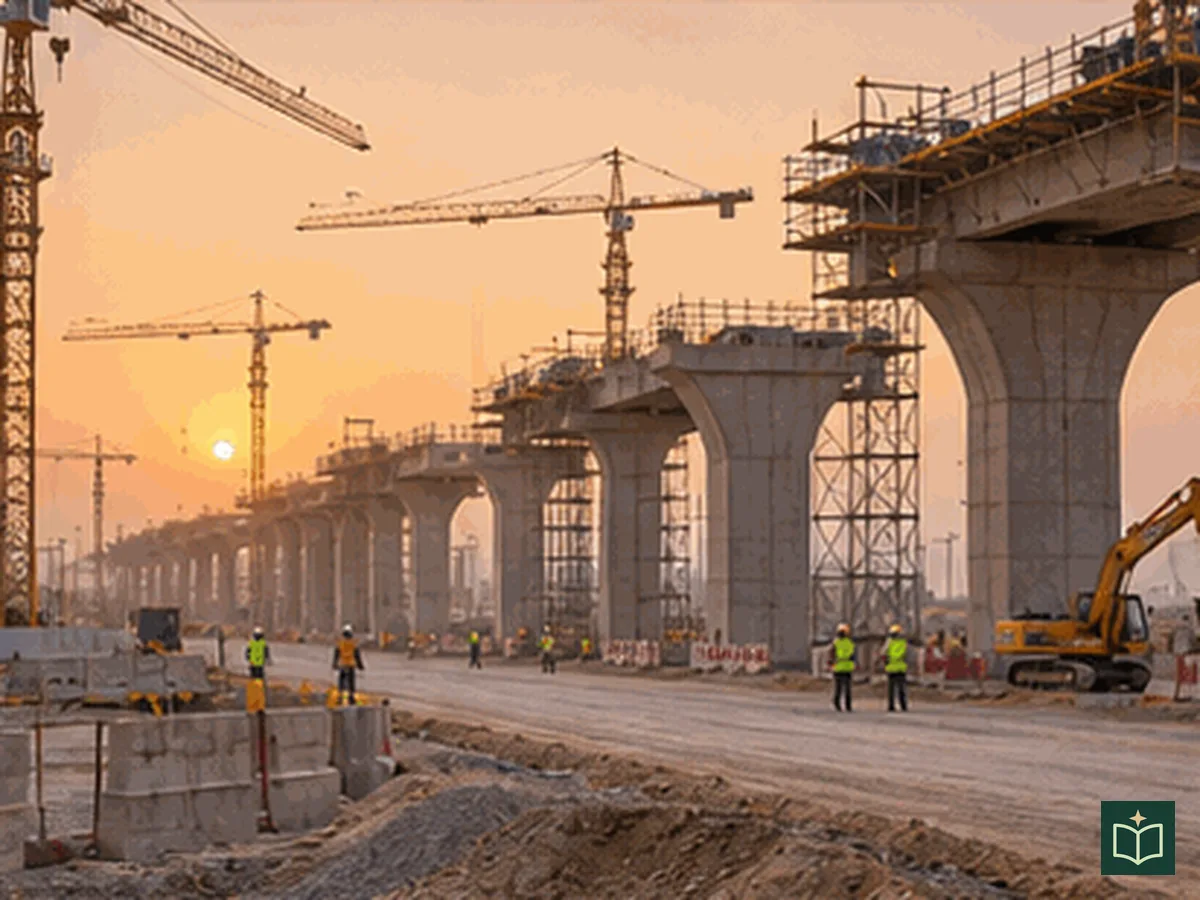
When a government builds a road, the money does not stop with the construction company. It pays workers and suppliers, who now have more income. They spend part of it on food, rent, transport and services, which becomes income for shopkeepers, landlords and drivers, who in turn spend part of theirs. The total rise in income across the economy can therefore exceed the original outlay. This is the multiplier effect. The idea was developed by the British economist Richard Kahn in 1931 and became central to John Maynard Keynes's General Theory in 1936, which argued that spending could lift an economy out of a slump.
The textbook formula
In the simplest model, the size of the multiplier depends on the marginal propensity to consume, the share of each extra dirham that people spend. If people spend 80% and save 20%, the multiplier is one divided by 0.2, which is 5. An initial AED 1 billion of spending would eventually raise total income by AED 5 billion. Each round is smaller than the last: AED 1 billion becomes 800 million, then 640 million, and so on, adding up to five times the start. The formula is elegant, but it describes an economy with no taxes, no imports and no other reactions.
Leaks in the real world
In practice, money leaks out at every round. Some is saved. Some goes to the government in taxes. Some is spent on imported goods, so it becomes income abroad rather than at home. Take an example where people spend 80% of after-tax income, the tax rate is 20% and 30% of income goes on imports. Only 34% of each new dirham is respent on domestic output, so the multiplier is one divided by 0.66, about 1.5. An AED 1 billion programme raises income by roughly AED 1.5 billion: rounds of 1 billion, 340 million, 116 million and so on, shrinking fast.
Why the Gulf is a special case
Small, open economies tend to have smaller multipliers because they import a large share of what they consume. Gulf economies add another leak: a large expatriate workforce sends a significant part of its earnings home as remittances, which supports spending in other countries rather than locally. Government spending on infrastructure that relies on imported materials and equipment also leaks quickly. On the other hand, spending on local services and wages can have stronger effects. This helps explain why economists studying Gulf states, where government spending drives much of the non-oil economy, often pay close attention to the composition of government spending, not only its total size.
What else changes the result
The multiplier also depends on how others react. If the economy is already near full capacity, extra spending may mostly raise prices rather than output. If a central bank raises interest rates to cool inflation, private investment may fall, offsetting some of the boost. If people expect higher taxes later to repay government borrowing, they may save more today. Estimates therefore vary widely. After the 2008 crisis, research by the International Monetary Fund suggested that multipliers had been larger than assumed in economies with idle resources and interest rates near zero, a finding that fed debate about austerity in Europe.
Why it matters
The multiplier sits at the centre of arguments about stimulus. Supporters of public spending in a downturn point out that each dirham can lift income by more than a dirham when businesses and workers are idle. Sceptics stress the leaks, the lags and the debt left behind. The idea also works in reverse: cuts in spending or a collapse in exports can shrink incomes by more than the initial loss. For businesses, it explains why a large project in a region can lift demand for shops and services well beyond the project itself. Understanding the leaks helps separate hopeful claims from realistic ones.
Sources & further reading
Figures are rounded and widely published; check the linked organisations for the latest editions. These organisations do not endorse this website.