A weapon that outlasts war
An anti-personnel mine is designed to explode when a person steps on it or near it. Unlike most weapons, it cannot distinguish between a soldier and a child, and it can remain dangerous for decades after fighting ends. Through the 1980s and 1990s, mines laid in countries such as Afghanistan, Angola, Cambodia and Mozambique killed and maimed thousands of civilians each year, blocked farmland and roads, and slowed recovery from conflict. Doctors, aid workers and deminers documented the toll. Their reports helped build a movement arguing that the humanitarian cost of these weapons far outweighed any short-term military value they offered.
How the ban came about
In 1992 a group of non-governmental organisations formed the International Campaign to Ban Landmines. It worked with sympathetic governments, led by Canada, to negotiate a treaty outside the usual consensus-based disarmament forums, where progress had stalled. This 'Ottawa process' produced the Convention on the Prohibition of the Use, Stockpiling, Production and Transfer of Anti-Personnel Mines and on their Destruction, signed in Ottawa in December 1997. That same year the campaign and its coordinator received the Nobel Peace Prize. The convention entered into force on 1 March 1999, and more than 160 states have since joined it, from most of Africa and Latin America to much of Europe and Asia.
What states must do
Parties accept a complete ban: they may never use, develop, produce, acquire, stockpile, retain or transfer anti-personnel mines, nor help anyone else do so. Small numbers may be kept for training in detection and clearance. Stockpiles must be destroyed within four years of the treaty taking effect for that state, and tens of millions of stored mines have been destroyed under this rule. Each party must clear mined areas under its jurisdiction within ten years, though it can request extensions. Parties also commit to assist survivors, provide mine-risk education and report annually on their progress. Meetings of states parties review compliance and extension requests.
How mines are cleared
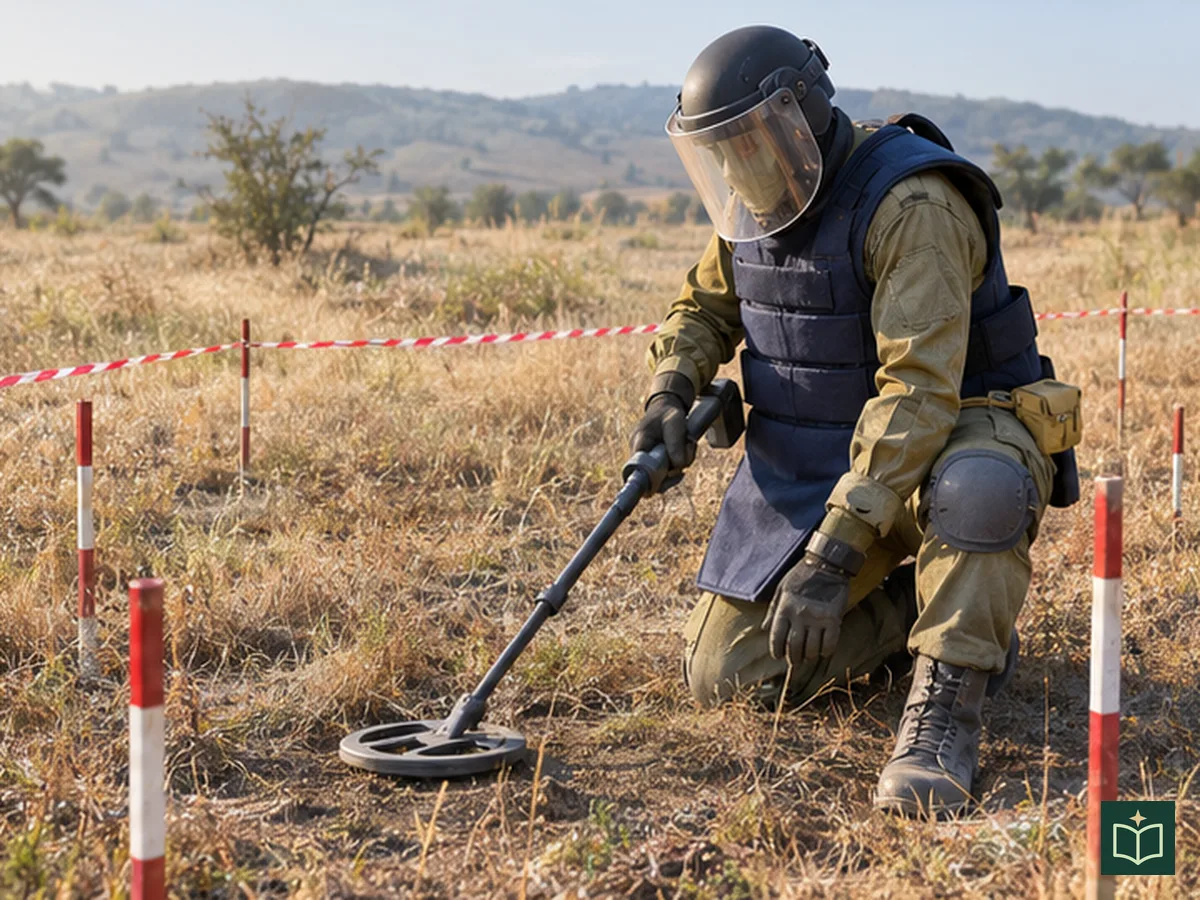
Clearance is slow and painstaking. Teams first survey land to confirm where mines are, often relying on local knowledge, and release areas that prove safe. Deminers then work in marked lanes with metal detectors and prodders, uncovering each signal by hand. Trained dogs, and in some programmes rats, can smell explosives, while armoured machines prepare ground in suitable terrain. Specialist bodies such as the Geneva International Centre for Humanitarian Demining support training and standards. Mozambique, once among the most heavily mined countries, declared in 2015 that it had cleared all known minefields, showing that even large problems can be solved with sustained funding.
Who stays outside
Several major military powers have never joined, including the United States, Russia, China, India and Pakistan, arguing that mines remain necessary for defending borders or troops. Some non-parties nonetheless observe moratoriums on exports or production. In 2025 several European states bordering Russia announced their withdrawal from the convention, citing changes in their security environment, a move criticised by humanitarian organisations. The treaty also has limits in scope. It covers anti-personnel mines only, not anti-vehicle mines, which fall under other rules, and it binds states rather than non-state armed groups, whose use of improvised mines is a growing concern in several conflicts.
Why it still matters
The convention established a strong international norm: even many non-parties now avoid using anti-personnel mines openly. Annual casualties fell substantially in the years after it entered into force, though they have risen again in some conflicts. The model of a partnership between governments and civil society influenced later agreements, notably the 2008 Convention on Cluster Munitions. When news reports mention landmines, it helps to ask whether the country concerned is a party, whether the devices are factory-made or improvised, and whether funding for clearance and survivor assistance is keeping pace, since those determine how quickly affected land can return to use.
Sources & further reading
- Anti-Personnel Mine Ban Convention ↗
- GICHD · Geneva International Centre for Humanitarian Demining ↗
- Landmine and Cluster Munition Monitor ↗
Figures are rounded and widely published; check the linked organisations for the latest editions. These organisations do not endorse this website.