The atmosphere writes in light.
An aurora makes an invisible exchange between the solar wind, Earth’s magnetic environment and atmospheric gases visible.
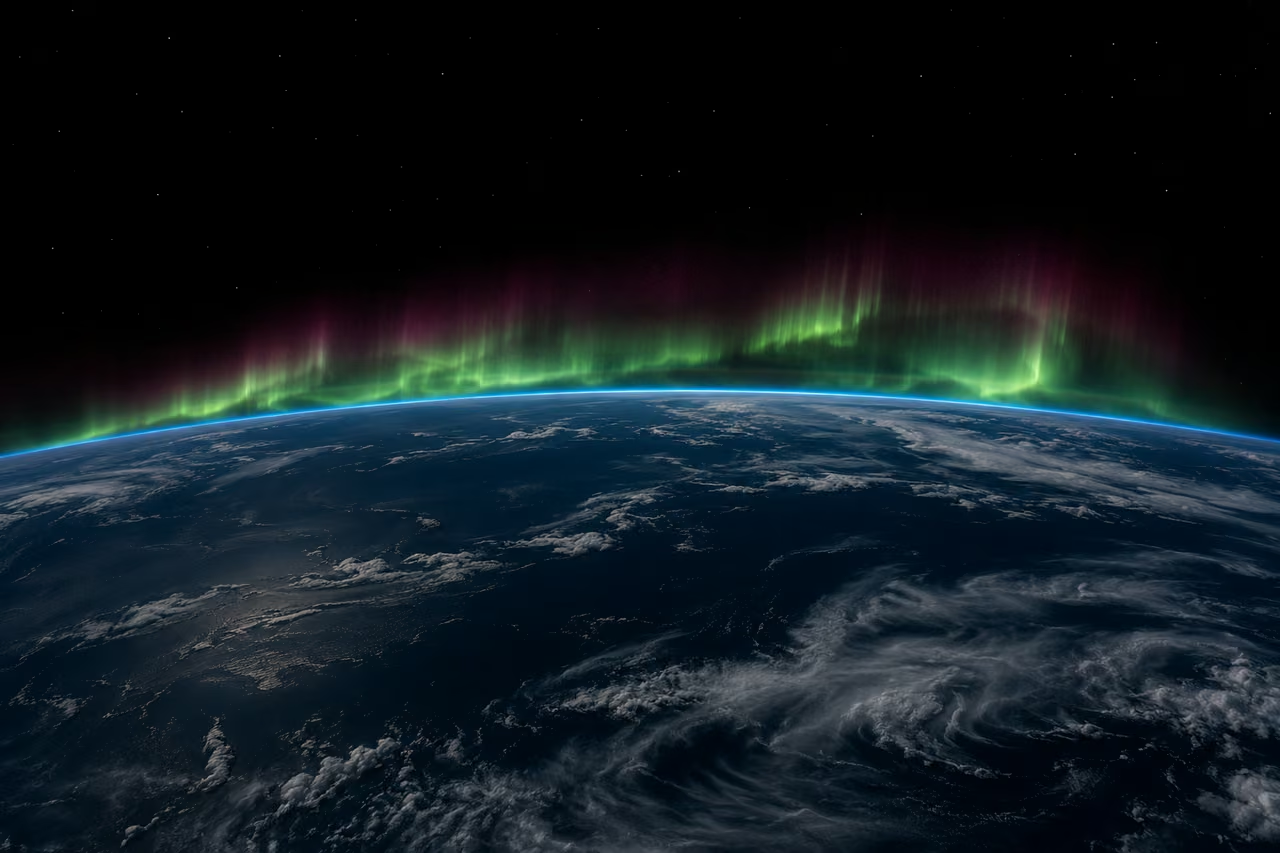
Conceptual AI illustration. Colours and scales are illustrative; not a documentary image or exact scientific model.
A curtain of light can look close enough to touch. It is actually a vast, elevated display: particles and fields organise the energy, while gases provide the colours.
From mystery
to mechanism.
- 01
Bring energy into the system
The solar wind interacts with Earth’s magnetosphere. Energy can accumulate and be released through processes involving its magnetic field and plasma.
- 02
Accelerate and guide particles
Electrons gain energy within the magnetosphere and along auroral field lines. Earth’s field guides their motion towards regions of the upper atmosphere.
- 03
Excite the gases
Collisions transfer energy to oxygen and nitrogen. As excited atoms and molecules return to lower-energy states, they emit light.
Energy becomes a visible sky
Swipe across the mechanism →
Fields and plasma connect the Sun–Earth environment.
Electrons excite upper-atmosphere gases.
Different transitions contribute different colours.
A simplified mechanism. The solar wind is not a beam of visible green light.
A magnetic connection, not a painted sky
NOAA describes aurora as mainly the result of energetic electrons colliding with the atmosphere. The magnetic geometry helps organise activity into ovals around the magnetic poles. During major geomagnetic disturbances these ovals can expand towards lower latitudes. The shifting pattern reflects a changing physical system, not a fixed luminous ring attached to the ground.
The colour is a clue to the mechanism
NASA associates common green aurora with excited oxygen, while oxygen can also emit red light at higher altitudes. Nitrogen contributes blue and pink emissions. The colours depend on species, energy states and atmospheric conditions. A beautiful photograph therefore carries physical information, although its camera exposure and processing affect how bright or saturated the display appears.
Not every glow is an aurora
NASA distinguishes aurora from airglow, another way the upper atmosphere emits light. Similar gases can glow through different energy pathways. This is a useful scientific habit: resemblance alone does not establish a common cause. Ask which particles deliver the energy, where the emission originates and which measurements can distinguish one explanation from another.
Sources & further reading.
- NOAA Space Weather Prediction Center · Aurora
- NASA · Auroras and their colours
- NASA Earth Observatory · Aurora, meet airglow
Sources checked 15 November 2026. Explanations simplify complex systems and identify their limits. These organisations do not endorse Canvas of Knowledge.