From research to the iPhone
Siri began as a spin-off from a US government-funded research project at SRI International, a research institute in California, which aimed to build a personal assistant that could learn and organise information. The company Siri released an app in 2010 and was acquired by Apple soon afterwards. In October 2011, Apple introduced Siri as a built-in feature of the iPhone 4S, inviting users to ask questions and give commands by voice.
A cultural moment
Siri captured the public imagination. People asked it to set reminders, send messages, check the weather and answer questions, and many tested it with jokes and philosophical questions, enjoying its witty pre-written responses. It was not the first speech recognition system, but it was the first voice assistant used by millions of ordinary people daily. It helped make the idea of talking to computers normal rather than science fiction.
Alexa enters the home
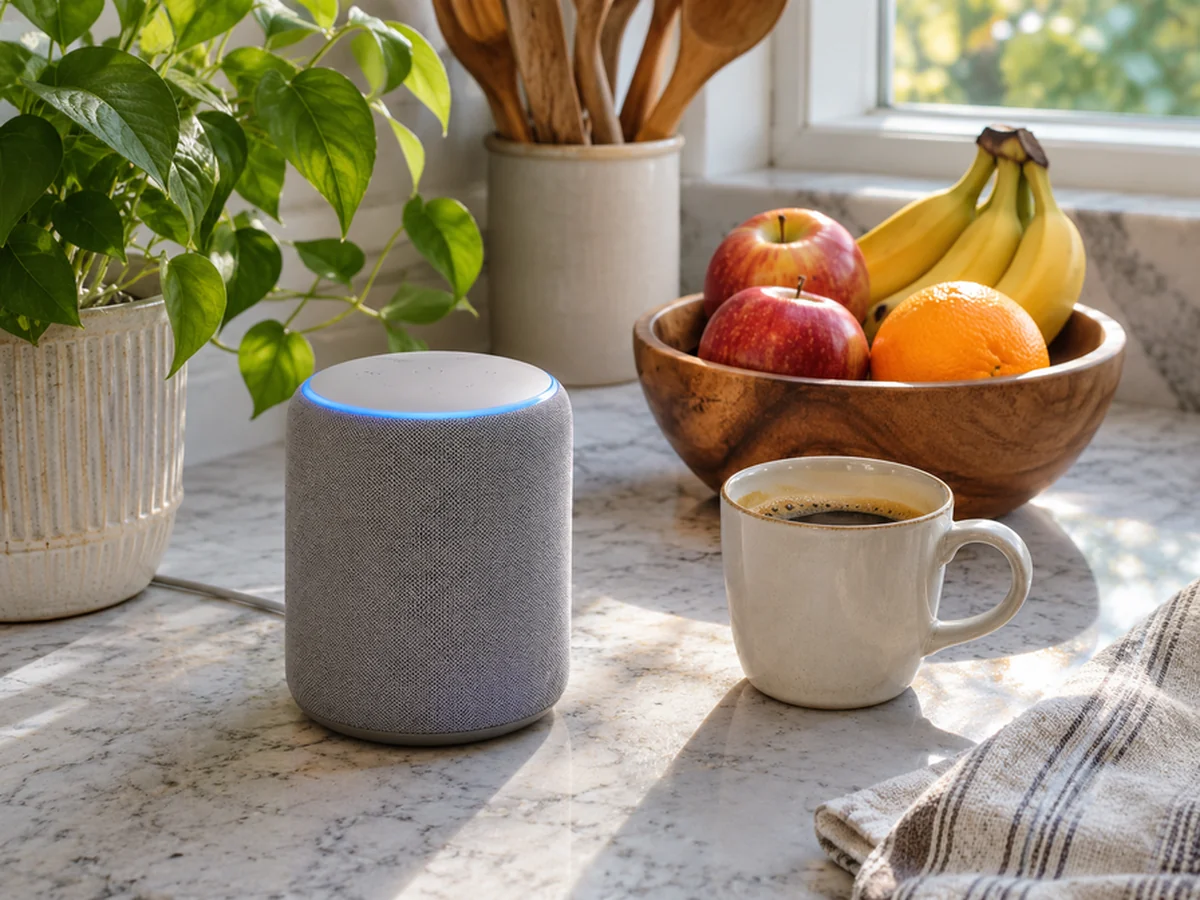
In November 2014, Amazon introduced the Echo, a smart speaker with a voice assistant called Alexa that could play music, answer questions, set timers and control smart home devices. Its far-field microphones could hear commands from across a room. The Echo was a surprise hit, and Amazon sold many millions of Alexa-enabled devices. Developers created thousands of skills, small apps that added abilities to Alexa.
Google and others
Google launched Google Assistant in 2016, drawing on its search engine and knowledge of the world, and built it into Android phones, smart speakers and cars. Microsoft offered Cortana, and Samsung developed Bixby. Voice assistants became common in cars, televisions, watches and headphones. Smart speakers became one of the fastest-adopted consumer technologies of the late 2010s in many countries.
How they worked
Classic voice assistants combined several technologies: a small on-device model listening for a wake word, speech recognition to convert speech to text, natural language understanding to identify the user's intent, such as setting a timer, and modules to carry out tasks or retrieve answers, followed by speech synthesis. Each type of request had to be anticipated and programmed, which made assistants reliable for common tasks but rigid for anything else.
Limits and frustrations
Over time, many users found that voice assistants were best for simple tasks such as timers, music, weather and smart home control, and that they often failed with complex requests or follow-up questions. Misunderstandings were common, especially with accents and background noise. Some companies reportedly struggled to make their assistants profitable. Privacy concerns grew after reports that human contractors reviewed some recordings to improve accuracy.
Arabic voice assistants
Voice assistants gradually added support for Arabic, though dialects posed challenges, since most systems were trained mainly on Modern Standard Arabic or a few dialects. Gulf Arabic speakers often found that assistants misunderstood them. Improvements in speech recognition, including models trained on diverse dialects and new Arabic language models developed in the UAE and the region, are making Arabic voice interaction more reliable.
The generative AI makeover
Large language models offered a solution to voice assistants' rigidity. In 2024, chatbot companies introduced advanced voice modes enabling natural, flowing conversations with AI that could discuss almost any topic. Amazon, Apple and Google began rebuilding their assistants around generative AI, with Amazon launching Alexa+ in 2025 and Google replacing Assistant with Gemini on many devices. These assistants can hold longer conversations and handle more complex requests.
Voice in daily life
Voice interaction is particularly useful when hands or eyes are busy, such as while driving, cooking or exercising, and for people with visual impairments or limited mobility. Older people and young children, who may find typing difficult, often use voice easily. As assistants become more capable, voice may become a primary way many people interact with AI, though privacy and accuracy remain concerns.
Why it matters
Siri and its successors changed how people think about computers, showing that technology could respond to natural speech. Although the first generation of voice assistants fell short of early hopes, they laid the groundwork for today's conversational AI. The combination of voice and generative AI may finally deliver the helpful, knowledgeable assistant that Siri's creators envisioned more than a decade ago, one that understands context and can actually help.
Sources & further reading
- Apple · Apple launches iPhone 4S, iOS 5 and iCloud (2011) ↗
- SRI International · Siri ↗
- Amazon · Introducing Alexa+ (2025) ↗
Product names are trademarks of their owners; this is an independent historical overview. Photograph: original AI-generated illustration (Adobe Firefly). Reference organisations do not endorse this website.