A rock that flows
Rock salt, or halite, behaves unlike most rocks. Under the pressure and warmth found a few kilometres underground, it creeps slowly, deforming like an extremely stiff fluid over thousands to millions of years. It is also relatively light, with a density of about 2.2 grams per cubic centimetre, lower than most of the compacted sediment that commonly buries it. That combination makes buried salt unstable. Like oil rising through water, it tends to move upwards wherever it finds a weakness, gathering into swellings called salt pillows and rising into columns known as diapirs, from the Greek for 'to pierce'. When a diapir bulges the surface above, geologists call it a salt dome.
The Gulf's ancient salt
Beneath the southern Gulf, the UAE and the Zagros mountains of Iran lies a thick salt layer called the Hormuz salt. It formed more than 500 million years ago, when shallow seas repeatedly evaporated in a hot climate, leaving beds of salt mixed with gypsum, dolomite and volcanic rocks. Over the following ages, kilometres of sediment piled on top, including the limestones that now hold much of the region's oil and gas. Squeezed by that weight, and later by the collision of the Arabian and Eurasian plates, the salt began to rise. Many salt domes now punctuate the region, both offshore and on land.
Islands lifted by salt
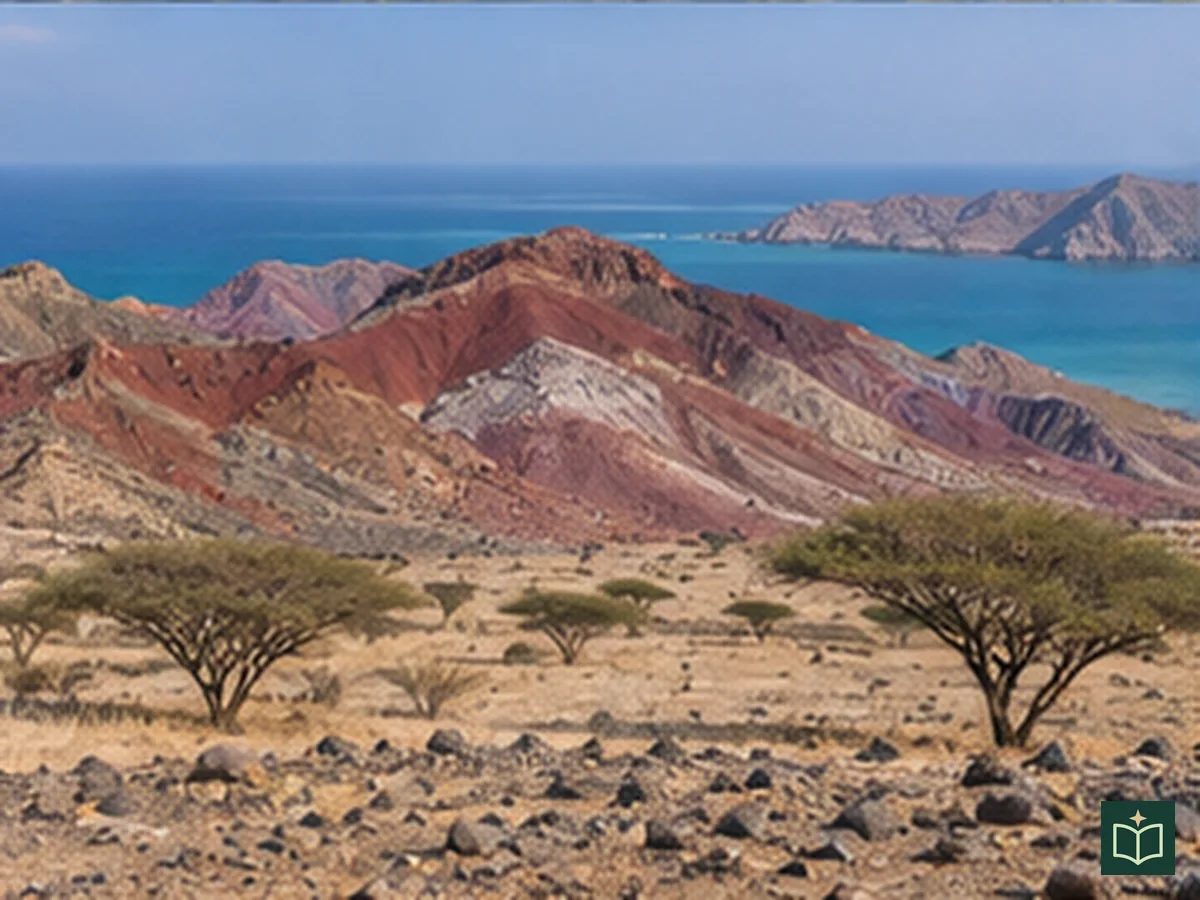
Several islands off Abu Dhabi, including Sir Bani Yas, Dalma and Zirku, owe their existence to salt domes. As the salt pushed upwards, it bent and broke the overlying sea-floor rocks and raised them above the waves. Sir Bani Yas, about 87 square kilometres, has rugged hills made of colourful rocks, reds, purples and greys, dragged up from deep below by the rising salt. Since the 1970s it has hosted a wildlife reserve established by Sheikh Zayed, and archaeologists have found the remains of an early Christian monastery there. Its unusual hills are a direct product of geology happening kilometres beneath the sea.
Salt glaciers of the Zagros
Across the water in Iran, salt domes reach the surface in a dry climate where rain is too scarce to dissolve them quickly. There, salt pushes out of the ground and flows downhill as namakiers, or salt glaciers, spreading over the surrounding rock. Some are several kilometres long. They move fastest after rare rainstorms, when moisture makes the salt more pliable, and slow again in dry spells. The island of Hormuz, near the strait that bears its name, is itself the top of a salt dome, famous for its red, ochre and white rocks and soils, some of which are used locally in cooking and dyeing.
Traps for oil and gas
Salt domes matter enormously to the energy industry. As salt rises, it bends the surrounding sedimentary layers upwards and seals them, because salt is almost impermeable. Oil and gas migrating through the rocks can collect against the flanks or above the dome. In 1901 the Spindletop gusher in Texas, drilled into a salt dome, launched the modern oil industry on the US Gulf Coast. In the Arabian Gulf, many oil and gas structures are linked to deep salt movement. Salt caverns, hollowed out by dissolving salt with water, are also used to store oil, natural gas and, increasingly, hydrogen. Understanding the shape of a dome is therefore central to exploration.
Why it matters
Salt tectonics shapes landscapes, resources and engineering. Domes create islands and hills, steer rivers, trap hydrocarbons and provide storage space underground. They can also cause problems: dissolving salt can produce sinkholes, and salty groundwater near domes can affect wells and foundations. For geologists, the domes and salt glaciers of the Gulf and Zagros are some of the best natural laboratories in the world for watching rock flow, because the dry climate preserves features that would wash away elsewhere. They are a reminder that the ground beneath the Gulf, which looks still, is in slow motion. Many domes in the region are still active today.
Sources & further reading
Figures are rounded and widely published; check the linked organisations for the latest editions. These organisations do not endorse this website.