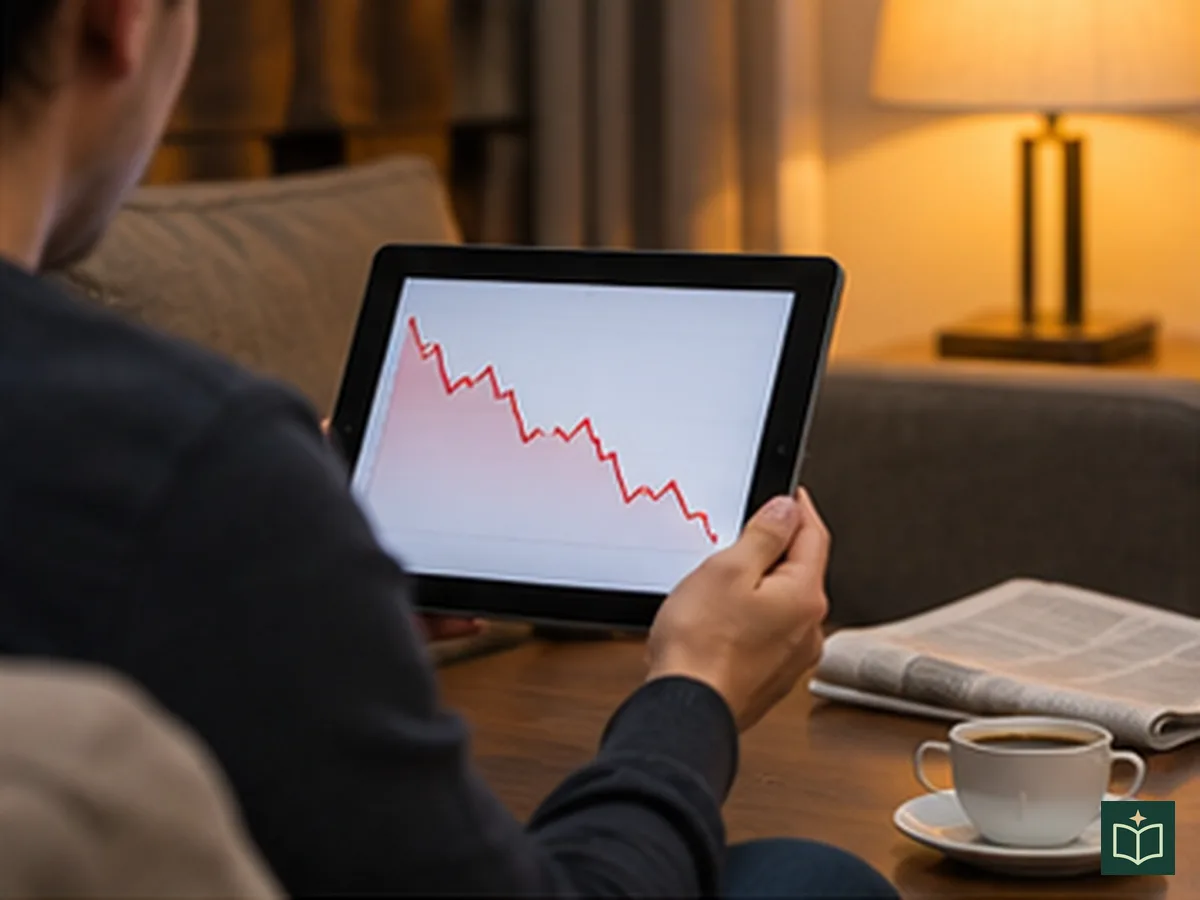
What recency bias is
Recency bias is the tendency to give more weight to recent events than to older ones when judging what is likely to happen next. It is closely related to the availability heuristic described by Amos Tversky and Daniel Kahneman in the 1970s: people judge how likely something is by how easily examples come to mind, and recent events come to mind most easily. In everyday life, a recent car accident on a road makes it feel more dangerous, and a run of sunny days makes rain seem unlikely. In investing, the effect is especially costly, because markets move in cycles, and the recent past can be a poor guide to what comes next.
How it shows up
Recency bias appears in several familiar patterns. After a strong year, investors tend to expect another, and money flows into whatever has recently performed best, whether a sector, a country or a fund. After a sharp fall, the same investors become pessimistic and move into cash. Studies of investor surveys have found that expectations of future returns tend to rise after markets have risen and fall after they have fallen, which is the opposite of what valuations would suggest. Fund flows show a similar pattern: money pours into funds after strong performance, often near the point where that performance is about to fade. The result is buying high and selling low.
A worked example
Suppose an investor holds a fund worth AED 100,000. Over one year the market falls 20%, leaving AED 80,000. The fall dominates the news, and the investor sells, deciding to wait until things feel safer. The following year the market rises 30%. Had the investor stayed, the fund would be worth AED 104,000, 4% above where it started. Having sold, they still have AED 80,000 in cash, and if they buy back only after the recovery feels convincing, they pay higher prices for the same holdings. Real markets do not always recover this quickly, but large rebounds have often followed large falls, and they are easy to miss.
Bubbles and crashes
History offers many illustrations. During the late 1990s, several years of soaring technology shares convinced many investors that a new era had arrived; enthusiasm peaked in early 2000, shortly before the Nasdaq index lost most of its value. After the 2008 financial crisis, many investors stayed out of shares for years, missing a long recovery. In early 2020, markets fell sharply as the pandemic spread, then recovered within months. In property, years of rising prices can make buyers assume prices only go up, as in the run-up to the US housing crash of 2007 and in property cycles in many other countries, including in the Gulf. Each time, the latest trend felt like the permanent one.
Why it is hard to resist
Recency bias persists because it is not entirely irrational. Recent information often is relevant, and trends can continue for a while, a pattern known in finance as momentum. The difficulty is knowing when a trend reflects lasting change and when it is temporary. Emotions amplify the problem. Recent losses feel painful and recent gains feel exciting, and financial media naturally focus on what has just happened. Social media adds to the noise, highlighting dramatic winners from the latest rally. Even professional fund managers are judged on recent performance, which can push them towards fashionable holdings. Knowing about the bias does not switch it off, but it can prompt a pause.
Habits that help
Investors use several practical habits to reduce recency bias. A written plan, setting out goals, time horizon and target mix of assets before markets move, provides a reference point when emotions run high. Regular rebalancing, returning a portfolio to its target mix, mechanically sells some of what has risen and buys what has fallen. Investing a fixed sum at regular intervals removes the need to time entry. Looking at long-run data, covering decades and several cycles, puts any single year into proportion. This article is general education, not investment advice. The central lesson is that the most memorable year is not necessarily the most informative one.
Sources & further reading
Figures are rounded and widely published; check the linked organisations for the latest editions. These organisations do not endorse this website.